

Brazil market sell-off follows Lula re-election

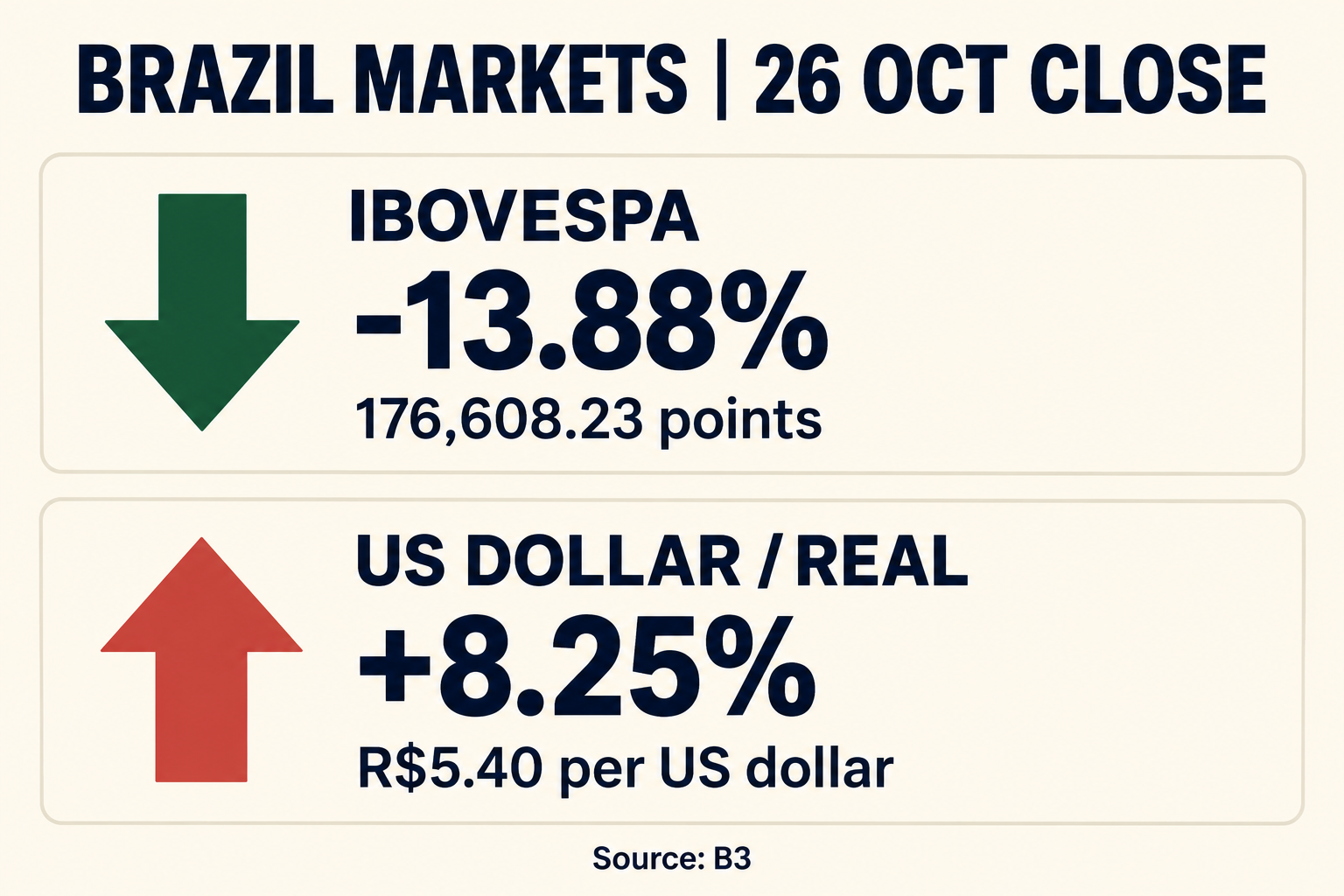
The Brazil market sell-off followed President Luiz Inácio Lula da Silva’s re-election on 25 October. The next day, Brazil’s main share index fell sharply and the real weakened against the US dollar. The electoral authority reported Lula won 51.79% of valid votes, ahead of Flávio Bolsonaro on 48.21%, according to the official tally. The B3 closing figures showed the Ibovespa down 13.88% at 176,608.23 points and the dollar up 8.25% against the real, to R$5.40.
The move matters because investors are reassessing the country’s economic outlook as Lula begins a fourth, non-consecutive term. It is a market reaction to an election result and expectations about policy; it does not, by itself, establish how the government will govern or what households will pay for goods.

What the Brazil market sell-off shows
B3 said the Ibovespa’s fall triggered a circuit breaker, temporarily suspending trading in shares and related assets for 30 minutes. The exchange said the pause is an operating measure for periods of steep declines, using movement in the Ibovespa, its main share index, as a reference. Trading resumed in an auction before normal activity continued.
The exchange’s closing figures give a clearer picture than early-session reports. Reuters reported that the real fell by more than 11% and the benchmark index dropped more than 15% at points during Monday’s trading. B3 later recorded the smaller losses at the close. The difference reflects separate points in a volatile session, rather than conflicting descriptions of the same closing price.
B3 says the mechanism had been activated 23 times since it was created in 1997, with six interruptions recorded in March 2020. The mechanism pauses trading to allow orders and prices to adjust. It is not a rescue measure and does not set a floor under share prices.
Why investors are watching Lula’s fiscal plans
The first-round result showed Bolsonaro ahead. Lula then won the 25 October run-off by about 4.43 million votes. The official tally recorded 64,256,232 votes for Lula and 59,826,041 for Bolsonaro. The result gave the incumbent a new mandate, while leaving questions about how he will balance campaign commitments with public finances.
Reuters reported that investors had positioned for a Bolsonaro victory, which some market analysts expected to bring tighter spending and more business-friendly measures. Those expectations are interpretations of likely policy, not commitments that a Bolsonaro government had made or guarantees of how assets would have performed. After Lula’s win, investors had to reassess those assumptions.
Markets trade expectations as well as current conditions. When investors demand a higher return to hold a country’s assets, share prices can fall and government or company borrowing may become more expensive. A weaker real can also raise costs for firms that rely on imported goods, although a single day’s currency move does not show whether those costs will persist or reach consumers.
For readers, the practical questions are whether the exchange rate remains under pressure, what economic team Lula appoints and how the government explains its budget plans. The B3 close is one day’s snapshot; it is not a measure of household inflation, employment or future growth.
What we don’t know yet
The immediate market reaction does not show how long the losses will last, whether investors will reverse part of Monday’s move, or how the incoming administration will respond. The election result is settled by the published tally, but its policy consequences are not. A clearer signal will come from government appointments, budget decisions and the market’s response over more than one session.
The next point to watch is trading on Tuesday, followed by any concrete statements from Lula’s team on economic appointments and fiscal policy. B3’s figures show where prices ended Monday; the next sessions will show whether investors treat the fall as a short-lived adjustment or a lasting reassessment.