

Supreme Court shakes Nigerian politics: ADC leadership battle sent back to court, PDP convention voided

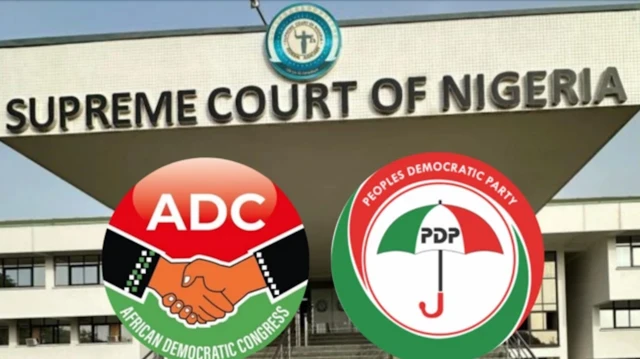
Supreme Court rulings rock ADC, PDP leadership battles
Nigeria’s political landscape witnessed a dramatic shift on Thursday as the Supreme Court of Nigeria delivered two critical rulings affecting the leadership structures of the African Democratic Congress (ADC) and the Peoples Democratic Party (PDP).
In decisions that could reshape party dynamics ahead of the 2027 general elections, the apex court dismissed an appeal in the ADC leadership crisis and separately nullified the PDP’s controversial national convention held in Ibadan.
The rulings have intensified legal and political tensions, raising fresh concerns about party stability, internal democracy, and electoral preparedness.
Supreme Court Dismisses ADC Appeal, Sends Case Back to Federal High Court
In a unanimous judgment, the Supreme Court dismissed the appeal filed by a faction loyal to David Mark over the leadership tussle within the ADC.
The apex court upheld the earlier ruling of the Court of Appeal, directing all parties to return to the Federal High Court for the determination of the substantive suit.
The dispute originated from a lawsuit filed by Nafiu Bala Gombe, who challenged the emergence of Mark as national chairman of the party and sought recognition as the legitimate leader.
The Federal High Court had earlier ordered parties to maintain the status quo, a directive reaffirmed by both the Court of Appeal and the Supreme Court.
INEC’s Position Deepens ADC Leadership Vacuum
Following the legal battles, the Independent National Electoral Commission (INEC) announced it would not recognise any faction within the ADC until the courts deliver a final verdict.
This decision led to the removal of contested leadership names from its official portal, effectively leaving the party without a recognised leadership structure at a crucial time.
The development has sparked protests among party members, with accusations of bias against INEC and warnings that the crisis could undermine the ADC’s participation in the 2027 elections.
Despite the legal uncertainties, the Mark-led faction proceeded with congresses and a national convention, moves later restrained by court orders.
PDP Convention Voided Over Disobedience of Court Order
In a separate but equally significant ruling, the Supreme Court delivered a split judgment that affirmed the nullification of the PDP’s national convention held in Ibadan.
The majority decision, led by Justice Stephen Adah, held that the convention violated an existing court order that required the party to halt proceedings until certain conditions were met.
The court emphasised that obedience to judicial orders is fundamental, ruling that parties in disobedience cannot seek relief from the courts.
As a result, the convention that produced a leadership team led by Tanimu Turaki was declared invalid and without legal effect.
READ ALSO
Court shocks ADC: Justice Joyce Abdulmalik bars INEC, nullifies congress plans
Dumebi Kachikwu accuses David Mark of hijacking ADC party structure amid court showdown
Dissenting Opinions Highlight Legal Complexity
However, the ruling was not without controversy.
In a dissenting opinion, Justice Haruna Tsammani argued that the matter was an internal party issue beyond the jurisdiction of the courts. He maintained that the Federal High Court should not have entertained the case in the first place.
Tsammani also criticised the majority for raising issues not argued by the parties, warning that such actions could undermine judicial fairness.
This split decision underscores the complex legal terrain surrounding political party disputes in Nigeria.
Implications for 2027 Elections and Party Stability
The twin rulings carry significant implications for Nigeria’s political future:
- ADC faces uncertainty over its leadership structure, which could affect its readiness for upcoming elections.
- PDP must reorganise its leadership process following the nullification of its convention.
- INEC’s neutrality remains under scrutiny, as parties demand clearer guidelines on recognition.
Analysts warn that prolonged legal battles could weaken internal democracy and disrupt political alignments ahead of 2027.
Judiciary Reasserts Authority in Party Affairs
The Supreme Court’s decisions reinforce the judiciary’s role as the final arbiter in political disputes, while also highlighting the tension between legal oversight and party autonomy.
As both ADC and PDP navigate the aftermath of these rulings, the focus now shifts to the Federal High Court and how quickly it can resolve pending issues.
For Nigeria’s democracy, the message is clear: compliance with the rule of law remains non-negotiable.
FAQ
What did the Supreme Court decide on the ADC leadership crisis?
The court dismissed the appeal and directed all parties to return to the Federal High Court to resolve the substantive case.
Who is involved in the ADC leadership dispute?
The dispute involves factions within the ADC, including one aligned with David Mark and another led by Nafiu Bala Gombe.
Why did INEC refuse to recognise ADC leadership?
INEC acted on court orders directing parties to maintain the status quo, leading it to withhold recognition of any faction.
What happened to the PDP convention held in Ibadan?
The Supreme Court nullified the convention because it was conducted in violation of a valid court order.
Why was the PDP convention considered invalid?
The court ruled that disobedience of a court directive to halt the convention made the entire process legally void.
Was the Supreme Court decision unanimous?
No, the PDP case was decided by a split judgment (3-2), reflecting differing legal interpretations.
What does this mean for PDP leadership?
The party may need to organise a fresh convention or resolve leadership issues through legal and internal processes.
How does this affect the 2027 elections?
Both ADC and PDP could face delays in preparations due to unresolved leadership disputes.
Can the ADC still participate in elections?
Yes, but leadership uncertainty may affect its organisational readiness unless resolved quickly.
What is the next step in the ADC case?
The case will continue at the Federal High Court, which will determine the substantive issues.