

Oleshky ceasefire: What the aid and evacuation plan confirms


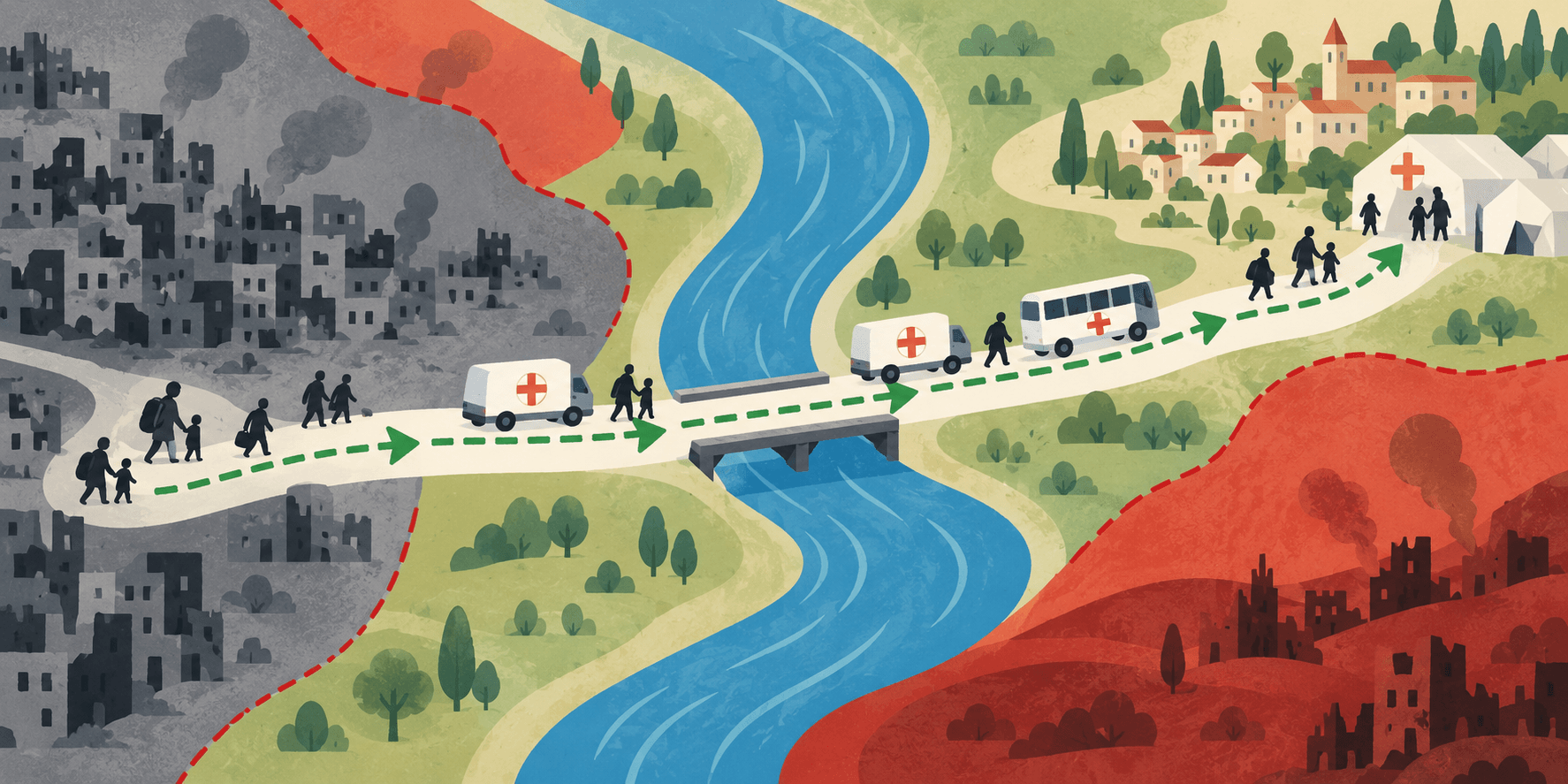
Illustration: a fictional riverfront and aid convoy, not a depiction of Oleshky or a real operation. Generated by OpenAI for CrispNG.
The Oleshky ceasefire is meant to let humanitarian supplies reach a Russian-occupied Ukrainian town and give residents a route to leave. The agreement has been confirmed by officials on all sides, but that does not yet answer the practical question residents face: how will the convoy and any evacuation be kept safe?
What the Oleshky ceasefire confirms
Oleshky lies in Ukraine’s southern Kherson region, across the Dnipro River from the Ukrainian-held city of Kherson. Russian forces have occupied it since the opening day of the full-scale invasion in 2022. The White House says an estimated 1,700 to 2,000 people remain, including about 50 children; it also says there has been no formal population count since 2022, so those figures are estimates.
The Oleshky ceasefire agreement announced by the White House calls for a temporary halt to military action to allow aid in and prepare a civilian evacuation through a designated safe passage. Russia and Ukraine have since confirmed the arrangement, according to the Associated Press. Ukraine’s General Staff said its forces would observe a local ceasefire to support the humanitarian operation, as reported by Ukraine’s Interfax news agency.
Why reports give two dates
The White House’s initial statement said the localized ceasefire would begin on October 29. Subsequent operational statements set the halt in fighting for Tuesday, October 27: 3am Kyiv time and 4am Moscow time. The AP reported that the pause is scheduled to start Tuesday, two days before the humanitarian mission begins on Thursday, October 29. The available information therefore points to separate stages: first a pause and safety preparation, then the aid and evacuation operation.
Russian military chief Valery Gerasimov said engineering reconnaissance would be carried out to support safe movement of a humanitarian convoy. Ukraine’s human rights ombudsman Dmytro Lubinets told the AP that mine removal would come before supplies are delivered. These are announced steps; the operation has not yet taken place.
How the aid corridor is meant to work
The White House says civilian representatives from Russia and Ukraine will visit residents to assess needs, while people who want to leave will receive coordinated transport to a destination of their choice. Russian officials have also said residents will be allowed to leave. A conceptual illustration below explains the idea of an aid corridor; it is not a map of Oleshky, an actual route or a depiction of the planned mission.
The plan is limited to this humanitarian operation. It is not a wider ceasefire in the Russia-Ukraine war. For background on Melania Trump’s earlier humanitarian channel with Moscow over Ukrainian children, see CrispNG’s previous report.
What remains unclear
The public statements do not set out a route map, who will independently monitor the pause, how violations would be handled, or the exact duration of the evacuation. The AP reported that Lubinets withheld operational details, citing the sensitivity of the negotiations. The White House has not named the American media organization it says will accompany the teams.
Those gaps matter because the town has faced months of shortages. The AP reported that Oleshky had been without power, heat and water and that civilians had struggled to leave safely. No public confirmation yet shows that aid has entered or that residents have been evacuated. Until the operation begins, the safe passage remains a plan whose implementation can still be tested.
Sources: White House announcement; Associated Press explainer, updated October 24; Ukraine General Staff statement via Interfax; Reuters report on the Kremlin’s confirmation.