

NYC isn’t fully banning AI in schools: Here’s who can still use it

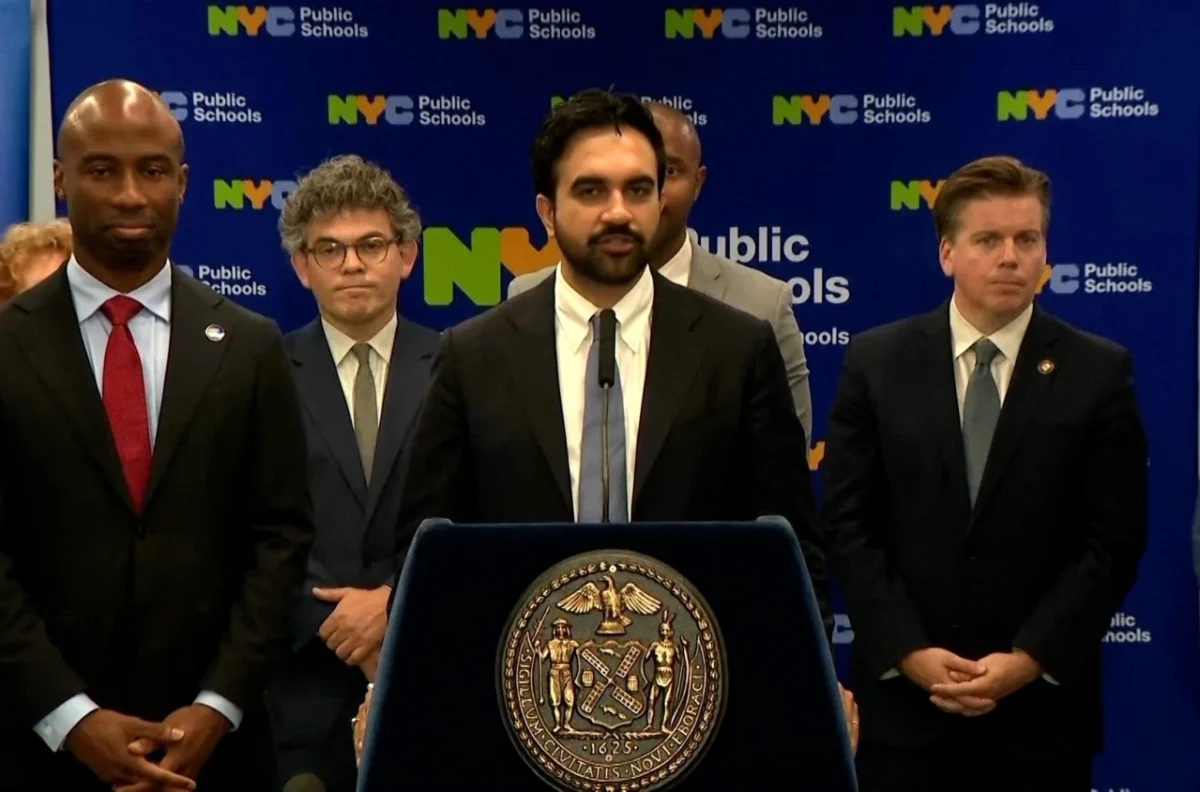
New York City’s AI School Ban Has a Big Exception for High School Students. Image Credit: NYCgov
New York City is putting the brakes on student-facing generative AI for hundreds of thousands of public school students, but the new policy is far from a complete ban on artificial intelligence in classrooms.
The administration of Mayor Zohran Mamdani and Schools Chancellor Kamar Samuels announced Wednesday that New York City Public Schools will impose a one-year moratorium on student-facing generative AI for students from 2-K through eighth grade during the 2026-27 school year.
The policy affects nearly 600,000 public school students, or roughly two-thirds of the city’s total public-school enrollment.
But there is a major exception.
High school students will not be completely shut out of AI. Up to 50,000 students in general education classes — about 5% of the city’s public-school population — will have access to five tightly controlled AI pilot programs. Every high school student will also receive twice-yearly AI literacy lessons.
That distinction is central to understanding what New York City is actually doing: the city is restricting students from using generative AI while simultaneously teaching older students how to question and work with it.
NYC puts generative AI on hold for grades 2-K through 8
The new moratorium applies to student-facing generative AI from 2-K through eighth grade.
That covers a wide range of software capable of generating text or other content in response to student prompts. Companion chatbots will also be prohibited across all grades.
City officials say the goal is to protect foundational learning, human interaction and independent thinking while the city studies how rapidly evolving AI tools affect students.
Mayor Mamdani said children need teachers, relationships with classmates and opportunities to struggle with difficult problems themselves, arguing that schools should not assume AI-powered education is inevitable.
The moratorium is scheduled to last for one school year, giving the city time to evaluate the technology before deciding what rules should remain in place.
A Technology in Schools Coalition made up of students, teachers, parents, elected officials, advocates, union representatives and technology experts will study the policy and the limited pilots throughout the school year.
The coalition is expected to publish recommendations for future school years.
The AI ban does not apply equally to every student
The headline-grabbing part of the policy is the moratorium, but the exceptions reveal a more complicated strategy.
Students with disabilities can continue using AI-related assistive technology. Exceptions will also cover multilingual learners and students involved in career-readiness programs such as computer science.
Teachers are also allowed to use AI for instructional planning and operational work, provided the tools meet NYC Public Schools’ safety requirements.
That creates a clear line between AI used by educators behind the scenes and AI directly interacting with students.
The city is not removing artificial intelligence from schools altogether. Instead, it is limiting the circumstances in which students can directly use generative AI.
Five AI programs will be tested in high schools
The most notable exception involves five limited AI pilots for high school classrooms.
Each participating high school can have no more than five classes using the programs. The tools must be used under the direct supervision of a trained educator and meet the city’s safety and data-privacy standards.
The five selected programs are Quill, Edia, Brisk Teaching, Playlab and Intel AI-Ready Schools.
Quill will be used in English language arts classrooms for close reading, text analysis and evidence-based arguments. Students will be limited to 15 minutes of use per week.
Edia will be used in mathematics and is designed to provide step-by-step coaching while asking students to explain their reasoning. Its usage will be capped at 20 minutes per week.
Brisk Teaching will be used through teacher-created activities, allowing students to work with teacher-selected texts or videos. Its Brisk Boost feature can be used for 10 to 20 minutes once or twice per week.
Playlab can be used across subjects for assignment-specific activities, including exercises in which students examine AI responses for bias and reasoning. Its use will be limited to two assignments per marking period.
Intel AI-Ready Schools will support semester-long projects in which students identify community problems and explore AI-based solutions. Students will use the platform for one class period per week.
The restrictions show that the city is not simply asking whether AI should be allowed. It is testing how much AI students should use, under what circumstances and with what level of teacher oversight.
Every NYC high school student will get AI literacy lessons
Even students who do not participate in one of the five pilots will receive AI education.
New York City says all high school students will have access to two 45-minute AI literacy modules each year.
The lessons will cover what artificial intelligence is and is not, along with issues including AI bias, risks, ethics, careers and future workplace skills.
That could prove to be one of the more consequential parts of the policy.
Rather than treating AI solely as a prohibited classroom shortcut, the city wants older students to understand how the technology works and how its answers can be questioned.
The approach reflects an increasingly common tension in education: students are expected to enter a workforce where AI is likely to be widespread, yet schools also have to ensure they can write, reason, research and solve problems without depending on a chatbot.
READ ALSO
Who is Kamar Samuels? Why does Zohran Mamdani trusts him to run America’s largest school system?
Why is New York City restricting AI in classrooms?
City officials say the decision is rooted in concerns about student development, safety and the lack of evidence surrounding rapidly evolving AI tools.
The administration argues that younger students need opportunities to develop foundational skills through direct interaction with teachers and peers.
The policy also reflects concerns about privacy, bias, accuracy and the possibility that students could rely on AI to produce answers without understanding the underlying work.
Chancellor Samuels described the policy as an effort to protect human connection, curiosity and creativity while giving students the critical-thinking skills needed to deal with AI.
The city will use the coming school year to collect evidence rather than permanently deciding that AI has no place in education.
New York is also putting limits on screen time
The AI policy arrives alongside new restrictions on 1:1 student screen time.
Students in second grade and below will face restricted one-to-one screen use.
The city recommends a maximum of 30 minutes per day for students in grades 3 through 5 and 45 minutes per day for students in grades 6 through 8.
That means the policy is broader than generative AI.
New York City is also reviewing the wider collection of technology used across its public schools. Tools could be removed if officials determine they are not mission-critical to learning.
The review will examine vendor accountability, safety and transparency, ethics, evidence behind learning design and instructional impact, along with ongoing feedback from users.
What the New York AI policy could mean for students
For younger students, the immediate effect is straightforward: they will have fewer opportunities to interact directly with generative AI through school-provided technology during the 2026-27 school year.
For high school students, the situation is different.
A small number will get supervised access to selected AI systems, while all high school students will receive lessons designed to help them understand the technology.
That creates a two-track model.
Younger students get a pause. Older students get controlled exposure. Teachers retain access for selected professional uses.
The policy could eventually become a blueprint for other school systems looking for a middle ground between unrestricted AI adoption and an outright ban.
The one-year deadline matters
The moratorium is deliberately temporary.
That gives the city an opportunity to measure whether restricting student-facing AI changes learning outcomes, classroom behavior or technology use.
The Technology in Schools Coalition will also have to weigh feedback from teachers, parents and students against evidence from the pilot programs.
The results could determine whether the city extends the restrictions, loosens them, expands the pilot programs or develops different rules for different age groups.
That makes the 2026-27 school year something of a live test.
New York City is effectively asking whether children need less AI exposure while they build foundational skills — and whether older students can benefit from the technology if they use it with strong guardrails.
Is New York City banning AI from schools?
Not exactly.
The city is imposing a one-year moratorium on student-facing generative AI for grades 2-K through eighth grade. It is not banning every form of artificial intelligence or every use of technology in schools.
Teachers can continue using compliant AI tools for instructional planning and operational work. Students with certain accessibility and career-readiness needs can also receive exceptions.
High school students can participate in limited AI pilots, and all high school students will receive AI literacy instruction.
That makes the policy less of an AI shutdown than a controlled reset of how the technology enters the classroom.
Frequently asked questions about New York City’s AI school ban
Is New York City banning ChatGPT in schools?
The new policy prohibits student-facing generative AI for grades 2-K through eighth grade, and companion chatbots are prohibited across all grades. The policy does not amount to a complete ban on every AI technology used by schools.
How many students are affected by the NYC AI ban?
Nearly 600,000 New York City public school students are affected by the policy, representing about two-thirds of the school system’s total enrollment.
What grades are covered by the NYC AI moratorium?
The one-year moratorium covers students from 2-K through eighth grade during the 2026-27 school year.
Can high school students use AI in New York City schools?
Yes, but access will be limited. Up to 50,000 high school students in general education classes can participate in five supervised AI pilot programs.
Which AI tools are allowed in NYC high schools?
The five approved pilot programs are Quill, Edia, Brisk Teaching, Playlab and Intel AI-Ready Schools. Their use will be limited and supervised by trained educators.
Can teachers in NYC schools still use AI?
Yes. Teachers can use AI for instructional planning and operational tasks as long as the tools comply with NYC Public Schools’ safety standards.
Are students with disabilities allowed to use AI?
Yes. The policy provides exceptions for assistive technology used by students with disabilities. Exceptions also apply to multilingual learners and students participating in certain career-readiness programs.
Will New York City students still learn about AI?
Yes. All high school students will receive two 45-minute AI literacy modules each year covering AI basics, bias, risks, ethics, careers and future skills.
How long will the NYC AI ban last?
The moratorium is scheduled for one school year, covering the 2026-27 academic year. A coalition will study the policy and make recommendations for future years.
Why did NYC ban generative AI for younger students?
City officials say the policy is intended to protect foundational learning, human connection, curiosity, creativity and independent critical thinking while the city studies the educational impact of generative AI.
Is New York City banning technology in classrooms?
No. The policy also introduces a broader review of technology used in NYC Public Schools, with officials saying tools that are not mission-critical to learning could be removed. The focus is on making technology serve learning rather than allowing technology use for its own sake.
Will the NYC AI ban become permanent?
That has not been decided. The 2026-27 moratorium gives the city a year to assess the effects of the restrictions and limited pilots before recommendations are made for future school years.