

Why Diplomats Walked Out During Netanyahu’s UN Speech

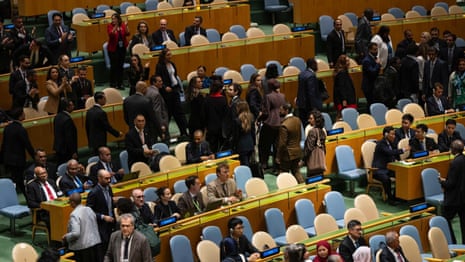
Dozens of diplomats walked out of the United Nations General Assembly hall as Israeli Prime Minister Benjamin Netanyahu began his address on Thursday, September 24, turning his appearance at the world body into a major protest over Israel’s military actions.
The delegates left their seats as Netanyahu approached the podium, with large sections of the chamber becoming empty during his speech.
Netanyahu continued speaking and responded by calling those who walked out “moral cowards”, while accusing his critics of trying to silence Israel.
The walkout was one of the most visible moments of the 81st United Nations General Assembly and came amid continuing international criticism of Israel’s military campaign in Gaza.
But why did so many diplomats leave the hall, and what did Netanyahu say after they walked out?
Why diplomats walked out
The walkout was linked to opposition to Israel’s military actions in Palestinian territories, particularly the continuing conflict in Gaza.
According to Reuters, dozens of delegates streamed out as Netanyahu began speaking. The Palestinian mission had also urged other UN missions to join the protest.
The protest came against the background of mounting international criticism of Israel over its conduct of the Gaza war.
Israel has rejected allegations that it is committing genocide in Gaza and maintains that its military operations are directed at Hamas.
Netanyahu used his speech to defend Israel’s actions and argue that the country was acting to protect itself.
He also presented Israel as fighting threats on several fronts, including Gaza, Lebanon, Iran, Syria, Yemen and Iraq.
What Netanyahu said after the walkout
Rather than stopping his address, Netanyahu directly addressed the delegates who were leaving.
He told those who remained that they were witnessing Israel’s case being presented despite attempts to prevent him from speaking.
He later described the departing delegates as “moral cowards” and invited any others who wanted to leave to do so.
The Israeli prime minister also rejected accusations that Israel had committed genocide in Gaza.
Netanyahu said Israel had prevented genocide rather than committed it, a position that directly contradicts accusations made by Palestinian officials and other critics of Israel.
Netanyahu defends Israel’s military campaigns
A significant part of the speech was devoted to defending Israel’s military operations beyond Gaza.
Netanyahu described Israel as fighting a “seven-front” conflict involving Gaza, the West Bank, Syria, Lebanon, Iran, Yemen’s Houthi movement and militias in Iraq.
He said Israel would continue fighting because, in his words, it had no other choice.
He also addressed Iran directly, saying he believed political change would eventually come to the country.
Netanyahu defended earlier US-Israeli military action against Iran and said Israel and the United States had acted together to protect themselves.
His comments came after months of heightened tensions involving Israel, Iran and other armed groups in the region.
Netanyahu attacks critics
The Israeli prime minister also used the speech to respond to several international critics.
He criticised Western European leaders, including those in Britain and France, over their positions on Israel.
Netanyahu also singled out New York Mayor Zohran Mamdani, who has accused Israel of genocide and previously called Netanyahu a war criminal.
Netanyahu accused Mamdani of spreading what he described as false claims about Israel and said he could not be silenced.
Mamdani later rejected Netanyahu’s characterisation and said the Israeli leader had used the speech to repeat what he described as false claims intended to defend Israel’s conduct in Gaza.
What did the Palestinian side say?
Before Netanyahu spoke, Palestinian President Mahmoud Abbas addressed the General Assembly through a recorded message.
Abbas criticised Israeli policies, particularly the expansion of Jewish settlements in the occupied West Bank, and argued that such policies threatened the possibility of a two-state solution.
He also accused Israel of subjecting Palestinians in Gaza to killing, destruction, starvation and displacement.
Abbas was not physically present at the UN meeting because he had been denied a US entry visa, according to the BBC.
The competing speeches highlighted the deep disagreement surrounding the Gaza conflict, with Palestinian officials and Israel presenting sharply different accounts of the war and its consequences.
Protests also took place outside the UN
The diplomatic walkout inside the General Assembly was accompanied by protests outside the UN headquarters in New York.
Reuters reported that police arrested at least 30 people, including actors and politicians, during demonstrations against Netanyahu ahead of his speech.
The protests involved different groups, including Palestinian supporters, human-rights activists and Jewish groups opposed to Netanyahu’s government.
This meant that Netanyahu’s appearance produced protests both inside and outside the UN building.
Why Netanyahu’s UN appearance matters
The walkout came at a particularly sensitive time for Israel.
Netanyahu is facing growing international criticism over the Gaza war while also preparing for Israel’s October 27 election.
Reuters reported that his UN address was used to defend Israel’s military actions and counter what his government sees as increasing diplomatic isolation.
For the UN, the episode also illustrated the extent of the disagreement surrounding Israel’s conduct in Gaza.
While Netanyahu used the podium to defend Israel and attack its critics, dozens of representatives chose to leave rather than remain in the chamber for his address.
The result was a speech marked not only by what Netanyahu said, but also by the empty seats left behind by diplomats who walked out in protest.