

ADC crisis deepens as Nafiu Bala leads protest to INEC, demands recognition over David Mark faction

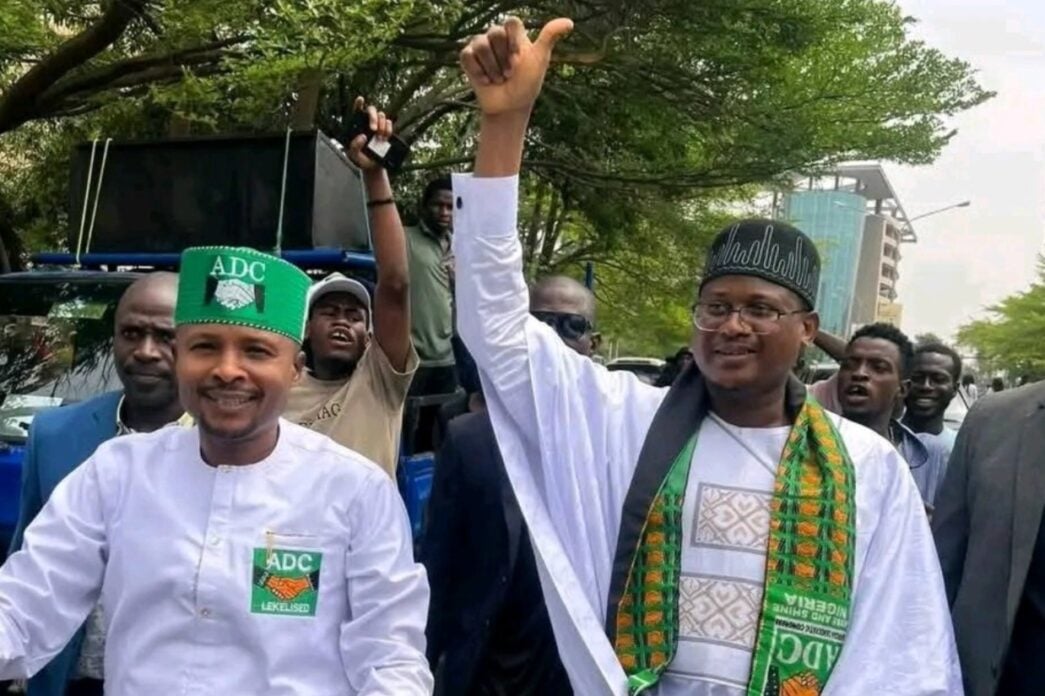
Nafiu Bala leads protest to INEC over ADC leadership row
The leadership crisis within the African Democratic Congress (ADC) took a dramatic turn on Thursday as Nafiu Bala led a protest to the headquarters of the Independent National Electoral Commission (INEC) in Abuja, demanding formal recognition as the authentic national chairman of the party.
The protest, which came barely 24 hours after a rival demonstration by the David Mark-led faction, has intensified public scrutiny over the growing internal battle for control of one of Nigeria’s opposition political platforms. With both camps now taking their grievances directly to INEC and invoking constitutional procedure, court rulings, and party rules, the unfolding conflict is quickly becoming one of the most closely watched developments in Nigeria’s evolving political realignment ahead of the 2027 elections.
Bala, backed by supporters and party loyalists, accused the David Mark group of attempting to hijack the ADC leadership through what he described as unconstitutional and undemocratic means. The protest adds another layer of tension to an already fragile political situation, especially after INEC recently suspended recognition of the party’s leadership pending a definitive court ruling.
Why Nafiu Bala Led the Protest to INEC Headquarters
The protest at INEC’s headquarters in Abuja was aimed at pressing the electoral commission to officially recognise Nafiu Bala as the legitimate national chairman of the ADC.
According to reports, Bala and his supporters argued that the party’s constitution and existing legal decisions favour his leadership claim. He told INEC officials that due process must be respected and warned against allowing what he described as “moneybags” or political newcomers to override the party’s internal democratic structures.
Bala’s faction insists that the ADC cannot be taken over “through the window”, maintaining that party leadership must emerge through established constitutional procedures rather than external influence or elite imposition. His camp framed the protest not just as a fight for office, but as a defence of internal party democracy.
The protest was also a direct response to the rising influence of the rival camp aligned with former Senate President David Mark, which has recently attracted several heavyweight political figures and opposition actors.
What Nafiu Bala and His Supporters Told INEC
During the demonstration, Nafiu Bala made a strong case before INEC, insisting that the commission should restore the status quo and recognise him as the party’s substantive national chairman.
Bala reportedly cited an Appeal Court ruling in support of his position and accused the rival faction of trying to unlawfully seize control of the ADC. He said INEC must act in line with the law and the party’s constitution rather than bow to political pressure.
Supporting him at the protest was Hon. Leke Abejide, a lawmaker from Kogi State, who also criticised the David Mark camp. Abejide argued that the ADC constitution clearly provides that anyone seeking party leadership must have spent at least two years as an active member of the party.
According to him, any attempt to bypass this requirement would amount to an abuse of party processes. He urged INEC to “rescue democracy” by resisting what he called an attempted takeover of the party.
Also speaking, the ADC Director of Youths and Mobilisation, Mohammed Sahad, praised INEC for complying with a court order but insisted that the commission must go further by publicly affirming Bala’s leadership.
INEC’s Position on the ADC Leadership Dispute
The protest comes against the backdrop of INEC’s recent withdrawal of recognition of the ADC’s leadership. On April 1, 2026, the electoral commission announced that it would no longer recognise any faction as the official leadership of the party, citing a court directive.
INEC also stated that it would not monitor any congresses or conventions organised by either faction until a court of competent jurisdiction gives a clear and final decision on the matter. This effectively froze the party’s official internal processes and created a vacuum that both camps are now trying to fill through public pressure and legal arguments.
Responding to the protesters, INEC National Commissioner Abdullahi Abdu Zuru assured the demonstrators that their petition would be reviewed. He thanked them for conducting an orderly protest and said the commission would consider their letter and provide feedback.
Although INEC did not immediately take sides, its response signalled that the matter remains under institutional review, pending legal clarity.
How the David Mark Faction Triggered the Latest Showdown
The Nafiu Bala protest came just one day after the David Mark-led ADC faction staged its own demonstration in Abuja under the banner of #OccupyINEC.
That earlier protest accused INEC of partisanship and alleged that the commission was undermining democracy by refusing to recognise the David Mark bloc. The Mark faction has been particularly vocal in recent days, with some of its members accusing the ruling All Progressives Congress (APC) of trying to engineer a one-party state by frustrating opposition platforms.
What makes the David Mark faction especially significant is the calibre of political figures reportedly associated with it. The bloc is said to have the backing or presence of major opposition names, including Atiku Abubakar, Peter Obi, Rotimi Amaechi, and Rabiu Kwankwaso, making the struggle for ADC control even more politically consequential.
With such high-profile actors now linked to the crisis, the dispute has moved beyond a routine internal party disagreement and into the realm of national opposition strategy ahead of 2027.
READ ALSO
Why the ADC Crisis Matters Ahead of the 2027 Elections
The intensifying leadership battle inside the ADC is not just about who chairs the party. It has broader implications for Nigeria’s opposition politics and the shape of alliances heading into the 2027 general election.
As larger opposition figures explore possible coalitions and alternative platforms, the ADC has emerged as a potentially strategic vehicle. That is why the battle over its structure, legal control, and official recognition has become so important.
If the crisis remains unresolved, it could weaken the party’s credibility, complicate coalition talks, and undermine its ability to serve as a stable platform for future political alignments. On the other hand, if one faction secures clear legal and institutional recognition, the ADC could become a more viable force in Nigeria’s next major electoral cycle.
For now, the back-to-back protests show that both camps understand what is at stake: control of a party that could play a bigger role in 2027 than it has in previous elections.
Nafiu Bala vs David Mark: What Happens Next?
With both factions now actively lobbying INEC and relying on competing legal interpretations, the next phase of the ADC crisis will likely shift back to the courts and to the commission’s administrative response.
If the court delivers a clear ruling on leadership, INEC may then restore recognition to the winning faction and resume oversight of party congresses and conventions. Until that happens, uncertainty will remain.
The public protests have already amplified the dispute, but they may also harden positions. Bala’s camp wants immediate recognition. The Mark faction wants INEC to reverse what it sees as an unfair posture. Neither side appears ready to back down.
That means the ADC’s internal crisis is far from over, and may yet become one of the defining subplots in Nigeria’s pre-2027 political drama.
ADC’s Internal Battle Enters a Critical Stage
The protest led by Nafiu Bala at INEC headquarters marks a significant escalation in the ADC’s internal power struggle. Coming so soon after the rival David Mark faction’s #OccupyINEC protest, it highlights how deeply divided the party has become.
At the heart of the conflict is a high-stakes question: Who truly controls the ADC? Until the courts or INEC provide a definitive answer, the party is likely to remain in turmoil.
For Nigeria’s opposition landscape, the outcome could be crucial. Whether the ADC emerges stronger or more fractured may shape coalition politics, opposition strategy, and the wider race toward 2027.
FAQ: Nafiu Bala Protest, ADC Crisis and INEC Recognition
1. Why did Nafiu Bala protest at INEC headquarters?
Nafiu Bala led a protest to INEC headquarters in Abuja to demand that the electoral commission recognise him as the authentic national chairman of the African Democratic Congress (ADC). He and his supporters said the rival faction led by David Mark was attempting to unlawfully hijack the party.
2. What is the crisis in the ADC about?
The ADC is facing a leadership crisis involving rival factions laying claim to the party’s national leadership. One faction is aligned with Nafiu Bala, while another is associated with former Senate President David Mark. Both sides are seeking recognition from INEC and citing legal and constitutional grounds.
3. Did INEC recognise Nafiu Bala as ADC chairman?
As of the latest reports, INEC has not officially recognised either faction. The commission previously withdrew recognition of the party’s leadership and said it would wait for a court of competent jurisdiction to make a final ruling.
4. Why did INEC withdraw recognition of ADC leadership?
On April 1, 2026, INEC said it withdrew recognition of the ADC leadership because of a court directive. It also announced that it would not monitor any congresses or conventions organised by either faction until the legal dispute is resolved.
5. What did Nafiu Bala tell INEC during the protest?
Nafiu Bala urged INEC to follow due process, respect the ADC constitution, and restore the party’s previous leadership structure by recognising him as the lawful chairman. He also reportedly referenced an Appeal Court ruling to support his claim.
6. Who supported Nafiu Bala at the protest?
Reports said Bala was joined by Hon. Leke Abejide, a lawmaker from Kogi State, along with other party officials including Mohammed Sahad, the ADC Director of Youths and Mobilisation, and numerous supporters.
7. What is the David Mark faction saying?
The David Mark-led faction has accused INEC of partisanship and suggested that the ruling APC may be trying to weaken opposition forces by interfering in the ADC crisis. The faction recently held its own protest under the #OccupyINEC banner.
8. Why is David Mark’s involvement in ADC important?
David Mark’s involvement matters because his faction is reportedly linked to high-profile opposition figures such as Atiku Abubakar, Peter Obi, Rotimi Amaechi, and Rabiu Kwankwaso. This makes the ADC crisis more than an internal party fight, it could affect broader opposition coalition plans for 2027.
9. Can the ADC still hold congresses or conventions?
No. INEC has said it will not monitor any congresses or conventions organised by any ADC faction until the court gives a clear ruling. This means the party’s official internal processes are effectively frozen for now.
10. How does the ADC crisis affect the 2027 elections?
The ADC crisis could significantly affect 2027 opposition politics. If the party is being considered as a platform for a larger opposition coalition, unresolved leadership disputes could derail alliance-building and weaken the party’s strategic value.
11. Who is the real national chairman of ADC?
That remains disputed. Nafiu Bala claims he is the authentic chairman, while the David Mark faction has its own claim to leadership influence and control. The final answer will likely depend on court rulings and INEC’s subsequent recognition.
12. What happens next in the ADC leadership battle?
The next major step will likely come from the courts and then from INEC. Once a court of competent jurisdiction gives a clear ruling, INEC may decide which faction to officially recognise and whether to resume monitoring party activities.
13. Why are people searching “Nafiu Bala Gombe”?
Some reports referred to him as Nafiu Bala Gombe, likely linking him to his full or commonly used political identification. This has led to increased searches around his name, role in the ADC, and connection to the ongoing leadership dispute.
14. Is the ADC becoming the opposition coalition platform for 2027?
There is growing speculation that the ADC could serve as a platform for a broader opposition coalition ahead of 2027, especially with major opposition figures being linked to one faction. However, the current leadership crisis may complicate or delay that possibility.