

From 2-0 up to elimination: Why Man United could have a hard time this season

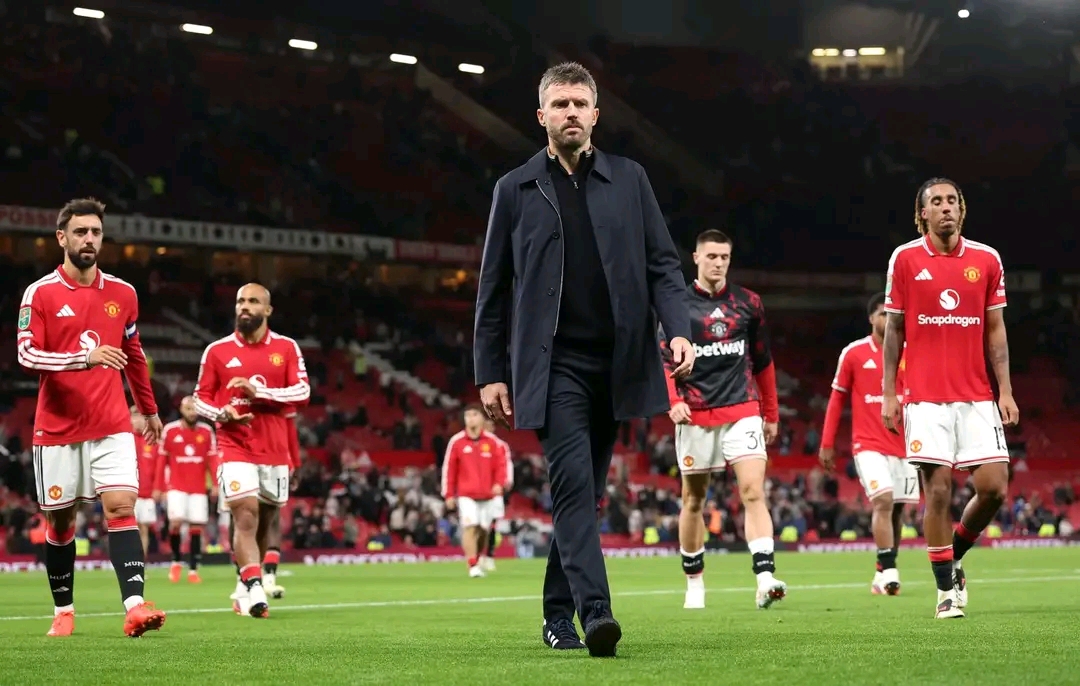
Manchester United’s Carabao Cup exit was more than another disappointing result for a club still trying to rebuild its identity.
United were two goals ahead of Brighton & Hove Albion after just 10 minutes at Old Trafford on Wednesday, with Shea Lacey and Mason Mount putting Michael Carrick’s side in control.
They still lost 3-2.
Charalampos Kostoulas pulled one back in first-half stoppage time before Pascal Gross equalised in the 65th minute. Four minutes later, Maxim De Cuyper completed Brighton’s comeback to send United out of the competition.
The defeat was particularly damaging because of the manner in which it happened. It was the first time Manchester United had lost at Old Trafford after leading by two goals since 1976, according to the Guardian.
For a team expected to build on last season’s third-place finish, the collapse raises questions about whether United are ready for the demands of a season that includes the Premier League and Champions League.
Manchester United are already struggling for consistency
The Brighton defeat came only three days after United lost the Manchester derby 1-0 to Manchester City.
That followed a 2-2 draw away to Everton and a 2-0 defeat to newly promoted Hull City on the opening weekend.
United’s only Premier League victory so far came against Ipswich Town, whom they defeated 5-2 after Bruno Fernandes scored a hat-trick.
That leaves a worrying pattern: United have shown they can score and recover from difficult situations, but they have struggled to control games consistently.
The opening-day defeat to Hull was particularly revealing. The Premier League noted that Hull secured a 2-0 victory over United through first-half goals from Semi Ajayi and Nobel Mendy.
The problem therefore is not simply that United lost to Brighton. It is that the team has repeatedly failed to turn promising moments into complete performances.
The Brighton collapse exposed the defensive problem
United’s biggest concern may be what happens after they lose control of a match.
Against Brighton, the early goals should have allowed Carrick’s team to dictate the game. Instead, Brighton gradually took control and United were unable to stop the momentum.
That is similar to concerns raised after the Everton draw and the defeat to Manchester City.
Reuters reported before the derby that former United defender Gary Neville had identified defending as a major concern, warning that the issue could become a major weakness during the season.
The concern is understandable considering United’s defensive personnel.
Matthijs de Ligt has been dealing with a long-term back problem, while Luke Shaw has also had fitness issues. Manuel Ugarte is recovering from knee surgery and Carlos Baleba, one of the club’s summer additions, has also missed matches with an ankle problem.
That creates a difficult situation for Carrick. A manager can have a preferred defensive structure, but maintaining it becomes considerably harder when important players are unavailable or returning from injury.
The midfield has not solved everything
United also invested heavily in midfield during the summer.
The Guardian reported that the club’s midfield-focused recruitment cost around £148 million, but the early returns have been mixed. The report highlighted injuries and inconsistent performances as part of the problem.
The expectation was that a stronger midfield would help United control matches rather than constantly rely on moments of individual brilliance.
That has not happened consistently.
Bruno Fernandes remains central to United’s attacking output. The Premier League’s own analysis of the opening fixtures noted that Fernandes had been United’s outstanding Fantasy performer after Carrick took over last season, registering four goals and 16 assists in 17 starts.
His importance is obvious, but it also creates a question for the team: what happens when Fernandes cannot create the difference?
United need more players capable of controlling matches, creating chances and changing the rhythm of games.
Carrick now has a bigger test on his hands
There is an important reason why expectations around Carrick are higher this season.
His first spell in charge last season transformed United’s fortunes. The club finished third in the Premier League and qualified for the Champions League, prompting Manchester United to retain him as head coach through 2028. The club said he had overseen 17 games during that improvement.
But a successful rescue job is different from managing an entire season.
Carrick now has to deal with expectations from the beginning of a campaign, a larger schedule and the pressure that comes with Champions League football.
The Brighton defeat also means the Carabao Cup is already gone.
That is not necessarily a disaster on its own, but it reduces the number of competitions in which United can challenge for silverware.
More importantly, the manner of the defeat gives Carrick another problem to solve: how does he make a team that can score early also capable of protecting a lead?
After the match, Carrick accepted responsibility for the collapse and said United had to return to winning football quickly.
The fixture list will become less forgiving
United’s early schedule was actually relatively favourable.
The Premier League’s pre-season analysis pointed out that their first five league matches included two promoted clubs, Hull City and Ipswich Town, while Manchester City was the only top-10 opponent from the previous season in that opening stretch.
United have already dropped points against Hull and Everton and lost to City.
The schedule gets considerably more demanding later in the campaign.
United face Chelsea away on October 31, Aston Villa at home in November, Liverpool away later that month, Arsenal away in December, Liverpool at home in January and Chelsea at home in February. The club also has Champions League fixtures during that period.
That means the team cannot afford to spend too much of the early season searching for its best combination.
The longer United remain inconsistent, the greater the pressure becomes when the schedule begins to pile up difficult fixtures.
The Champions League changes the equation
Returning to the Champions League is a sign of progress after United’s third-place Premier League finish last season.
But it also creates another test.
United now have to manage domestic football alongside European competition, while dealing with injuries and the demands placed on the same core group of players.
The Premier League schedule shows Champions League nights coming alongside important domestic fixtures, including matches against Liverpool, Chelsea, Arsenal and other sides competing near the top of the table.
A squad that struggles to maintain its level over 90 minutes in September could face an even tougher challenge when the number of matches increases.
The real issue is not the Carabao Cup exit
Manchester United can recover from one bad night.
The bigger concern is whether Brighton’s comeback becomes another example of the same problems that have appeared since the season started.
United have already lost to Hull, drawn with Everton, lost the derby to City and now surrendered a two-goal lead to Brighton.
At the same time, they have demonstrated attacking quality, most notably in the 5-2 victory over Ipswich and the 4-0 Champions League win over Sabah.
That contradiction explains why the season could become difficult.
There is enough quality in the squad for United to produce impressive performances. What remains uncertain is whether Carrick can turn those moments into a reliable level of performance across an entire season.
For now, the Brighton collapse has provided the clearest warning yet.
United did not simply lose a cup match. They showed how quickly control can disappear once an opponent begins to push back.
With the Carabao Cup already gone, a demanding Premier League schedule ahead and Champions League football returning to Old Trafford, Carrick’s biggest task is no longer proving that United can play good football.
It is making sure they can do it consistently.