
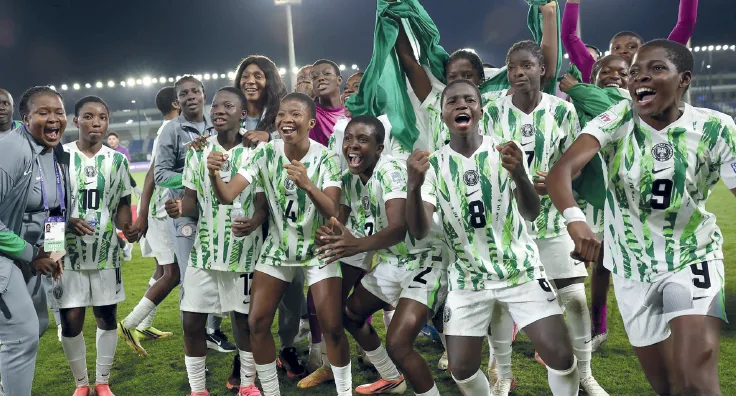
President Bola Tinubu has rewarded each member of Nigeria’s victorious U-17 women’s football team, the Flamingos, with a ₦100 million Federal Government Savings Bond. However, unlike an ordinary cash reward, the players will not have immediate access to the full amount.
The decision is intended to preserve their money and provide financial support while they continue their education and football careers.
The announcement came on Wednesday, November 11, 2026, during a presidential reception for the team at the State House, Abuja.
First Lady Oluremi Tinubu represented the President and explained that the savings certificates would keep the money in trust for the young players.
Chairman of the National Sports Commission, Shehu Dikko, subsequently explained how the investment would work.
What is a Federal Government Savings Bond?
A Federal Government bond is an investment through which an individual lends money to the government for an agreed period.
In return, the government promises to pay interest at an agreed rate and return the original investment when the bond reaches maturity.
According to the Debt Management Office (DMO), FGN bonds are debt instruments issued on behalf of the Federal Government.
For the Flamingos, this means the government has committed ₦100 million for each player as an investment rather than handing them the money to spend immediately.
How does the ₦100m bond work?
The investment will run for five years and attract annual interest of between 12 and 14 per cent, according to Dikko.
For a player with a ₦100 million bond, the estimated returns will be:
- At 12 per cent interest: ₦12 million annually.
- At 14 per cent interest: ₦14 million annually.
This translates to approximately ₦1 million to ₦1.17 million monthly.
Dikko described the arrangement as a way of providing the players with regular financial support without exposing them to the responsibility of managing ₦100 million at a young age.
He said the interest would help cover expenses relating to education, football training and family needs.
The original ₦100 million, however, remains invested during the five-year period.
How can Flamingos players access the money?
The arrangement separates access to interest from access to the original investment.
Players are expected to benefit from the interest generated during the investment period. Dikko said the returns would provide monthly financial support.
However, the government has not publicly explained the precise payment procedure, including the accounts through which the players will receive their returns.
The original ₦100 million is expected to become accessible when the five-year investment matures.
This means the players cannot simply approach a bank and withdraw the entire investment as they would with ordinary cash in a savings account.
The DMO’s explanation of FGN bonds also shows that some government bonds can be sold through authorised dealers in the secondary market before maturity.
However, it remains unclear whether the special bonds issued to the Flamingos carry the same early-sale arrangement or restrictions.
The National Sports Commission and the DMO will need to clarify the specific redemption procedure for the beneficiaries.
What happens after five years?
At the end of the five-year period, the investment reaches maturity.
The government is expected to return the original ₦100 million to each player, alongside any outstanding interest due under the bond’s terms.
By then, the players will be older and better positioned to make decisions about their finances.
Dikko explained that the arrangement was deliberate because most members of the team are teenagers.
He argued that giving a 15 or 16-year-old player ₦100 million immediately could create financial distractions.
The five-year investment, therefore, provides an opportunity for the players to build financial security while concentrating on their careers.
How much did Tinubu give the coaching crew?
The presidential reward also covered the team’s technical leadership.
The head coach received a ₦100 million cash reward, while each member of the technical crew received ₦50 million in cash.
Unlike the players’ rewards, these payments were announced as cash gifts rather than five-year investments.
The government’s decision marks an unusual approach to rewarding young athletes, combining immediate financial incentives for the coaching staff with long-term investments for the teenage players.