

Borno: How soldiers repelled four-pronged ISWAP attack

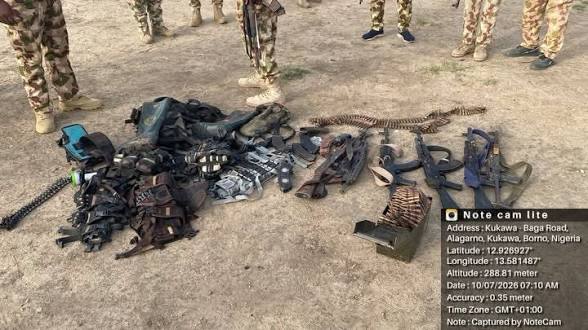
Troops of the Nigerian Army have repelled a coordinated attack by Islamic State West Africa Province (ISWAP) fighters on a military position in Kukawa Local Government Area of Borno State.
The terrorists attacked troops of the 101 Special Forces Battalion from four different directions, but the soldiers resisted the assault with support from the Air Component of Operation Hadin Kai.
According to the Nigerian Army, more than 25 ISWAP fighters were neutralised during the encounter, while 14 bodies had been recovered as of the preliminary assessment. Some soldiers were also killed in the attack.
The attack occurred on Tuesday night as the terrorists attempted to overwhelm the military position.
How the ISWAP attack unfolded
The attackers approached the military position from four different flanks, according to Captain Mohammed Goni, acting military information officer at the headquarters of the Joint Task Force, North-East, Operation Hadin Kai.
The Army described the assault as a coordinated, multi-directional attack carried out by the terrorists in large numbers.
Rather than allowing the attackers to overrun the position, the troops responded with firepower, tactical manoeuvres and battlefield coordination.
The Air Component also provided support during the confrontation.
The Army said the combined response overwhelmed the attackers and forced surviving ISWAP fighters to flee the area.
More than 25 terrorists killed, Army says
The military said a preliminary assessment showed that more than 25 terrorists were neutralised during the counter-offensive.
However, only 14 bodies had been recovered when the Army issued its statement.
Troops also recovered a cache of weapons and ammunition from the area.
The recovered items included six AK-47 rifles, according to the military.
The Army said troops were still conducting operations around the location to recover more weapons, track the fleeing fighters and prevent them from regrouping.
Soldiers also suffered casualties
While announcing the success of the operation, the Army confirmed that some soldiers were killed.
Captain Goni expressed condolences to the families of the fallen troops and described their deaths as the ultimate sacrifice in service to the country.
The Army did not give a number of soldiers killed in its statement.
However, a senior military officer told the Associated Press that 10 soldiers were killed in the attack. The officer spoke anonymously because he was not authorised to speak publicly about the matter.
The difference is important because the Army’s official statement did not provide a specific figure.
Air support helped troops repel attack
The confrontation also highlighted the role of air-ground coordination in the military’s response to attacks in the North-East.
According to the Army, the troops received support from the Air Component as they engaged the ISWAP fighters.
The combined operation helped the soldiers repel the assault and inflict heavy casualties on the attackers.
The military said surviving terrorists fled the area after the counter-offensive.
Troops then began exploiting the area to recover abandoned weapons and gather information that could help track the fleeing fighters.
Why the Kukawa attack matters
The attack is another reminder of the continued threat posed by ISWAP in Borno and the wider North-East.
The group has repeatedly targeted military positions in the region, seeking to inflict casualties, seize weapons and disrupt military operations.
Kukawa is located in the Lake Chad area, where Nigerian forces have continued counter-insurgency operations against ISWAP and other armed groups.
The latest assault also shows the scale of the threat facing troops stationed at remote military positions.
In this case, the attackers attempted to overwhelm the 101 Special Forces Battalion by approaching from four directions.
The military’s response prevented the position from being overrun, according to the Army.
Military begins follow-up operation
The battle did not end with the withdrawal of the surviving ISWAP fighters.
The Army said troops were continuing to search the area for additional weapons and track terrorists who escaped from the battlefield.
The objective is also to prevent the fighters from regrouping and launching another attack.
The military said it would maintain pressure through further operations in the area.
The Nigerian Army’s account of the encounter points to a fierce battle in which troops faced a coordinated assault but retained control of their position.
While more than 25 terrorists were reported neutralised, the Army also acknowledged the loss of soldiers, underlining the continuing cost of the counter-insurgency campaign in Borno.