

Artificial intelligence and the future of healthcare: How AI could transform medicine, economies and human life

By Chidinma Chukwuneke
For much of modern medical history, advances in healthcare have been driven by discoveries in biology, pharmaceuticals, medical imaging, surgery and public-health systems. Artificial intelligence is different because it is not simply another medical instrument. It is a general-purpose technology capable of changing how information is collected, interpreted and acted upon across almost every stage of healthcare.
Algorithms can already help interpret medical images, generate clinical documentation, identify patterns in patient data, support drug discovery, monitor patients remotely and assist clinicians with diagnosis and treatment decisions.
The United States Food and Drug Administration (FDA) now maintains a growing list of authorized AI-enabled medical devices, while physician adoption of AI has risen sharply. In a 2024 American Medical Association survey, 66% of physicians reported using healthcare AI, compared with 38% in 2023.
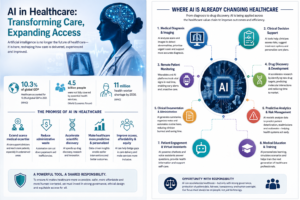
Yet the significance of AI in healthcare extends beyond technology. Healthcare is one of the world’s largest economic sectors, accounting for 10.3% of global GDP in 2021, while 4.5 billion people were not fully covered by essential health services. At the same time, the World Health Organization projects an 11-million health-worker shortage by 2030, with Africa facing particularly severe workforce constraints.
AI therefore presents both an extraordinary opportunity and a serious governance challenge. Properly deployed, it could extend scarce medical expertise, reduce administrative waste, accelerate scientific discovery and make healthcare more predictive and personalized. Poorly designed or governed, it could reproduce social inequalities, expose sensitive health information, amplify clinical errors, create new forms of discrimination and concentrate healthcare power in a small number of technology companies.
The focus question is whether societies can ensure that AI makes healthcare more accessible, safer, more affordable and more human-centered, rather than simply more automated.
Where AI Is Already Changing Healthcare
1. Medical diagnosis and imaging
Medical imaging is one of the most mature areas of clinical AI. AI systems can flag abnormalities on scans, prioritize urgent cases, quantify measurements and provide clinicians with a second interpretation. Radiology has become a particularly important testing ground because medical images contain enormous amounts of information that computers can analyze rapidly.
A 2024 systematic review and meta-analysis of 48 real-world studies of AI in medical imaging found that 67% of the studies measuring task time reported reductions after AI implementation. However, the researchers also found substantial heterogeneity, and three separate meta-analyses did not demonstrate statistically significant effects.
Another meta-analysis of 36 studies found that AI assistance reduced image-reading time by about 27%, while also increasing diagnostic sensitivity in the pooled analysis.
These findings illustrate an important principle: AI is often more useful as a second reader or assistant than as an autonomous replacement for the clinician.
AI can identify a pattern, but a doctor must still understand the patient’s history, assess whether the finding is clinically meaningful and decide what action is appropriate.
2. Clinical documentation
One of the most immediate applications of generative AI is administrative work.
Doctors and other clinicians spend substantial time documenting encounters, writing notes, preparing discharge instructions and completing other administrative tasks. Ambient AI systems can listen to a clinical conversation, generate a draft note and place information into electronic health-record workflows.
A 2025 JAMA Network Open study found that ambient AI documentation was associated with reduced mental demand from documentation and improvements in clinicians’ perceived well-being and connection with patients.
A larger 2026 study involving 1,547 clinicians found that ambient AI use was associated with modest reductions in time spent documenting during clinic and sustained reductions in after-hours documentation.
This may become one of AI’s most economically important healthcare applications because administrative work represents a huge amount of labor that does not directly involve treating patients.
The goal, however, should not be simply to allow clinicians to see more patients. If AI saves documentation time, healthcare organizations should ask how that time is reinvested: into patient interaction, clinical reasoning, education, research, rest or additional appointments.
3. Drug discovery and development
Drug development is slow, expensive and characterized by high failure rates.
AI can search chemical libraries, predict molecular properties, identify potential biological targets, analyze scientific literature, help select clinical-trial participants and model biological processes.
The opportunity is enormous because conventional drug development can require years and substantial capital. A review of drug-development economics found that estimates of capitalized pre-launch R&D costs vary enormously, from about $161 million to $4.54 billion depending on methodology and therapeutic area.
AI does not eliminate the need for laboratory experiments or clinical trials. Instead, its greatest potential may be to reduce the number of poor candidates entering expensive stages of development and to improve decisions earlier in the process.
There are now signs that AI-generated drug candidates are moving beyond theoretical demonstrations. In 2025, Nature Medicine reported a randomized phase 2a trial of an AI-discovered drug and target combination for idiopathic pulmonary fibrosis, describing it as a significant milestone for AI-enabled drug discovery.
But enthusiasm should be tempered. A promising molecule still has to demonstrate safety, efficacy, manufacturing feasibility and regulatory acceptability in humans.
4. Personalized and precision medicine
Medicine has traditionally relied heavily on population averages. AI could push healthcare toward more individualized prediction.
By integrating genomic information, medical history, imaging, laboratory tests, medication data, lifestyle information and continuous measurements from wearable devices, AI systems may eventually identify which intervention is most likely to work for a particular person.
The long-term objective is a transition from reactive medicine to predictive medicine then preventive medicine.
Instead of waiting until disease becomes obvious, healthcare systems could identify rising risks earlier and intervene before a crisis occurs. This is particularly relevant to chronic diseases. Noncommunicable diseases including cardiovascular disease, cancer, diabetes and chronic respiratory disease, account for 74% of deaths globally, according to WHO. More than three-quarters of NCD deaths and 86% of premature NCD deaths occur in low- and middle-income countries.
If AI can improve early detection and long-term disease management, its greatest population benefit may come not from treating rare diseases but from helping millions of people manage common ones.
5. Public health
Public-health agencies can use machine learning and large datasets to detect disease patterns, forecast outbreaks, optimize vaccination strategies, identify populations at elevated risk and allocate scarce resources.
WHO’s African Region has specifically identified artificial intelligence, machine learning, computational methods and geospatial technology as tools that can support precision public health and disease-control efforts.
This could be particularly valuable in countries where health professionals and diagnostic facilities are unevenly distributed.
A system that helps a community health worker identify a high-risk pregnancy, recognize signs of tuberculosis or malaria, or determine which patient requires urgent referral could have a much greater effect than a sophisticated AI system confined to a wealthy tertiary hospital.
The Economic Case for Healthcare AI
Healthcare which is a public service, is one of the world’s largest economic sectors. Global health spending reached approximately $9.8 trillion in 2021, equivalent to 10.3% of global GDP.
The economic significance is even clearer in the United States. U.S. national health expenditures reached $5.3 trillion in 2024, or 18% of GDP, according to the Centers for Medicare & Medicaid Services.
Even relatively small efficiency improvements can therefore have enormous financial consequences.
McKinsey has estimated that broader adoption of AI could eventually generate annual savings equivalent to roughly 5–10% of U.S. healthcare spending, about $200 billion to $360 billion using its cited 2019 spending base. This is an estimate of potential value, not money already saved.
The potential economic gains come through several channels: administrative efficiency, reduced diagnostic delays, better resource allocation, drug-development efficiency, Workforce productivity, preventive healthcare.
However, efficiency does not automatically produce lower healthcare spending. If an AI system makes it easier to perform a test, healthcare providers may perform more tests. If documentation becomes faster, clinicians may see more patients rather than reducing total expenditure. If insurers use AI to detect claims, administrative costs may fall on one side while disputes and appeals increase on the other. If AI creates expensive new services, the technology may increase spending before it produces savings.
The economic question is therefore, “who captures the savings, who bears the costs, and are the resulting resources reinvested in better health?”
The Risks: Why AI Could Also Make Healthcare Worse
1. Algorithmic bias
An AI model can reproduce patterns of inequality contained in its training data. If a system is trained primarily on patients from one demographic group, its performance may deteriorate when applied to another. WHO explicitly identifies bias relating to factors including race, ethnicity, ancestry, sex, gender identity and age as a concern for generative AI in healthcare.
2. Hallucinations and false information
Generative AI can produce convincing but false statements. This is particularly dangerous in medicine because a fabricated reference or incorrect dosage can harm a patient. A 2025 systematic review and meta-analysis of 83 studies evaluating generative AI for medical diagnosis found an overall diagnostic accuracy of 52.1%. AI did not significantly outperform physicians overall and performed significantly worse than expert physicians. The lesson is here is that impressive language ability is not equivalent to clinical reliability.
3. Automation bias
People can become overly trusting of machine recommendations. A clinician who would have questioned a human colleague may accept an algorithm’s recommendation because it appears objective or technologically sophisticated. WHO specifically identifies automation bias as a risk.
4. Privacy
Health data is among the most sensitive forms of personal information. AI systems may process medical histories, genetic information, mental-health records, images, voice recordings and behavioral data. The more data systems collect, the greater the potential consequences of a breach or misuse.
5. Cybersecurity
AI expands the attack surface of healthcare systems. A compromised AI system could potentially produce incorrect recommendations, expose confidential information or manipulate clinical workflows. Healthcare organizations therefore need cybersecurity strategies that cover not only conventional IT systems but also models, training data, APIs, connected devices and AI-generated outputs.
6. Liability
If an AI system makes a harmful recommendation, who is responsible? The developer? The hospital? The clinician? The organization that purchased the software? The answer will vary according to the system, jurisdiction and circumstances. Regulation is consequently moving toward lifecycle oversight. The FDA has developed guidance around predetermined change-control plans for AI-enabled medical devices so that modifications can be managed while maintaining safety and effectiveness.
7. Deskilling
If clinicians rely too heavily on AI, some skills may weaken. A young doctor who routinely accepts automated interpretations may have fewer opportunities to develop independent diagnostic reasoning. This creates a paradox: AI can make professionals more productive while potentially making them less capable if used without appropriate training.
8. Inequality
The best AI may be expensive. Hospitals with modern infrastructure, reliable electricity, high-quality electronic health records and large datasets may adopt AI rapidly. Poorly funded facilities may fall further behind. The result could be a two-tier system: AI-enhanced healthcare for wealthy populations and conventional under-resourced healthcare for everyone else. That would contradict the idea that AI is a tool for global health improvement.
The Rules Will Matter as Much as the Algorithms
Healthcare AI cannot be governed like an ordinary consumer application. Medical AI must be evaluated for safety, effectiveness, fairness, security and performance in its intended population.
WHO’s six foundational principles for AI in healthcare are particularly important:
1. Protect human autonomy.
2. Promote human well-being, safety and the public interest.
3. Ensure transparency, explainability and intelligibility.
4. Foster responsibility and accountability.
5. Ensure inclusiveness and equity.
6. Promote responsive and sustainable AI.
These principles point toward a broader concept of responsible AI.
A responsible healthcare AI system should have:
- Clearly defined intended uses.
- Evidence appropriate to the level of clinical risk.
- Testing on representative populations.
- Human oversight.
- Privacy and security protections.
- Mechanisms for reporting errors.
- Continuous performance monitoring.
- Procedures for updating or withdrawing unsafe systems.
- Clear allocation of responsibility.
- Transparency about limitations.
The regulatory challenge is particularly difficult because AI can change after deployment. A traditional medical device may remain substantially unchanged after approval. A machine-learning system can be retrained, updated or integrated with new data. The FDA’s approach to predetermined change-control plans recognizes this challenge by emphasizing controlled modification, validation, monitoring and lifecycle management.
What Governments and Health Systems Should Do Now
Start with measurable problems: AI should be introduced because it solves a defined healthcare problem, not because an organization wants to appear technologically advanced.
Demand clinical evidence: Accuracy on a laboratory benchmark is not enough. Systems should be evaluated in the environments and populations in which they will actually be used.
Measure outcomes, not hype: A hospital should ask questions like did diagnosis improve? Did patient safety improve? Did waiting times fall? Did clinician workload fall? Did costs fall? Did health outcomes improve? Did disparities widen or narrow?
Keep humans accountable: AI should support clinical judgment rather than create a situation in which everyone blames the algorithm after something goes wrong.
Build strong data governance: Patients should know how their data is collected, used, stored and shared.
Invest in healthcare workers: AI adoption requires training. Clinicians need to understand model limitations, uncertainty, bias, privacy and appropriate use.
Design for low-resource settings: Governments and international organizations should ensure that AI is not developed only for wealthy healthcare systems.
Create continuous monitoring: A model that performs well in development can fail after deployment because patient populations, clinical practices and data patterns change.
Conclusion
Artificial intelligence is not a distant possibility for healthcare. It is already part of the healthcare system.
It is being used in medical imaging, documentation, clinical decision support, drug discovery, patient engagement, monitoring and medical-device technology. Physician adoption is accelerating, and the number of AI-enabled medical devices continues to grow.
The potential benefits are substantial. AI could help address workforce shortages, accelerate drug development, improve diagnostic capacity, reduce administrative burdens, support preventive medicine and expand access to expertise.
The potential harms are equally significant. AI could produce incorrect recommendations, reproduce discrimination, compromise privacy, create cybersecurity vulnerabilities, encourage automation bias and deepen inequalities between healthcare systems.
The difference between these two futures will be determined by computing power as well as governance, evidence, economics, education and human judgment.
The world’s healthcare challenge that billions of people still lack adequate access to healthcare, while health systems struggle with workforce shortages, rising costs, chronic disease and demographic change. In 2021, 4.5 billion people were not fully covered by essential health services. AI will be valuable if it helps close that gap.