
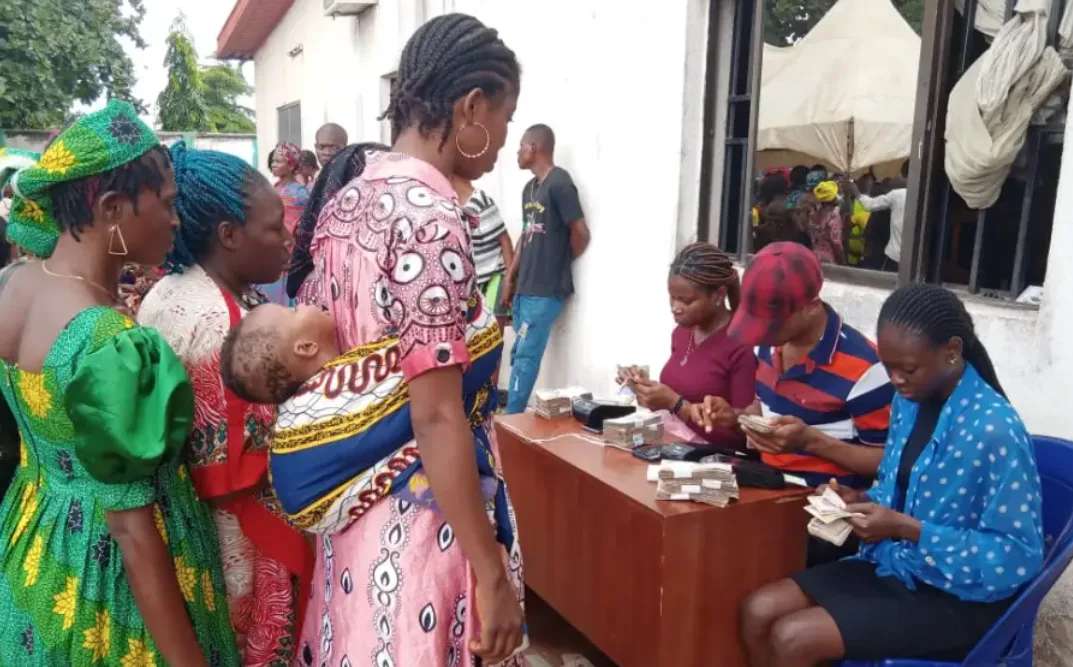
The Federal Government says its ₦50,000 NERSI grant is intended to help vulnerable households cope with rising food prices and other essential living costs.
However, the amount raises a broader economic question: how much relief can ₦50,000 realistically provide to a household facing several competing expenses?
The answer depends on household size, location, existing income and the prices of essential goods.
Although ₦50,000 may provide immediate support, its ability to improve a family’s longer-term financial position is more complicated.
What is the ₦50,000 intended to achieve?
According to the minister’s October 30 announcement, NERSI is designed to provide immediate relief to vulnerable Nigerians.
The intervention is described as shock-responsive, meaning it is intended to help households manage economic pressures.
This is different from a programme designed primarily to create permanent employment or finance business expansion.
The purpose is short-term financial stabilisation.
How much does ₦50,000 represent per family member?
Consider a household of five people.
If the entire ₦50,000 is divided equally among them, each person’s share would be ₦10,000.
For a family of seven, the equivalent would be approximately ₦7,143 per person.
These figures are simple illustrations, not the government’s method of allocating the grant.
They show how household size can affect the value of a fixed payment.
A smaller household may find the support more substantial per person than a larger one.
What could a family spend the money on?
The government describes NERSI as support for essential living costs.
A hypothetical household might allocate the money as follows:
| Expense | Illustrative allocation |
|---|---|
| Food and groceries | ₦25,000 |
| Transport | ₦8,000 |
| Electricity and cooking fuel | ₦7,000 |
| Medication and health needs | ₦5,000 |
| Emergency reserve | ₦5,000 |
| Total | ₦50,000 |
This is not a recommended official budget or a claim about current market prices.
It simply illustrates how quickly several necessary expenses can absorb the grant.
A household facing rent arrears, school fees or a medical emergency may need to allocate the money differently.
Does ₦50,000 have the same value everywhere?
No.
The purchasing power of money depends partly on local prices.
Transportation costs, food prices, housing expenses and access to public services vary across communities.
A household in a rural area may face different expenses from one living in a major city.
However, the ministry’s public NERSI guidance does not explain whether the ₦50,000 amount was determined using regional cost-of-living differences.
The same nominal amount may therefore provide different levels of practical relief.
What if the payment is monthly?
A recurring ₦50,000 payment could provide greater stability than a one-time transfer.
For example, a household receiving ₦50,000 monthly for six months would obtain ₦300,000 over that period.
However, the current official FAQ does not establish a guaranteed six-month payment schedule.
Beneficiaries should therefore avoid treating hypothetical future payments as money already available.
Can the grant permanently lift a family out of poverty?
A single cash transfer may help a household meet urgent needs.
However, permanent poverty reduction generally depends on factors extending beyond one payment, including sustainable income, employment opportunities, healthcare, education and access to essential services.
NERSI’s stated purpose is immediate relief rather than a comprehensive guarantee of long-term financial security.
The programme may help prevent some households from facing deeper hardship, but its actual impact requires evidence.
How should the programme’s success be measured?
The number of people paid is one measure.
However, the programme’s effectiveness could also be assessed by examining whether beneficiaries were able to meet urgent expenses, reduce harmful coping strategies or improve short-term financial stability.
Such assessments would require reliable monitoring and evaluation.
The ministry says payments are independently verified, but payment verification is not the same as measuring changes in household welfare.
A successful transfer proves that money was delivered.
It does not automatically establish that poverty was reduced.
The bigger picture
The ₦50,000 grant can provide meaningful immediate assistance, particularly for households facing urgent expenses.
However, its real value depends on purchasing power, household circumstances and whether support continues.
The government’s challenge is therefore twofold: ensuring that the money reaches vulnerable Nigerians and demonstrating that the intervention improves their welfare.
₦50,000 may help a household manage immediate hardship, but the amount alone cannot establish whether NERSI will produce lasting poverty reduction.