

Who will lead Iran next? Inside the power struggle after Khamenei’s death

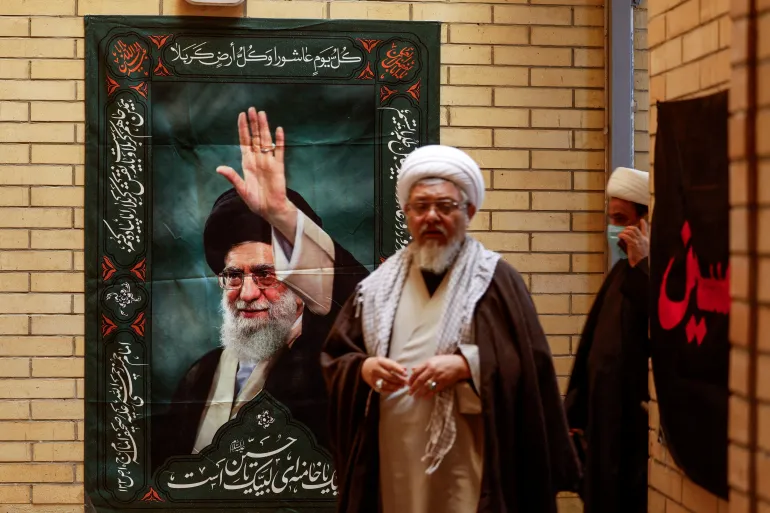
Clerics walk past a wall with a poster of Iran’s Supreme Leader Ayatollah Ali Khamenei, after offering their condolences following his killing in Israeli and US strikes, at the office of the supreme leader’s representative in Najaf, Iraq, March 1, 2026 [Alaa al Marjani/Reuters]
The reported killing of Iran’s Supreme Leader, Ayatollah Ali Khamenei, in joint US-Israeli air strikes has plunged Tehran into one of the most consequential political transitions since the 1979 Islamic Revolution. As the country reels from the shock, attention has swiftly turned to a critical question: Who will become Iran’s next supreme leader?
Khamenei, who assumed the role in 1989 after the death of Ruhollah Khomeini, presided over the Islamic Republic for nearly four decades. His tenure shaped Iran’s domestic governance, regional strategy and ideological posture. Now, amid rising tensions with Washington and Tel Aviv, the process to choose his successor has begun.
How Is Iran’s Supreme Leader Chosen?
Under Iran’s constitution, the supreme leader is selected by the Assembly of Experts, an 88-member clerical council elected by the public every eight years. However, candidates for the Assembly must first be vetted by the Guardian Council — a powerful entity whose members are partly appointed by the supreme leader himself.
When the office becomes vacant due to death or resignation, the Assembly convenes to select a successor. A simple majority vote is sufficient. Constitutionally, the candidate must be a senior Shia jurist with expertise in Islamic jurisprudence, alongside qualities such as political judgment, courage and administrative capability.
There has only been one previous leadership transition in the Islamic Republic’s history: when Khamenei succeeded Khomeini in 1989.
What Happens During a Leadership Vacuum?
Article 111 of Iran’s constitution outlines a temporary arrangement to avoid a power vacuum. A three-member council assumes the supreme leader’s responsibilities until a successor is formally appointed.
Following Khamenei’s death, Iranian state media reported that President Masoud Pezeshkian, Judiciary Chief Gholam-Hossein Mohseni-Ejei and cleric Alireza Arafi would form the interim leadership body. Ayatollah Arafi, a member of the Guardian Council, has reportedly been appointed as the clerical representative on this council.
This mechanism ensures continuity in governance, particularly during periods of heightened external threat. Analysts note that Iran’s political system has long anticipated the eventual succession process, preparing institutional safeguards to maintain stability.
What Does the Supreme Leader Actually Do?
Under the doctrine of velayat-e faqih — guardianship of the Islamic jurist — the supreme leader is the highest political and religious authority in the Islamic Republic.
The role includes:
-
Commander-in-chief of the armed forces
-
Oversight of the powerful Islamic Revolutionary Guard Corps (IRGC)
-
Appointment of judiciary heads and military commanders
-
Influence over state broadcasting and major policy decisions
In practice, the supreme leader holds ultimate authority over Iran’s strategic direction.
The Main Contenders to Succeed Khamenei
1. Mojtaba Khamenei
Khamenei’s second son, Mojtaba, is widely viewed as a leading contender. Known for his influence within clerical networks and the IRGC, he has cultivated significant behind-the-scenes power.
However, dynastic succession remains controversial in Iran. The 1979 revolution overthrew the monarchy of Mohammad Reza Pahlavi, and many conservatives oppose the appearance of hereditary rule.
2. Alireza Arafi
Ayatollah Alireza Arafi, 67, holds several prominent religious roles. He serves as deputy chairman of the Assembly of Experts and is a member of the Guardian Council. He also leads Iran’s seminary system in Qom, the country’s religious epicenter.
Though influential within clerical circles, some observers question whether he has the broad political backing required to assume the top post.
3. Mohammad Mehdi Mirbagheri
A hardline cleric and member of the Assembly of Experts, Mirbagheri is known for his staunch anti-Western views. He heads the Islamic Sciences Academy in Qom and represents a strongly ideological faction within the establishment.
4. Gholam-Hossein Mohseni-Ejei
Currently Iran’s judiciary chief, Mohseni-Ejei has long been aligned with conservative and hardline elements of the regime. He previously served as intelligence minister and prosecutor-general, building a reputation as a loyal institutional figure.
His inclusion in the interim leadership council may elevate his profile in succession discussions.
5. Hassan Khomeini
The grandson of Ayatollah Ruhollah Khomeini, Hassan Khomeini is a more reform-minded cleric. While he has not held elected office, he remains a respected figure due to his family legacy and relatively moderate tone.
He previously attempted to run for the Assembly of Experts but was disqualified by the Guardian Council in 2016 — a reminder of the political barriers reformists often face.
A Pivotal Moment for Iran
The succession unfolds amid escalating tensions. Tehran has already retaliated against regional targets, while US President Donald Trump has warned that further strikes could follow.
With key figures reportedly killed alongside Khamenei — including senior security officials — Iran’s leadership transition is taking place under extraordinary pressure.
The coming weeks will determine whether Iran opts for ideological continuity, hardline consolidation or a subtle shift in tone at the top of its political system.
One thing is certain: whoever emerges as supreme leader will inherit not just an office — but one of the most powerful positions in the Middle East.
FAQ
How is Iran’s supreme leader selected?
By the Assembly of Experts, an 88-member clerical body elected by the public.
What qualifications are required?
The candidate must be a senior Shia jurist with political judgment and administrative capability.
Who temporarily runs Iran after the supreme leader’s death?
A three-member interim council composed of top officials as outlined in Article 111 of the constitution.
Is Mojtaba Khamenei likely to succeed his father?
He is considered a strong contender but faces criticism over potential dynastic succession.
Has Iran had a leadership transition before?
Yes, once — in 1989, when Khamenei succeeded Ruhollah Khomeini.