

China: What licences did the US grant to Samsung and SK Hynix?

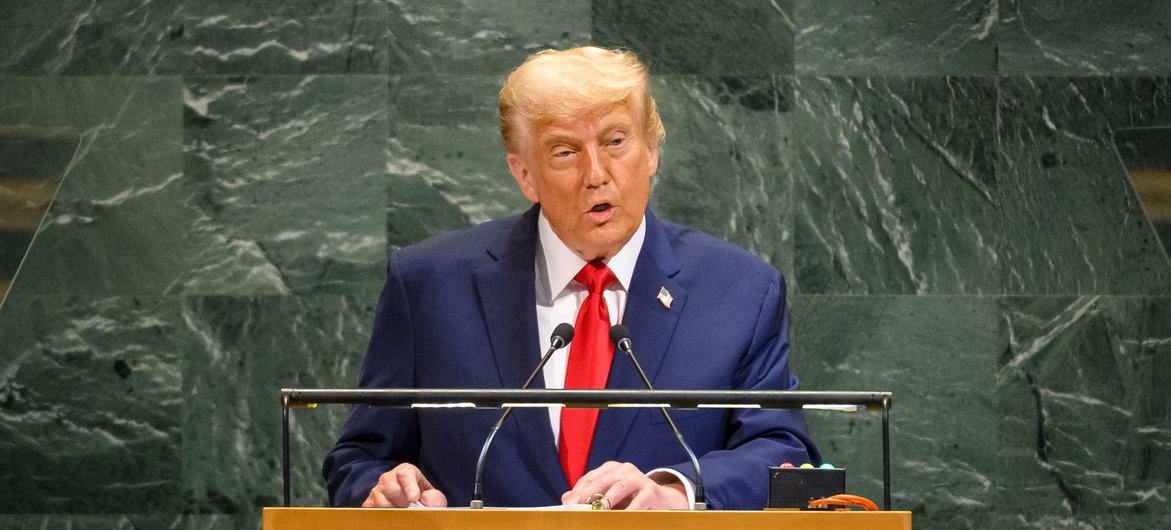
President Donald Trump delivers a controversial address at the 80th UN General Assembly in New York City. Image Credit: UN Photo/Loey
The U.S. government has approved annual export licences allowing Samsung Electronics and SK Hynix to import advanced semiconductor manufacturing equipment into their Chinese production facilities in 2026, according to sources familiar with the decision.
The move offers a temporary reprieve for the two South Korean tech giants after Washington’s earlier decision this year to end long-standing licence waivers that had eased technology exports to China.
Under new U.S. export controls, shipments of American‑made chipmaking tools to China will now require explicit government authorisation. Previously, Samsung, SK Hynix and Taiwan’s TSMC benefited from a streamlined permission known as validated end‑user status, which exempted them from individual licence requirements. That status is set to expire on December 31, 2025, prompting industry concern over supply chain disruptions.
To address this, U.S. authorities have introduced an annual approval mechanism for export licences that would cover sales of specialised semiconductor equipment destined for authorised facilities in China throughout 2026, two people with direct knowledge of the matter said on Tuesday.
Samsung and SK Hynix have not publicly commented on the licences. TSMC did not immediately respond to requests for comment, while the U.S. Department of Commerce was unavailable for immediate comment outside regular business hours.
Strategic Export Controls and Washington’s Policy Shift
The approval comes amid intensifying U.S. efforts to curb China’s access to cutting‑edge semiconductor technology. The Trump administration initially tightened export controls on advanced chip‑making tools, aiming to slow Beijing’s progress in strategic sectors. Although some of these policies were reviewed under President Joe Biden’s administration, U.S. officials have signalled renewed momentum toward stricter enforcement.
The annual licence approvals reflect a compromise: they allow major foreign semiconductor manufacturers to continue operations in China while maintaining tighter overall control over technology transfers that could boost China’s domestic semiconductor capabilities.
Importance of China to South Korean Chip Makers
For Samsung Electronics, the world’s largest memory chip producer, and SK Hynix, the second‑largest, China remains a critical market and manufacturing hub. Both firms operate extensive production facilities in the country, particularly for traditional memory products such as DRAM and NAND flash—components that have seen intense global demand due to the rapid growth of artificial intelligence (AI) data centres and inventory shortages.
The U.S. export licence approvals are expected to help stabilise supply chains and reassure customers and investors that production continuity will be maintained in 2026.
However, industry analysts caution that long‑term uncertainty persists. As geopolitical tensions over semiconductors and technology transfer continue, manufacturers may need to adjust their China strategies to align with evolving regulatory landscapes in Washington.
FAQ
Q: What licences did the U.S. grant to Samsung and SK Hynix?
A: The U.S. approved annual export licences for chipmaking equipment shipments to their facilities in China for the year 2026.
Q: Why are these licences significant?
A: They provide temporary relief after the U.S. ended licence waivers for certain chipmaking tools, requiring explicit approval for exports to China.
Q: What is validated end user status?
A: It was a U.S. designation that allowed certain companies to receive exports with fewer regulatory barriers. It is set to expire at the end of 2025.
Q: How does this affect China’s tech industry?
A: The licences help sustain foreign semiconductor production in China, though export controls remain stringent.
Q: Are Samsung and SK Hynix the only firms affected?
A: No. TSMC and other major semiconductor manufacturers also face similar regulatory changes.