

UK medical breakthrough: First baby born from deceased donor womb transplant in historic ‘miracle’ birth

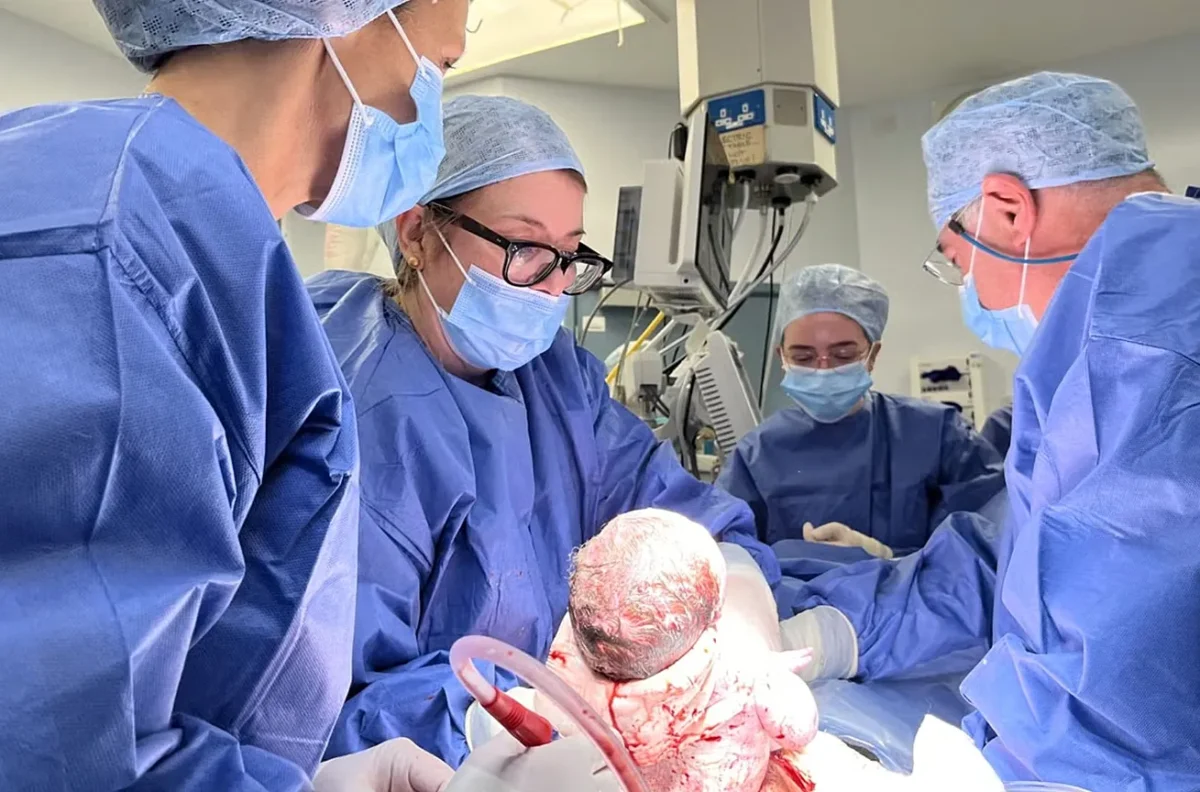
UK’s first baby born from deceased donor womb. Image Credit: Womb Transplant UK
A baby boy has become the first child in the UK to be born using a womb transplanted from a deceased donor, marking a historic breakthrough in reproductive medicine.
Grace Bell, in her 30s, who was born without a functioning womb, described the birth of her son Hugo as “simply a miracle.” The pioneering procedure offers new hope to women diagnosed with uterine factor infertility, including those born with rare conditions such as Mayer-Rokitansky-Küster-Hauser (MRKH) syndrome.
Medical teams involved in the case have hailed the birth as a “ground-breaking moment” for organ transplantation and fertility science in Britain.
Baby Hugo’s Birth Marks UK Medical Milestone
Hugo was born just before Christmas 2025 at Queen Charlotte’s and Chelsea Hospital in west London, weighing nearly 7lbs.
Grace Bell underwent a 10-hour womb transplant operation in June 2024 at The Churchill Hospital in Oxford. Following recovery, she and her partner Steve Powell received IVF treatment and embryo transfer at The Lister Fertility Center.
The transplant formed part of a UK clinical research trial led by the charity Womb Transplant UK.
Speaking after Hugo’s birth, Bell said waking up to see her baby felt “like I needed to wake up from a dream.”
Understanding MRKH Syndrome and Uterine Infertility
Grace Bell was born with MRKH syndrome, a condition affecting approximately one in 5,000 women in the UK. Women with MRKH do not have a developed uterus but often have functioning ovaries.
At 16, Bell was told she would not be able to carry her own child. Until recently, the only option for women in her position was surrogacy or adoption.
The successful womb transplant from a deceased donor changes that narrative, allowing women without a viable womb to conceive via IVF and carry a pregnancy themselves.
Importantly, babies born following womb transplantation do not share any genetic link with the donor. The transplanted womb provides a gestational environment, while the embryo comes from the intended parents.
READ ALSO
NHS told not to discourage first cousin marriage as genetic risk debate intensifies
A Breakthrough in UK Organ Transplantation
Consultant gynaecologist Professor Richard Smith of Imperial College Healthcare NHS Trust, who has researched womb transplantation for over 25 years, described Hugo’s birth as the culmination of decades of work.
“This gives hope to young girls told they do not have a womb,” he said.
Transplant surgeon Isabel Quiroga called the birth “a breakthrough for organ transplantation in the UK,” noting that very few babies in Europe have been born from wombs donated after death.
Globally, more than 100 womb transplants have been performed, resulting in over 70 healthy births. However, this is the first UK baby born from a deceased donor womb.
Earlier in 2025, the UK also celebrated its first baby born following a womb transplant from a living donor, where a woman received her sister’s uterus.
Donor Family’s “Incredible Gift”
Womb donation differs from other organ donations. It requires specific consent from families who have already agreed to donate their relative’s organs.
The anonymous donor in this case also donated five other organs to four individuals. Her parents said they felt “tremendous pride” in their daughter’s legacy.
“Through organ donation, she has given other families the precious gift of time, hope, healing and now life,” they said.
Grace Bell said she thinks of the donor and her family every day, calling it “the gift of life.”
What Happens Next?
Bell may choose to have a second child using the transplanted womb. After completing her family, surgeons plan to remove the uterus. This avoids the need for lifelong immunosuppressant medication, which is required to prevent organ rejection.
The clinical trial aims to determine whether womb transplantation could become a routine, approved fertility treatment in the UK.
If successful, it could transform the future for thousands of women born without a uterus or who lose it due to illness or surgery.
FAQ: Womb Transplant Baby Born in the UK
What is a womb transplant?
A womb transplant is a surgical procedure where a uterus is transplanted into a woman who does not have one or has a non-functioning uterus.
Who was the first UK baby born from a deceased donor womb?
Hugo, born in December 2025 in London, is the first UK baby born following a womb transplant from a deceased donor.
Does the baby share DNA with the donor?
No. The donor provides the uterus only. The embryo is created using the parents’ genetic material through IVF.
What is MRKH syndrome?
MRKH syndrome is a congenital condition where women are born without a fully developed uterus. It affects around 1 in 5,000 women in the UK.
How many womb transplants have happened worldwide?
More than 100 womb transplants have been performed globally, resulting in over 70 healthy births.
Is womb transplantation now available on the NHS?
Currently, it is part of a clinical research trial in the UK. Researchers are evaluating whether it can become a regular treatment.
Are there risks involved?
Yes. The procedure involves major surgery and requires temporary immunosuppressant drugs to prevent organ rejection.
Can women have more than one baby with a transplanted womb?
Yes, potentially. However, the womb is usually removed after family completion to avoid long-term medication.