

What Trump’s racist Obama video means for US policy, governance and race relations

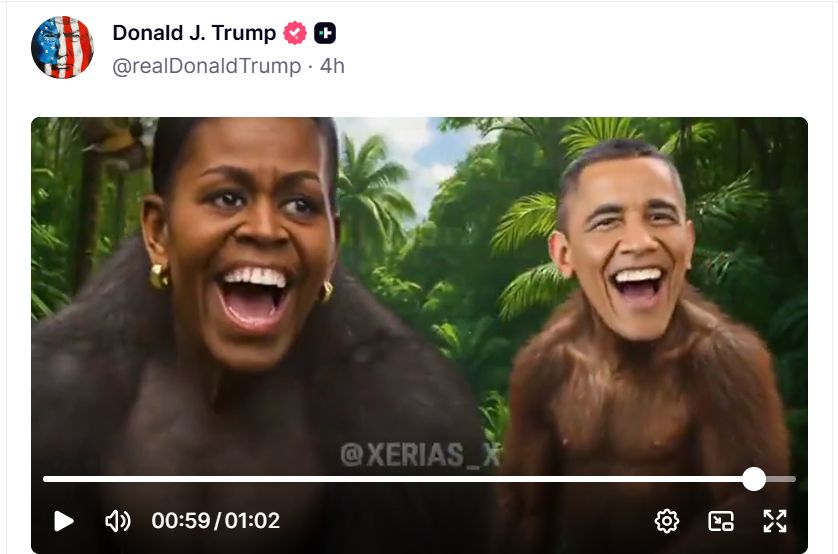
US President Donald Trump on Thursday posted an election conspiracy video that depicted former president Barack Obama and his wife Michelle as monkeys. Image Credit: Donald Trump/Truth Social
President Donald Trump sparked intense national controversy in early February 2026 when a video shared on his social media platform depicted former President Barack Obama and former First Lady Michelle Obama as apes — imagery that evokes longstanding racist tropes in American history.
The post, which included AI‑generated animation of the Obamas’ faces on primate bodies, was part of a longer clip promoting election conspiracy theories. After bipartisan condemnation — including from Republican Senator Tim Scott — the White House deleted the post and attributed it to a staffer error.
While brief, the incident has deep policy and political implications, touching on national unity, racial equity, media regulation, and standards of presidential conduct.
1. Setting Policy Tone: Presidential Communication Standards
At the heart of this episode is the standard of conduct expected from the nation’s leader. A president’s communications shape public discourse and can either elevate democratic norms or erode them.
The U.S. presidency, codified by the Constitution, has no explicit code of speech for social media, but longstanding norms emphasize respect and restraint. By amplifying racist imagery — even if attributed to a staffer — the presidency risks normalizing content that echoes racist caricatures deeply embedded in American history.
From a policy perspective, this raises questions about whether:
-
There should be formal guidelines governing presidential or official social media content;
-
Platforms hosting presidential speech should adopt stricter safeguards for misinformation and harmful imagery; and
-
Congress should revisit civility and harmful conduct in digital public communication.
These are not purely abstract questions. With misinformation already a focus of legislative efforts — such as bills on algorithm transparency and social media accountability — incidents like this intensify calls for policy frameworks that address harmful political content across online platforms.
2. Race and Anti‑Discrimination Law in Political Communication
U.S. civil rights law bars discrimination in employment, housing, and public accommodations, but the First Amendment protects broad swaths of political speech — even when offensive or racist. However, political actors and government institutions can choose self‑regulation to avoid legitimising dehumanizing imagery.
Historically, comparing Black people to apes has been used to justify exclusion, segregation, and racist violence. That Trump’s post was widely condemned — including by Republicans — shows that many see the issue as more than partisan dispute; it touches on core civil rights and dignity concerns.
Policy impacts include:
-
Civil rights enforcement: Advocacy groups may push for renewed attention to discriminatory conduct in public messaging.
-
Education policy: Renewed emphasis on historical literacy about racist visual tropes in schools and media literacy programs.
-
Platform governance: Private companies may face increased pressure from lawmakers and the public to take action against racist content, even from public officials.
3. Impact on Democratic Norms and Public Trust
Democracies rest on shared norms — trust, respect for opponents, and peaceful competition. Research shows that dehumanizing language and imagery can heighten polarization and reduce empathy across political divides, making compromise and governance more difficult.
A president’s amplification of such content — even inadvertently — can have ripple effects:
-
Polarization deepens: Voters who see the video as racist are more likely to distrust institutions and political opponents.
-
Erosion of norms: Once extreme content becomes acceptable in mainstream discourse, the bar for public conduct is lowered.
-
Media dynamics: Amplification of controversial content boosts engagement, which can incentivize more extreme messaging absent regulation.
These dynamics intersect with ongoing legislative debates over social media reform, hate speech policies, and platform accountability.
4. Election Policy and Trust in Institutions
The video that included the racist imagery also promoted false claims about the 2020 election — tying it to broader concerns about misinformation. This convergence matters because policy responses to election misinformation are actively debated in the U.S..
Lawmakers across the spectrum have expressed interest in regulating:
-
Disinformation: Crafting definitions and enforcement mechanisms without violating free speech.
-
Election integrity laws: Balancing access with security — including controversies over voter ID and ballot counting.
-
Civic education: Ensuring citizens can distinguish fact from engineered political content.
This incident highlights the policy challenge of preserving free expression while addressing harmful political communication that damages public trust.
5. Implications for International Reputation and Diplomacy
American democratic credibility often benchmarks against free and respectful political discourse. Incidents of racist content by a sitting president can:
-
Undermine U.S. moral authority in advocating human rights globally.
-
Be used by foreign governments to criticize U.S. racial policy or legitimacy.
-
Affect bilateral relations where race and governance issues are sensitive.
For example, partners and rivals alike may cite such controversies when discussing human rights or leadership in international forums.
6. Social and Racial Policy Impact on Black Americans
For Black Americans and other communities of color, the episode resonates beyond political theatre. Its timing — during Black History Month — and its imagery evoke a historical narrative of dehumanization.
Policies that could be influenced include:
-
Reinforcement of anti‑bias training in government institutions.
-
Increased funding for civil rights enforcement and community outreach.
-
Legislative attention to hate speech consequences, even when constitutionally protected.
Advocates argue that laws alone are insufficient without cultural and educational leadership that challenges racist ideologies.
7. Congressional and Judicial Oversight
The uproar — including backlash from lawmakers of both parties — could translate into congressional hearings, resolutions condemning racist conduct, or renewed scrutiny of presidential communications.
Judicial interpretation of First Amendment limits continues to be tested, but public discourse and legislative pressure often shape how norms evolve over time.
Policy Takeaways
In sum, Trump’s sharing of a video with racist depictions of the Obamas — even if brief and deleted — carries implications that cut across:
-
Presidential speech norms and official conduct policies
-
Race and civil rights advocacy
-
Media governance and platform regulation
-
Public trust in democratic institutions
-
Social and racial equity policy
The bipartisan condemnation illustrates that many lawmakers recognize the danger of normalising racist imagery — even when defended as humor or internet memes — and highlights the need for policy clarity on conduct, communication, and accountability in American public life.