

Trump Obama monkey video: Inside Donald Trump’s long history of controversial and racially charged posts

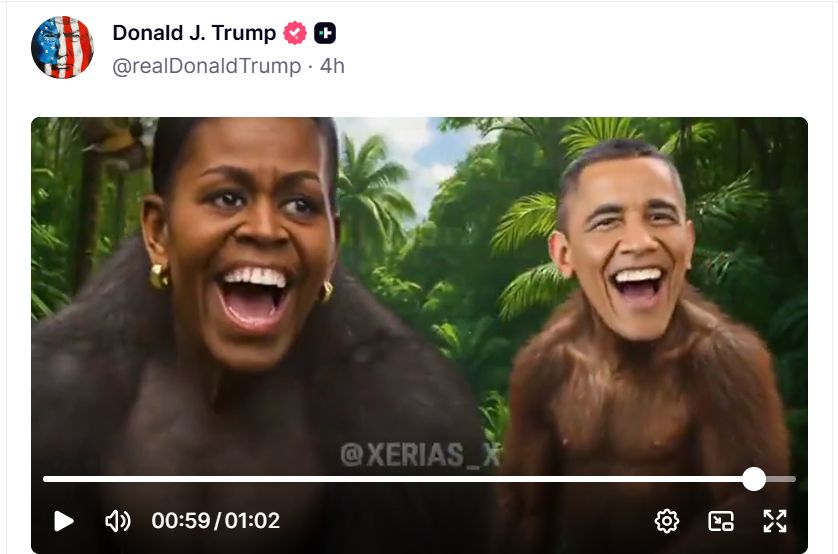
US President Donald Trump on Thursday posted an election conspiracy video that depicted former president Barack Obama and his wife Michelle as monkeys. Image Credit: Donald Trump/Truth Social
The White House’s belated decision to remove a racist video shared on President Donald Trump’s social media account has reignited a familiar debate: was it an innocent mistake by an aide, or another example of a long-standing pattern that has defined Trump’s online presence for nearly a decade?
The video, which promoted false claims of voter fraud, ended with a deeply offensive visual—images of former President Barack Obama and former first lady Michelle Obama with their heads superimposed on the bodies of apes. The post lingered online for hours, even as outrage mounted across party lines. Initially, the White House dismissed the backlash as “fake” before eventually reversing course, deleting the post and blaming a staffer for sharing it “erroneously.”
Trump later said he had reviewed only part of the video and declined to apologize, insisting the offensive clip was missed by someone else. But critics, including members of his own party, have questioned that explanation, pointing out that the post appeared during one of Trump’s characteristic late-night Truth Social sprees and that the video itself was just over a minute long.
More importantly, they argue, this was hardly an isolated incident.
A Familiar Defense: “It Wasn’t Me”
Blaming staffers or interns for controversial posts has become a recurring refrain throughout Trump’s political career. As far back as 2015, his campaign attributed a crude tweet suggesting that Iowans’ support for Ben Carson was due to “too much #Monsanto in the #corn” to a “young intern who accidentally did a retweet.” The explanation rang hollow even then, especially as Trump later echoed similar sentiments publicly.
Since that early episode, the disclaimers have changed little, even as the controversies have grown more severe.
Repeated Brushes With Racist and Extremist Imagery
In 2016, Trump shared an image of Hillary Clinton alongside piles of cash and a six-pointed star reminiscent of the Star of David—an image that had circulated on antisemitic and white supremacist forums. After widespread condemnation, his campaign quietly replaced the star with a circle, but never fully addressed how the image made it onto his feed.
As president in 2017, Trump reposted anti-Muslim videos from a British far-right account. When pressed on the extremist views of the group behind the posts, he offered a conditional apology—only if it turned out they were “horrible, racist people.” Even then, the White House initially stood by the reposts.
Two years later, Trump amplified tweets from British anti-immigration activist Katie Hopkins, known for comparing migrants to cockroaches. That same year, he told four non-White Democratic congresswomen to “go back” to the “crime infested places from which they came,” despite the fact that most were American-born. The remarks triggered bipartisan condemnation, but Trump refused to retract them.
The Trump Presidency and Social Media Shockwaves
The pattern continued into the 2020 election year. Trump reposted doctored images depicting Democratic leaders in Middle Eastern attire and shared a video from a Florida retirement community praising supporters—despite the footage including a chant of “White power.” Once again, the White House claimed Trump had not heard the offensive portion of the video.
Other posts portrayed dark-skinned migrants as “monsters” and framed immigration in explicitly racial and fear-based terms. Each time, critics raised alarms. Each time, Trump either dismissed the criticism or deflected blame.
Back in Office, Same Old Playbook
By 2025, with Trump back in the White House, the tone of his social media presence showed little evidence of restraint. He repeatedly shared an AI-generated video mocking Democratic leaders with racist caricatures and doubled down on xenophobic rhetoric, including comments targeting Somali immigrants.
Against this backdrop, the reposting of the racist video involving the Obamas appears less like an accident and more like a continuation of a well-established approach: provocative content first, explanations later—if at all.
Republican Discomfort, but Few Consequences
What makes the latest episode notable is the intensity of the pushback from within Trump’s own party. Senator Tim Scott of South Carolina, the only Black Republican in the Senate and a close Trump ally, called the video “the most racist thing I’ve seen out of this White House.” It was not the first time Scott had felt compelled to speak out; he previously labeled Trump’s “White power” repost “indefensible” and the “go back” comments “racially offensive.”
Yet despite repeated warnings from allies and critics alike, meaningful safeguards around Trump’s social media use appear nonexistent.
A Broader Pattern
Taken together, Trump’s history of online controversies paints a consistent picture. Whether through personal approval, indifference, or a lack of discernment, his social media platforms have repeatedly amplified content that many—including Republicans—have labeled racist, extremist, or beyond the pale.
The Obamas video, then, is not an anomaly. It is part of a decade-long pattern that has shaped Trump’s political identity, fueled division, and raised persistent questions about accountability at the highest level of power. And as history suggests, unless something fundamentally changes, it is unlikely to be the last.