

“I won’t use force”: Trump signals shift on Greenland in Davos speech, prompting diplomatic and market response

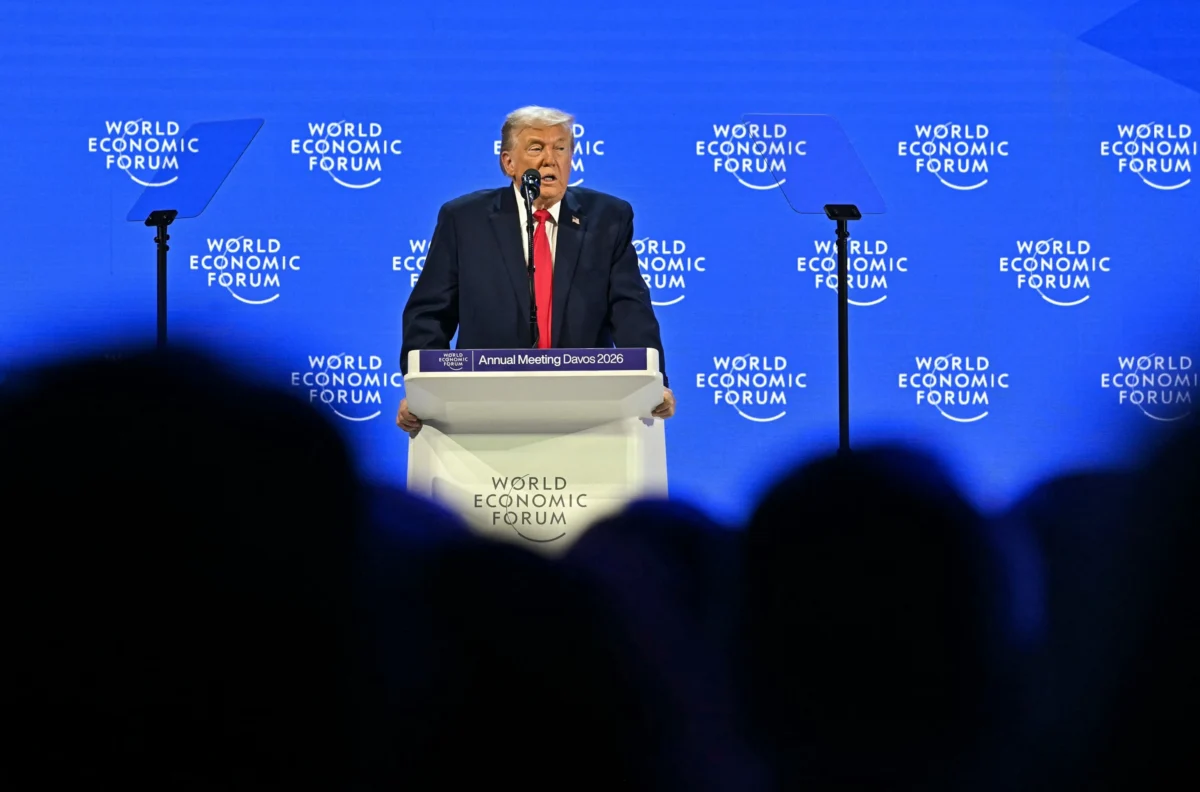
Trump speaks at Davos amid Greenland tensions. Image Credit: Fabrice Coffrini/AFP via Getty Images
President Donald Trump’s Davos speech at the World Economic Forum (WEF) in Switzerland has thrust U.S. foreign policy back into the global spotlight, as the president declared he would not use military force to obtain Greenland, while still pressing for negotiations over its ownership.
Speaking on Wednesday, Trump addressed months of speculation surrounding his renewed push for U.S. control of Greenland, a semi-autonomous territory under Denmark, insisting that while the United States has overwhelming power, he has no intention of using it.
“I won’t use force. I don’t want to use force,” Trump told world leaders and investors gathered in Davos, adding that U.S. ownership of Greenland is critical for national and global security.
Greenland and National Security Take Centre Stage
Trump framed Greenland as a strategic necessity rather than a territorial ambition, describing the Arctic island as vital for defense and global protection.
“So we want a piece of ice for world protection,” Trump said, arguing that the region’s location makes it increasingly important amid rising geopolitical competition in the Arctic.
While the president reiterated his desire for immediate negotiations, his comments included pointed warnings, suggesting the United States would “remember” countries that oppose its position, remarks that have unsettled European allies.
Allies Push Back as Diplomatic Tensions Rise
Trump’s Davos appearance followed days of escalating diplomatic friction. In the run-up to the forum, he threatened new tariffs on eight European countries and NATO members that oppose a U.S. acquisition of Greenland.
Denmark and Greenland swiftly rejected the proposal, with several European governments issuing a joint statement expressing solidarity with Copenhagen and affirming Greenland’s right to self-determination.
NATO Secretary General Mark Rutte and French President Emmanuel Macron were among leaders who privately urged restraint. Macron reportedly told Trump he did not understand the Greenland strategy, while still signaling a desire to maintain dialogue.
Canadian Prime Minister Mark Carney, speaking separately at Davos, warned that global stability is being undermined as major powers increasingly weaponise trade, tariffs and economic leverage.
READ ALSO
Inside Davos 2026: Trump takes center stage as trade wars, AI fears and Global power shifts dominate
Markets React as Trump Rules Out Military Action
While Trump’s comments intensified diplomatic debate, they had a calming effect on global markets.
According to CNBC, U.S. technology stocks rebounded sharply after Trump explicitly ruled out military force, easing fears of geopolitical escalation that had triggered a sell-off earlier in the week.
Chipmakers led the rally:
- Intel surged 11%
- Advanced Micro Devices rose about 9%
- Arm Holdings climbed roughly 8%
- Micron Technology and Marvell Technology gained at least 5%
Investors appeared reassured by Trump’s softer tone, even as uncertainty remains around future tariffs and trade disputes linked to Greenland.
Tariffs, NATO and the Global Order
Despite the market rally, Trump’s broader Davos message underscored a shift toward transactional diplomacy.
He recently reposted commentary portraying NATO and the United Nations as greater threats to U.S. interests than China or Russia, a stance that has alarmed allies already wary of weakening multilateral institutions.
When asked whether his Greenland push could fracture NATO unity, Trump struck a more conciliatory note, saying, “Something’s going to happen that’s going to be very good for everybody.”
Beyond Greenland: Trump’s Expanding Davos Agenda
Trump’s Davos visit extends beyond Greenland. The White House confirmed he will unveil a “Board of Peace” Charter, part of a broader plan to end the Israel-Hamas conflict.
The proposed board, which Trump would chair permanently, has drawn criticism after reports suggested member countries may be required to contribute $1 billion for permanent seats. French President Macron has already declined to participate.
Trump has also said his main message at Davos is that the U.S. economy is performing strongly, with aides hinting at new announcements on housing and affordability.
Why Trump’s Davos Speech Matters
Trump’s remarks have reshaped the Davos agenda, turning what is typically an economic forum into a stage for geopolitical confrontation and negotiation.
By ruling out force, Trump eased immediate fears of military conflict, but his insistence on acquiring Greenland, coupled with tariff threats, ensures the issue will remain a defining test of U.S. relations with Europe in 2026.
FAQ
What did Trump say at Davos about Greenland?
Trump said the U.S. wants to negotiate ownership of Greenland for national security reasons but will not use military force to obtain it.
Did Trump threaten to use force against Greenland?
No. Trump explicitly stated at Davos that he would not use force, despite saying the U.S. has overwhelming power.
Why does Trump want Greenland?
Trump argues Greenland is strategically vital for global and national security, particularly as Arctic competition increases.
How did markets react to Trump’s Davos speech?
Markets reacted positively, with technology stocks rallying after Trump ruled out military action, easing geopolitical fears.
Did Trump threaten tariffs over Greenland?
Yes. Days before Davos, Trump threatened tariffs on European countries opposing a U.S. deal for Greenland.
How have U.S. allies responded?
European leaders, including Denmark, France and Canada, have rejected the idea and warned against destabilising the international order.
What is the World Economic Forum in Davos?
The World Economic Forum is an annual global meeting where political and business leaders discuss economic, political and security issues.
What else did Trump plan to announce at Davos?
Trump is expected to promote U.S. economic performance and unveil details of a proposed “Board of Peace” initiative.