

Trump’s Board of Peace launches with $10BN US pledge: Is it replacing the United Nations?

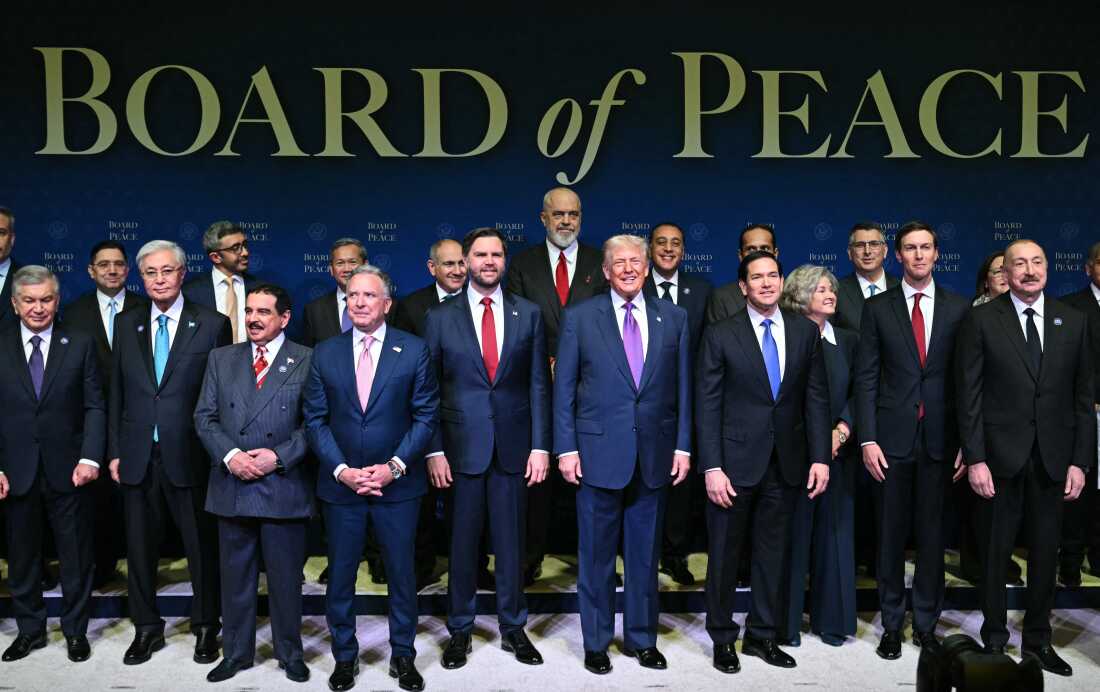
US President Donald Trump (C), flanked by US Vice President JD Vance (L) and US Secretary of State Marco Rubio (R), joins leaders for a group photo during the inaugural meeting of the “Board of Peace” at the US Institute of Peace in Washington, DC, on February 19, 2026. Image Credit: SAUL LOEB / AFP via Getty Images
President Donald Trump has formally launched the first meeting of the Board of Peace, a new international body he says will oversee ceasefire efforts in Gaza and reshape global diplomacy.
Gathering representatives from more than 40 countries in Washington, the president announced that the United States would contribute $10 billion to the initiative, while member states have pledged billions more toward Gaza’s reconstruction.
But as the Board of Peace begins operations, questions are mounting: Is it designed to support the United Nations, or challenge its authority?
What Is the Board of Peace?
The Board of Peace was established last month and is chaired by Trump. According to the administration, its primary purpose is to oversee and support the ceasefire plan in Gaza, coordinate reconstruction funding, and promote regional stability.
The inaugural meeting was held at the renamed Donald J. Trump Institute of Peace in Washington, where heads of state and senior diplomats gathered for the first formal session.
Trump described it as “the most prestigious board ever put together,” emphasising its role in global peace-building efforts.
Representatives attended from countries including Hungary, Argentina, India, Pakistan and Vietnam. Some European allies such as France and the United Kingdom sent observers but did not formally join the board, citing concerns about its structure and potential overlap with existing international institutions.
$10 Billion US Commitment and Gaza Reconstruction Plan
During the meeting, Trump confirmed the United States would pledge $10 billion to the Board of Peace. Member states collectively pledged additional funds, reportedly totaling billions for Gaza reconstruction.
The funding is tied to maintaining a fragile ceasefire between Israel and Hamas, brokered last October.
Trump stated that the war in Gaza is “over,” apart from “little flames,” and credited his administration with securing the return of Israeli hostages.
The next phase of the ceasefire plan includes:
- Reconstruction efforts in Gaza
- Deployment of an International Stabilization Force
- Disarmament of Hamas
Indonesia has reportedly signaled willingness to contribute troops to a stabilization force, though final agreements remain under negotiation.
READ ALSO
Is Iran backing down? Trump says crackdown is easing as Tehran denies executions
Iran nuclear talks take dramatic turn as Trump deploys warships and warns Tehran
Trump on Iran: “They Can’t Have a Nuclear Weapon”
Beyond Gaza, Trump used the Board of Peace platform to reiterate his administration’s position on Iran’s nuclear program.
“We do have some work to do with Iran. They can’t have a nuclear weapon,” Trump said, adding that negotiations are ongoing and that developments could unfold within 10 days.
He did not rule out stronger action, but emphasised the need for a “meaningful deal.”
The comments come amid reports of heightened US military positioning in the region and congressional efforts to assert war powers oversight.
Concerns About the United Nations
One of the most controversial aspects of the Board of Peace is its relationship with the United Nations.
Trump stated that the board would work “very closely” with the UN, but added that it would “almost be looking over the United Nations and making sure it runs properly.”
This has prompted unease among some US allies and international observers, who fear the initiative could undermine the UN’s authority.
A UN Security Council meeting on Gaza was reportedly rescheduled to accommodate diplomats attending the Board of Peace gathering.
Still, Trump framed the initiative as complementary, promising financial support to strengthen the UN if necessary.
Political Optics and Global Alignments
The meeting also had notable geopolitical optics.
Hungary’s Viktor Orbán attended and received Trump’s public endorsement ahead of his country’s parliamentary elections. Leaders from Gulf states were prominent on the speaker list, while several NATO allies opted not to formally join.
There is no Palestinian representative on the Board of Peace, a fact critics argue raises questions about inclusivity in shaping Gaza’s future.
Meanwhile, the ceasefire remains fragile, with ongoing violence reported in Gaza despite the agreement.
What Happens Next?
Key developments to watch include:
- Finalization of Gaza reconstruction funding mechanisms
- Details of troop deployment for stabilization
- Progress on Iran nuclear negotiations
- Congressional oversight of US financial commitments
The Board of Peace is still in its early stages, but it has already reshaped diplomatic conversations in Washington and beyond.
Whether it becomes a transformative peace platform or a controversial parallel structure to the UN remains to be seen.
FAQ
What is the Board of Peace?
The Board of Peace is a new international body created and chaired by President Donald Trump. It aims to oversee the Gaza ceasefire, coordinate reconstruction funding, and promote regional stability.
How much is the US contributing to the Board of Peace?
The United States has pledged $10 billion to the initiative, alongside additional commitments from member states.
Is the Board of Peace replacing the United Nations?
Trump says the board will work closely with the UN, but some allies fear it could undermine or overlap with the UN’s authority.
Which countries joined the Board of Peace?
More than 40 countries sent representatives to the inaugural meeting. Hungary formally joined, while some European allies sent observers instead of becoming members.
What is the Board’s role in Gaza?
It is expected to oversee reconstruction funding, support ceasefire implementation, and coordinate the deployment of an international stabilization force.
Will international troops be sent to Gaza?
Plans include an International Stabilization Force to serve as a buffer between Israel and Hamas, though final agreements are pending.
What did Trump say about Iran?
Trump reiterated that Iran “can’t have a nuclear weapon” and suggested negotiations are ongoing, with possible developments within days.
Is Hamas required to disarm under the plan?
Yes. Disarmament of Hamas is considered a key condition for reconstruction funding and long-term stability.
Why are some NATO allies hesitant?
Concerns include duplication of UN functions, governance transparency, and geopolitical implications.