

Why the Supreme Court just shut down the biggest flip-on-same-sex marriage fight and what that means for the future

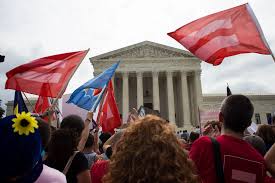
Why the Supreme Court just shut down the biggest flip-on-same-sex marriage fight … and what that means for the future
In a move that surprised many and reassured others, the Supreme Court of the United States on Monday declined to take up a high-profile appeal that sought to overturn the landmark 2015 decision in Obergefell v. Hodges, the ruling that enshrined nationwide rights for same-sex couples to marry.
The appeal was brought by Kim Davis, the former county clerk in Rowan County, Kentucky, who became a lightning rod of controversy ten years ago when she refused to issue marriage licences to same-sex couples citing her religious convictions. Her petition asked the Court to revisit and overturn Obergefell, and to reverse a lower-court ruling that held her liable for damages and attorney’s fees after she denied licences.
On Monday the Court issued a brief order denying review — without explanation, without noted dissents — signalling that at least for now it sees no reason to reopen the fundamental question of marriage equality in the United States.
Davis’ case centered on two main arguments: First, she claimed her religious freedom should protect her from being required to act (as a government official) in a way she believed contravened her faith. Second, her lawyers seized the opportunity to argue that Obergefell, the 5-4 decision from 2015, should be overturned as “unworkable” or “badly reasoned.”
Yet the Court’s refusal to take the case suggests that despite its 6-3 conservative majority — which has overturned other precedents such as in the abortion rights context — it is not yet willing to reopen the marriage equality question. Legal observers say the petition may simply not have presented the right vehicle to walk back Obergefell.
Advocates for LGBTQ+ rights hailed the decision as a victory for millions of couples whose marriages, families and legal entitlements rested on the Obergefell ruling. “When public officials take an oath to serve their communities, that promise extends to everyone — including LGBTQ+ people,” said one leader in the field.
At the same time, opponents of Obergefell lost a potential opening. Though some voices on the Court — notably Justice Clarence Thomas — have previously suggested marriage equality might be revisited, the absence of even a shadow dissent on Monday signals a kind of institutional stability for the ruling — at least for now.
The underlying lawsuit that brought this appeal proceeds from the case in which Moore and Ermold, a same-sex couple, were denied a marriage licence by Davis shortly after Obergefell. A federal jury awarded them damages and fees; the appeals process flowed up to the Sixth Circuit, which rejected Davis’ immunity and First Amendment arguments.
What this means in practical terms is that the 2015 decision remains intact, reinforcing that same-sex couples may continue to marry under constitutional protection. For government officials who might harbour objections, the ruling sends a strong message: once you assume a public office and wield state authority, you cannot simply opt out of issuing rights guaranteed by the Constitution.
Nevertheless, legal watchers caution that the stability of Obergefell is not guaranteed forever. The Court’s composition and priorities could shift; future cases may argue different angles (such as religious exemptions, state laws) that could chip away at the decision. For now, though, the Court has closed the door on this particular path to overturning marriage equality.
FAQ
Q: What was the core question in this appeal?
A: The petition asked the Supreme Court to review whether a public official (Kim Davis) could claim religious-freedom and immunity from liability for refusing to issue licences to same-sex couples — and in doing so asked the Court to reconsider the Obergefell decision that established same-sex marriage rights.
Q: Does the Supreme Court’s refusal to hear the case mean Obergefell is safe forever?
A: Not necessarily “forever,” but Monday’s decision signals the Court currently has no appetite to overturn that precedent. It remains binding unless and until the Court explicitly overrules it or Congress/state legislatures act.
Q: Why did Kim Davis argue she should be exempt?
A: Davis contended that her religious convictions prevented her from issuing marriage licences to same-sex couples and that she should be shielded from liability under the First Amendment and other protections as she no longer acted in her “private capacity.” However, the Sixth Circuit found she acted as a state official and thus could not claim those exemptions.
Q: Was there any dissent or commentary from the justices on Monday?
A: No. The order list did not show any noted dissents or opinions explaining the refusal to review. The denial was routine.
Q: Are there any implications for other LGBTQ+ rights (e.g., transgender rights)?
A: While this case directly addressed same-sex marriage, some analysts view the decision as part of a broader context of how the Court handles fundamental-rights precedents. Safeguards in Obergefell may bolster other rights, but each legal challenge remains distinct.