

Why Is South Africa being sidelined from the G20 amid economic pressures?”

Why Is South Africa being sidelined from the G20 amid economic pressures?”
The South African rand remained largely unchanged on Wednesday following the release of November’s Purchasing Managers’ Index (PMI), which suggested continued contraction in private sector activity. The currency traded at R17.075 to the US dollar, a modest increase of about 0.2% from Tuesday’s close, amid heightened attention to upcoming US economic data and the Federal Reserve’s interest rate decision next week.
According to an S&P Global survey, South Africa’s private sector activity contracted for the second consecutive month. The PMI edged up slightly to 49.0 in November, from 48.8 in October, remaining below the 50-point threshold that separates growth from contraction. Firms reported rising input costs over the year, prompting a sharper increase in output prices—the fastest since February.
This week has seen a series of disappointing economic data. The country reported slower GDP growth in the third quarter, a subdued manufacturing survey, weaker-than-expected vehicle sales for November, and a rise in fuel prices for December. On the Johannesburg Stock Exchange, the Top 40 index saw a minor increase of 0.1%.
As of Thursday, 4 December, the rand traded at R17.06 to the dollar, R22.75 to the pound, and R19.89 to the euro, while oil prices were slightly lower at $62.94 per barrel.
Key Developments in South Africa
1. G20 Exclusion:
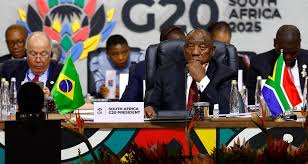
The United States, under President Donald Trump, assumed the 2026 G20 presidency on 1 December and confirmed that South Africa would not be invited to the first “sherpas’” meeting in Washington on 15-16 December. Trump cited procedural disputes over the handover of the G20 presidency and reiterated claims regarding human rights issues, though these statements have been widely disputed.
South African officials maintained that the country’s commitment to G20 principles remains intact. Dirco spokesperson Chrispin Phiri emphasized that unilateral decisions to exclude a member undermine the forum’s legitimacy. Other G20 members, including Germany, have reportedly raised concerns over the exclusion.
2. Rand Volatility at Record Low:
The implied one-month volatility for the rand against the US dollar fell to 7.9%, the lowest since February 2000. Analysts interpret this as a signal that traders expect minimal short-term currency fluctuations.
3. Rail Investment:
Traxtion, Africa’s largest private rail operator, announced a R3.4 billion investment to import 46 locomotives from New Zealand to strengthen South Africa’s rail infrastructure.
4. Solar Regulation Dispute:
The Organisation Undoing Tax Abuse (Outa) has threatened legal action against municipalities that require engineering council approval for home solar power systems, citing concerns over unnecessary regulatory hurdles.
5. ANC Salary Delays:
The African National Congress has reportedly failed to pay staff salaries at its Luthuli House headquarters for the third time this year, following previous issues linked to court-ordered account attachments due to outstanding debts.
FAQ
Q1: How did the rand perform recently?
A1: The rand traded at R17.075/USD on Wednesday, a small increase from Tuesday, with volatility at its lowest since 2000.
Q2: What does the PMI indicate for South Africa?
A2: The November PMI of 49.0 suggests continued contraction in private sector activity, though slightly improved from October.
Q3: Why was South Africa excluded from the US G20 meeting?
A3: The US cited procedural disputes and human rights concerns as reasons for excluding SA from the sherpas’ meeting and the 2026 summit.
Q4: What other economic events are affecting South Africa?
A4: Recent data include slower GDP growth, weak manufacturing and vehicle sales, rising fuel prices, and low currency volatility.
Q5: Are there significant infrastructure projects underway?
A5: Yes, Traxtion is investing R3.4 billion in 46 locomotives from New Zealand to enhance rail capacity.