

Russian fighter jets intercepted near Alaska: U.S. scrambles F-16s and F-35s in high-stakes NORAD operation

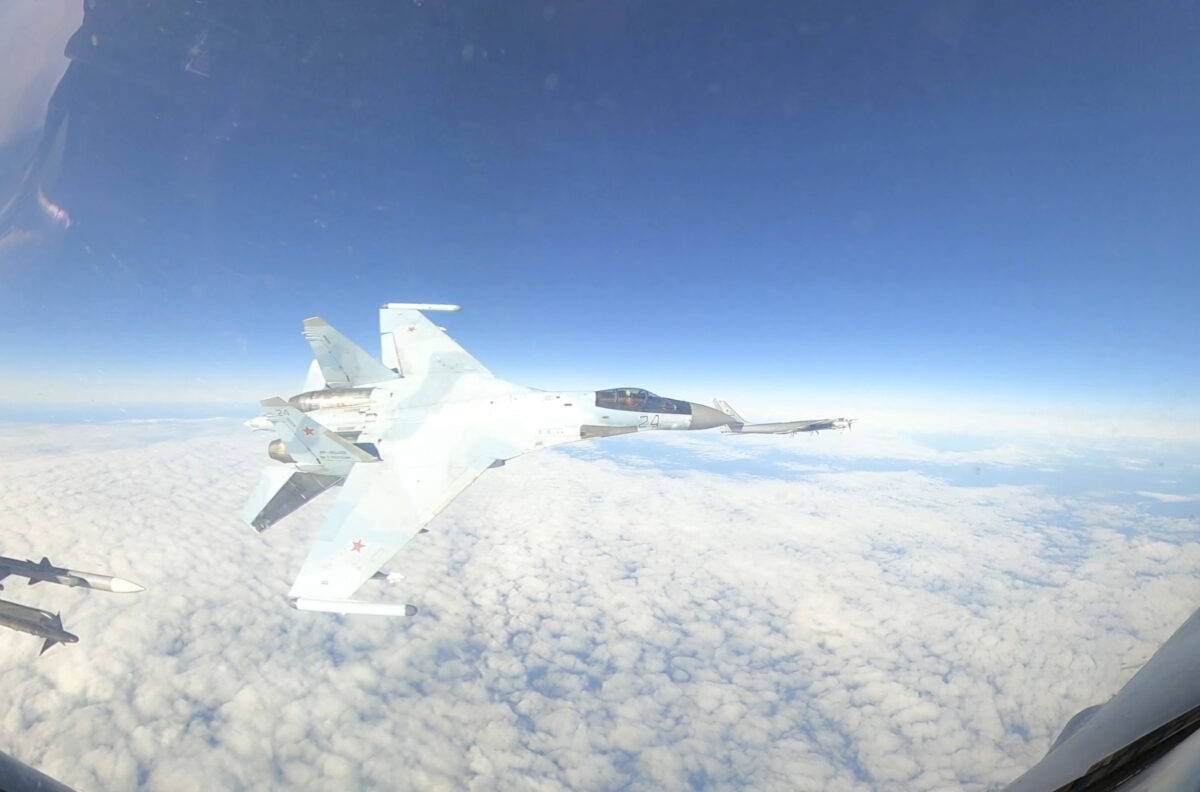
In this Sept. 23, 2024, image taken from video, a U.S. Air Force F-16 operating under the direction of North American Aerospace Defense Command, conducts a routine intercept of a Russian Tu-95 aircraft in the Alaskan Air Defense Identification Zone (ADIZ) when NORAD said a Russian Su-35 aircraft conducts an unsafe maneuver directed at the F-16. Image Credit: Department of Defense via AP
U.S. fighter jets were scrambled Thursday after multiple Russian military aircraft, including bombers, fighter jets and a surveillance plane, were detected flying near Alaska, according to U.S. defense officials.
The North American Aerospace Defense Command (NORAD) confirmed that two Russian Tu-95 bombers, two Su-35 fighter jets, and one A-50 airborne early warning aircraft were tracked in the Alaskan Air Defense Identification Zone (ADIZ). The Russian aircraft did not enter U.S. or Canadian sovereign airspace.
The incident underscores ongoing military activity near North American airspace amid heightened global tensions.
What Russian Aircraft Were Detected?
According to North American Aerospace Defense Command, the following aircraft were identified:
- Two Tupolev Tu-95 strategic bombers
- Two Sukhoi Su-35 multirole fighter jets
- One Beriev A-50 surveillance plane
The aircraft were operating within the Alaskan ADIZ, a designated stretch of international airspace that requires identification of all aircraft in the interest of national security.
NORAD emphasized that the Russian planes remained in international airspace and did not violate U.S. or Canadian borders.
U.S. Response: F-16s and F-35s Deployed
To intercept and monitor the Russian aircraft, NORAD launched:
- Two F-16 fighter jets
- Two F-35 stealth fighter jets
- Four KC-135 refueling tankers
The U.S. jets escorted the Russian planes until they departed the ADIZ.
NORAD stated that this type of Russian military activity in the region “occurs regularly” and was not considered an immediate threat.
READ ALSO
Kyiv under fire as Russia launches Massive Strike ahead of Trump-Zelensky Peace Talks
Is Minsk in Russia? Green Party MP’s University Challenge answer sparks backlash
What Is the Alaskan ADIZ?
The Alaskan Air Defense Identification Zone begins where U.S. and Canadian sovereign airspace ends. It is not U.S. territory but functions as a security buffer zone.
Aircraft entering the ADIZ must identify themselves and communicate with air traffic authorities. Failure to do so can prompt interception.
NORAD, created in 1957 as a joint U.S.-Canada command, is responsible for aerospace warning and control across North America. It remains on constant alert for potential threats from aircraft, missiles, or space vehicles.
Pattern of Russian Military Flights Near Alaska
This latest interception follows a pattern of similar incidents:
- In September 2025, U.S. jets intercepted Russian Tu-95s and Su-35s in the same region.
- In August 2025, NORAD intercepted a Russian reconnaissance aircraft multiple times within a week.
- In July 2024, both Russian and Chinese bombers jointly entered the Alaska ADIZ for the first time.
Defense analysts note that these operations are often used by Russia to test response times and assert strategic presence in international airspace.
Strategic Implications
While officials described Thursday’s activity as routine, the presence of strategic bombers and advanced fighter aircraft highlights ongoing military posturing between Moscow and Washington.
The Tu-95 bomber is capable of carrying long-range cruise missiles, while the Su-35 is considered one of Russia’s most advanced fighter platforms.
NORAD said it “remains ready to employ a number of response options in defense of North America.”
The event serves as a reminder of continued geopolitical friction in the Arctic region, an area of growing military and economic significance.
FAQ: Russian Fighter Jets Near Alaska
What happened with Russian fighter jets near Alaska?
U.S. fighter jets intercepted multiple Russian military aircraft, including Tu-95 bombers and Su-35 fighter jets, in the Alaskan Air Defense Identification Zone.
Did Russian aircraft enter U.S. airspace?
No. NORAD confirmed the Russian aircraft remained in international airspace within the ADIZ and did not violate U.S. or Canadian borders.
What aircraft did the U.S. deploy?
NORAD launched F-16s, F-35s, and KC-135 refueling tankers to escort the Russian planes.
What is the Alaskan ADIZ?
The Alaskan Air Defense Identification Zone is a designated area of international airspace where aircraft must identify themselves for security purposes.
Is this the first time Russian jets have flown near Alaska?
No. Russian military flights near Alaska occur regularly and have been intercepted multiple times in recent years.
Why does Russia fly near Alaska?
Military analysts suggest these missions demonstrate strategic capability, test response readiness, and assert presence in international airspace.
What is NORAD’s role?
NORAD is a joint U.S.-Canada defense command responsible for monitoring and defending North American airspace.
Is this considered a threat?
According to NORAD, the activity was routine and not considered an immediate threat.