

Robert Mueller: 10 things to know about ex-FBI director

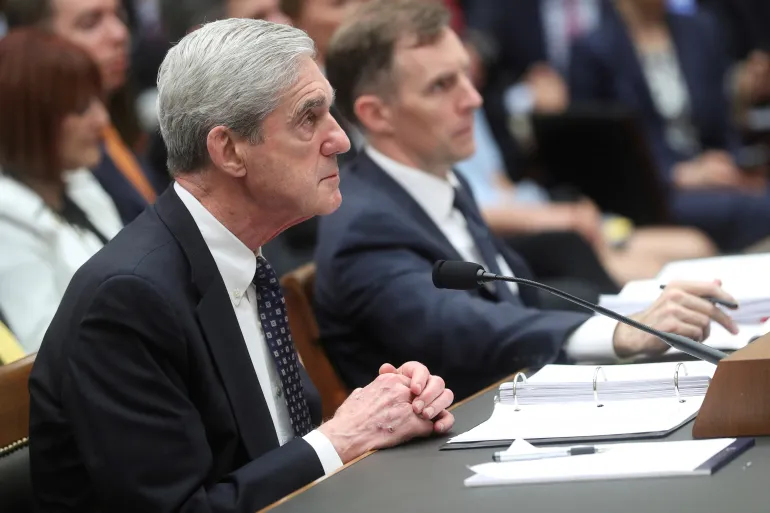
Former Special Counsel Robert Mueller testifies during a US House Intelligence Committee hearing in Washington, DC, on July 24, 2019 [File: Jonathan Ernst/Reuters]
Robert Mueller, the former director of the Federal Bureau of Investigation and one-time US special counsel, has died at the age of 81, bringing to a close a long and often controversial career in American public service.
His family confirmed his passing in a brief statement, saying he died on Friday night and requesting privacy as they mourn.
Mueller’s career spanned some of the most defining moments in modern US history, from the aftermath of the September 11 attacks to the politically charged investigation into Russian interference in the 2016 presidential election.
A Career Shaped by Crisis and Reform
Mueller was appointed FBI director in 2001 by former US President George W. Bush, just days before the 9/11 terrorist attacks reshaped America’s security landscape.
He went on to lead the bureau for 12 years, making him one of its longest-serving directors since J. Edgar Hoover. During his tenure, Mueller oversaw major reforms, including strengthening counterterrorism operations and expanding intelligence-gathering capabilities.
However, his time at the FBI was not without criticism. Civil liberties groups raised concerns over surveillance programmes and the use of informants, particularly within Muslim communities, arguing that some policies overstepped constitutional boundaries.
Return to Spotlight During Trump Era
Years after stepping down in 2013, Mueller returned to national prominence when he was appointed special counsel in 2017 to investigate Russian interference in the 2016 election, which brought Donald Trump to power.
His 22-month probe led to multiple indictments and convictions of Trump associates, including Paul Manafort and Roger Stone, but stopped short of charging the president himself.
The investigation deepened political divisions in Washington. Trump repeatedly dismissed it as a “witch hunt,” while Democrats criticised Mueller for not taking a firmer stance.
Mixed Reactions Trail His Death
Mueller’s passing has drawn sharply contrasting reactions.
Trump responded with a controversial post, criticising the former FBI chief even in death. Meanwhile, several lawmakers, including Democratic Representative Dan Goldman, praised Mueller as a dedicated public servant who upheld the rule of law.
Senator Mark Warner also highlighted Mueller’s decades of service, describing his legacy as one defined by integrity and commitment.
Mueller is survived by his wife and two children.
10 Things to Know About Robert Mueller
- He led the FBI during a defining era
Mueller served as FBI director from 2001 to 2013, guiding the agency through the post-9/11 security overhaul. - Appointed just before 9/11
He took office only a week before the September 11 attacks, placing him at the centre of a national crisis. - One of the longest-serving FBI directors
His 12-year tenure made him the longest-serving director since J. Edgar Hoover. - A decorated military veteran
Before his legal career, Mueller served in the US Marine Corps and received honours for his service in Vietnam. - Led the Russia investigation
As special counsel, he investigated alleged Russian interference in the 2016 US election. - His report led to multiple convictions
Several high-profile figures linked to Trump’s campaign were convicted or pleaded guilty following his probe. - He declined to charge a sitting president
Mueller did not indict Donald Trump, citing Department of Justice policy and legal considerations. - Faced criticism from both sides
Democrats felt he was too cautious, while Republicans accused him of political bias. - Oversaw controversial surveillance programmes
His FBI tenure included expanded intelligence operations that drew criticism from civil rights groups. - Returned to private life after public service
After leaving the FBI, he worked as a lawyer and briefly as an academic before being called back as special counsel.
A Complex Legacy
Robert Mueller’s life in public service leaves behind a legacy that is both widely respected and deeply debated.
From national security reforms to politically sensitive investigations, his career reflected the challenges of balancing power, justice, and accountability in modern America.
For many, he remains a symbol of institutional duty. For others, a figure tied to contentious chapters in US political history. Either way, his impact on American law enforcement and governance is undeniable.