

Atiku, Peter Obi, Amaechi lead ‘Occupy INEC’ protest in Abuja as ADC accuses Electoral body of partisanship

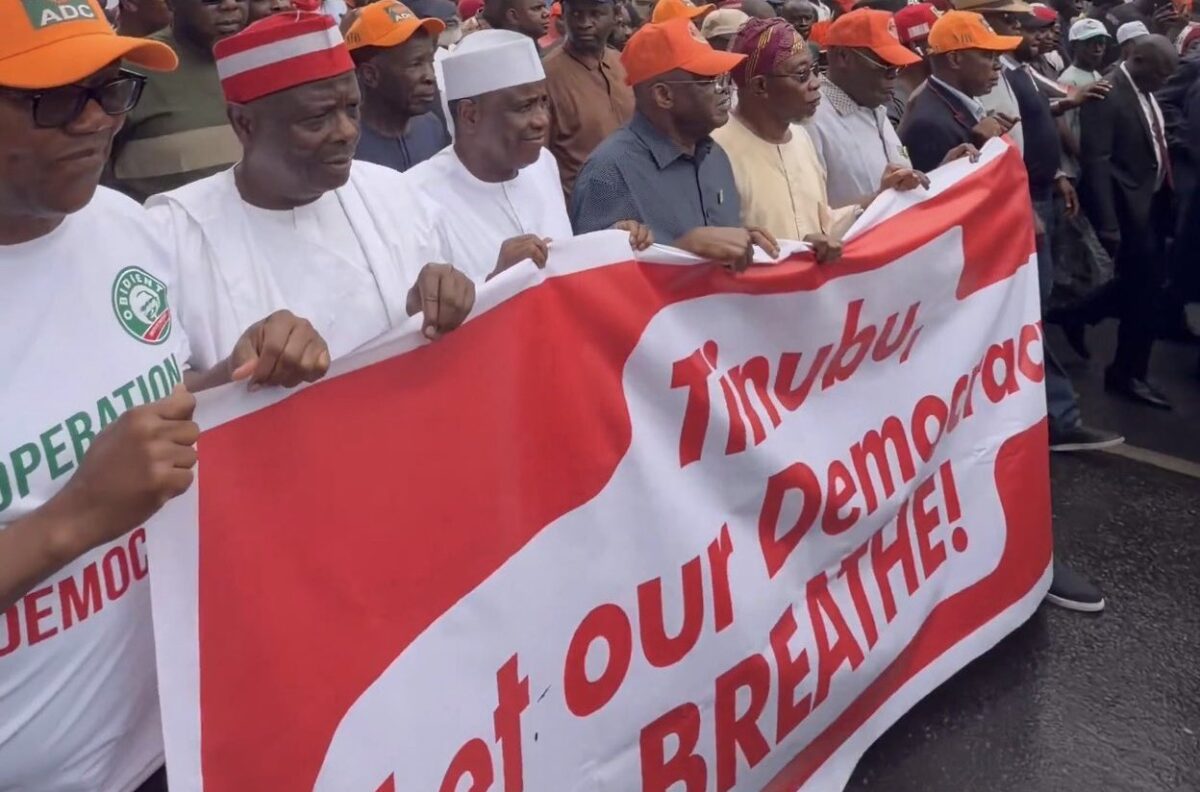
Atiku, Obi and ADC leaders leads Occupy INEC protest at INEC headquarters
Nigeria’s political atmosphere heated up on Tuesday as top opposition figures, including Atiku Abubakar, Peter Obi, David Mark, and Rotimi Amaechi, led a high-profile protest in Abuja under the banner “Occupy INEC.” The demonstration, staged at the headquarters of the Independent National Electoral Commission (INEC), was organised by leaders of the African Democratic Congress (ADC) and framed as a direct challenge to what they described as the electoral body’s growing partisanship.
The protest quickly became one of the most talked-about political developments in Nigeria, not only because of the calibre of those involved but also because of the symbolism behind the phrase “Occupy INEC.” For many observers, the action signals an early escalation in the battle over the integrity of Nigeria’s democratic institutions ahead of the 2027 general elections.
According to reports, the protest was triggered by INEC’s recent decision to withdraw recognition of both factions of the ADC leadership following a Court of Appeal ruling in an ongoing leadership dispute within the party. The commission said it would no longer accept correspondence from either the David Mark-led faction or the Nafiu Bala Gombe faction, and would also refrain from monitoring meetings, congresses, and conventions linked to both sides pending the outcome of the case before the Federal High Court.
What Is ‘Occupy INEC’? Understanding the Protest
The term “Occupy INEC” refers to a political protest movement aimed at putting public pressure on Nigeria’s electoral umpire over decisions opposition figures say threaten democratic fairness. In this case, it was specifically used by ADC leaders and allied opposition figures to protest INEC’s handling of the party’s internal leadership crisis.
In practical terms, Occupy INEC means a coordinated, peaceful demonstration at or around INEC facilities, especially the commission’s Abuja headquarters, to demand transparency, neutrality, and what protesters describe as non-partisan conduct from the electoral body. The name mirrors the style of issue-based protest branding often used to create public attention and media traction.
Former Vice-President Atiku Abubakar described the protest as a patriotic intervention. In a statement shared publicly, he said he and other leaders were “peacefully protesting against the partisanship of the electoral umpire” and insisted the move was aimed at “safeguarding our democracy and preventing the enthronement of a dictatorship.” TheCable reported the protest and Atiku’s remarks on April 8.
Similarly, Peter Obi framed the protest as part of a broader resistance to what he and allies described as attempts to undermine multi-party democracy in Nigeria. In his message, Obi called on Nigerians who believe in unity, peace, and security to join the movement in defence of democracy.
Why Are Atiku, Peter Obi and ADC Leaders Protesting INEC?
At the heart of the protest is INEC’s controversial decision to de-recognise all factions of the ADC leadership after reviewing the March 12 Court of Appeal ruling on the party’s internal dispute.
INEC said it acted to preserve the status quo ante bellum, essentially, the state of affairs before the legal dispute escalated, and to avoid taking any step that could prejudice the case before the Federal High Court. The commission stressed that it would not recognise either faction until the court delivers a substantive ruling.
However, the David Mark-led ADC faction strongly rejected that interpretation, arguing that INEC had misread the court order and effectively plunged the party into avoidable chaos. The faction accused the commission of caving to political pressure and helping to weaken the opposition at a sensitive moment in Nigeria’s political calendar. In a statement, the party alleged the decision reflected a government allegedly “panicked by the opposition momentum.”
This clash over interpretation is what transformed a party leadership crisis into a wider national political controversy, one now being framed by opposition leaders as a test of INEC’s independence.
Inside the ADC Leadership Crisis Behind the Occupy INEC Protest
To understand Occupy INEC, it is crucial to understand the internal crisis rocking the African Democratic Congress (ADC).
The dispute centers on competing claims to the party’s leadership structure, primarily between the David Mark-led bloc and the Nafiu Bala Gombe faction. According to TheCable’s background reporting, the crisis intensified after opposition figures sought to use the ADC as a possible coalition platform ahead of the 2027 elections. This created fresh internal tensions, legal battles, and rival claims over who legitimately controls the party machinery.
Following the Court of Appeal’s directive that parties should maintain the status quo pending the substantive hearing, INEC chose to stop engaging with both factions. That decision included removing or declining to recognise names associated with the competing leadership claims and refusing to monitor their internal activities until the matter is settled.
For the protesting camp, that move is not just an administrative step, it is being portrayed as a politically consequential intervention that could weaken the opposition’s organisational strength ahead of 2027.
READ ALSO
How the Occupy INEC Protest Unfolded in Abuja
The protest in Abuja drew some of the biggest names in Nigeria’s opposition politics. Those reported at the demonstration included Atiku Abubakar, Peter Obi, David Mark, Rotimi Amaechi, Rauf Aregbesola, Rabiu Kwankwaso, and Dino Melaye.
Protesters reportedly chanted “Ojoro”, a popular Nigerian slang implying manipulation or unfairness, while holding placards with messages such as “Tinubu, why are you afraid?”, “Judges must give justice”, and “Let democracy breathe.” The tone of the protest made clear that participants wanted to elevate the dispute beyond a party matter and turn it into a national conversation about democratic integrity.
Security concerns around the planned demonstrations had already prompted a heavy deployment at INEC headquarters in recent days. TheCable reported that security personnel from multiple agencies were stationed at strategic points around the commission’s Maitama headquarters, restricting movement as tensions rose over the ADC dispute.
The heavy security presence underlined just how politically sensitive the matter has become.
Why Occupy INEC Matters for Nigeria’s 2027 Elections
The Occupy INEC protest is important because it may be an early indicator of how fierce the contest over Nigeria’s democratic institutions could become before the 2027 presidential election.
Opposition leaders are increasingly trying to frame the current moment as a struggle to protect multi-party democracy from erosion. By linking INEC’s actions to fears of a one-party state, they are attempting to mobilise supporters early and cast electoral administration itself as a frontline political issue.
That strategy matters because trust in electoral institutions is central to public confidence in any election. If a significant portion of the electorate begins to believe that the umpire is biased, every future decision, from party recognition to candidate lists, conventions, or election-day processes, will likely face intense scrutiny.
For INEC, the challenge will be to defend its legal rationale while preserving the perception of neutrality. For the opposition, the goal is to keep public attention fixed on the commission and build momentum around the idea that democracy must be defended before 2027.
What Happens Next After the Occupy INEC Protest?
The next major step will likely come from the courts, not the streets.
Since INEC has tied its position to the pending Federal High Court matter, the eventual legal interpretation of the ADC leadership dispute will shape what happens next. If the court clarifies who the legitimate leadership is, the commission may restore formal recognition accordingly.
In the meantime, the protest could trigger further political mobilisation, especially if the ADC and allied opposition blocs continue to frame the dispute as evidence of broader institutional bias. Additional demonstrations, legal filings, press briefings, and coalition-building efforts are all possible in the coming days.
For now, Occupy INEC has succeeded in one major respect: it has turned a party leadership dispute into a national political flashpoint.
FAQ
1. What is Occupy INEC?
Occupy INEC is a political protest campaign led by members and allies of the African Democratic Congress (ADC) against the Independent National Electoral Commission (INEC). The protest is aimed at challenging what participants describe as INEC’s partisan handling of the ADC leadership dispute and defending democratic pluralism in Nigeria.
2. Why are Atiku Abubakar and Peter Obi protesting INEC?
Atiku Abubakar and Peter Obi joined the Occupy INEC protest because they believe INEC’s decision to stop recognising both factions of the ADC leadership is unfair and politically damaging. They argue that the electoral body’s actions risk weakening opposition politics and could contribute to a drift toward a one-party system.
3. Why did INEC de-recognise the ADC leadership?
INEC said it stopped recognising both the David Mark-led faction and the Nafiu Bala Gombe faction of the ADC after reviewing a March 12 Court of Appeal ruling. According to the commission, the court directed parties to maintain the status quo ante bellum while the substantive case continues at the Federal High Court. As a result, INEC said it would refrain from engaging with either faction until the court gives a final decision.
4. What does “status quo ante bellum” mean in the ADC crisis?
Status quo ante bellum is a legal phrase meaning the state of affairs before the dispute or conflict escalated. In the ADC case, INEC says it is trying to preserve the situation as it existed before the legal battle over party leadership intensified, pending a final court ruling.
5. Who attended the Occupy INEC protest in Abuja?
According to reports, the protest was attended by major opposition figures including Atiku Abubakar, Peter Obi, David Mark, Rotimi Amaechi, Rauf Aregbesola, Rabiu Kwankwaso, and Dino Melaye. Their presence gave the protest national political significance.
6. What is the ADC leadership crisis about?
The ADC leadership crisis is an internal dispute over who legitimately controls the party. The conflict mainly involves the David Mark-led bloc and the Nafiu Bala Gombe faction. The disagreement has led to court cases, competing claims, and INEC’s decision to suspend recognition of both sides until the judiciary settles the matter.
7. Is Occupy INEC linked to the 2027 elections?
Yes, many analysts and opposition leaders see the protest as strongly linked to the 2027 general elections. The ADC has been viewed as a potential platform for a broader opposition coalition, so any disruption to its structure or recognition carries major political implications ahead of the next election cycle.
8. What did Atiku Abubakar say about the Occupy INEC protest?
Atiku said he and other ADC leaders were peacefully protesting against the partisanship of the electoral umpire. He described the action as a patriotic effort to safeguard democracy and prevent what he called the enthronement of a dictatorship.
9. What did Peter Obi say about Occupy INEC?
Peter Obi said the protest was about ensuring Nigeria’s democracy is not killed. He called on Nigerians who believe in unity, peace, and security to join the defence of democracy and reject the emergence of a one-party system.
10. Did INEC respond to accusations of partisanship?
Yes. INEC has defended its action by saying its decision was guided strictly by the Court of Appeal ruling and the need to uphold the rule of law. The commission said it wants to avoid taking any step that could prejudice the case before the trial court.
11. Why is Occupy INEC trending in Nigeria?
The protest is trending because it combines three high-interest issues:
- the involvement of major political figures like Atiku and Peter Obi,
- accusations that INEC is acting unfairly, and
- wider fears about the future of Nigeria’s democracy and the possibility of a one-party state ahead of 2027.
12. Could the Occupy INEC protest affect Nigeria’s political landscape?
Potentially, yes. The protest could increase pressure on INEC, deepen public scrutiny of electoral decisions, and strengthen opposition mobilisation ahead of 2027. It may also push the ADC crisis further into the national spotlight and influence how future coalition politics develop.