

North Korea fires multiple ballistic missiles in 24 Hours, crushing Seoul’s hopes for diplomacy

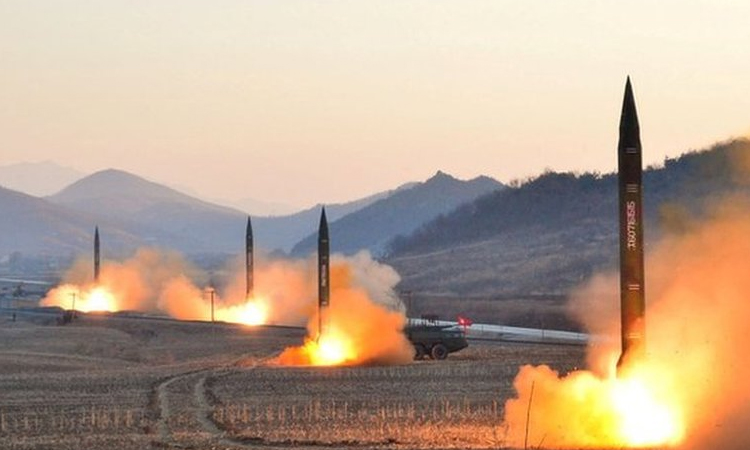
North Korea launches missiles as Seoul’s diplomacy hopes fade
North Korea escalated tensions on the Korean Peninsula on Wednesday after launching multiple ballistic missiles in quick succession, just a day after another suspected missile test, in a move that has sharply undercut South Korea’s hopes for renewed diplomacy. The back-to-back launches, confirmed by South Korean and Japanese authorities, mark one of the most significant missile escalations from Pyongyang this year and signal that any recent optimism over easing inter-Korean tensions may have been premature.
According to Reuters and regional reports, South Korea’s Joint Chiefs of Staff (JCS) said North Korea fired several short-range ballistic missiles from the Wonsan area toward waters off its east coast on Wednesday morning, before launching an additional unidentified ballistic missile later in the afternoon. The missiles reportedly traveled about 240 kilometers (150 miles), while Japan said the latest projectile fell into the sea roughly 10 minutes after launch without entering Japanese territorial waters or its exclusive economic zone.
The latest tests came just one day after South Korean military officials detected a suspected ballistic missile launch near Pyongyang on Tuesday, which appeared to fail early in flight. Together, the launches have intensified security concerns in Seoul, Tokyo, and Washington, and have once again placed North Korea missile tests at the center of global geopolitical attention.
North Korea Missile Launches: What Happened on April 8, 2026?
South Korea’s military said it detected multiple short-range ballistic missiles launched from near Wonsan on North Korea’s east coast earlier Wednesday. Hours later, officials reported a separate additional missile launch, also heading toward the East Sea (Sea of Japan). South Korea’s JCS did not immediately provide full technical details on the second projectile, but confirmed that the launches were under close analysis by both South Korean and U.S. intelligence authorities.
Japanese officials also reacted swiftly. The Japan Coast Guard confirmed the latest missile fell into the sea and that no immediate damage or intrusion into Japanese waters was reported. Prime Minister Sanae Takaichi ordered officials to intensify surveillance, gather intelligence, and ensure the safety of aircraft and maritime traffic.
The U.S. Indo-Pacific Command (USINDOPACOM) said it was aware of the launches and was consulting closely with allies and partners. Importantly, it noted that, based on initial assessments, the launches did not pose an immediate threat to U.S. territory, personnel, or allied nations, though Washington reaffirmed its defense commitments in the Indo-Pacific.
Why North Korea’s Latest Ballistic Missile Tests Matter
These launches are not just another routine show of force. They represent North Korea’s fourth, fifth, and sixth ballistic missile launches of 2026, following earlier launches in January and March, according to Reuters. That pace suggests Pyongyang is accelerating its weapons testing program despite international sanctions and repeated warnings from neighboring countries.
Under U.N. Security Council resolutions, North Korea is prohibited from conducting ballistic missile tests because of their connection to the country’s nuclear weapons and long-range strike ambitions. However, Pyongyang has consistently rejected those restrictions, arguing that they violate its sovereign right to self-defense.
The latest launches matter because they come during a sensitive diplomatic moment. In recent days, some observers in Seoul had cautiously interpreted remarks from Kim Yo Jong, the influential sister of leader Kim Jong Un, as a possible signal of reduced hostility. Those hopes have now been significantly weakened.
READ ALSO
Iran War Ceasefire: Trump, Tehran claim victory as two-week truce reopens Strait of Hormuz
Pyongyang Rejects Seoul’s Diplomacy Hopes in Blunt Warning
Any lingering optimism over inter-Korean reconciliation was further undercut by a strongly worded statement from Jang Kum Chol, a senior official in North Korea’s foreign ministry.
In comments carried by state media KCNA, Jang dismissed the idea that South Korea could be seen as anything other than an enemy. He said the Republic of Korea (ROK) remains the “enemy state most hostile to the DPRK,” making clear that Pyongyang sees no fundamental shift in its posture toward Seoul.
The timing was especially striking. Just a day earlier, North Korean messaging had seemed slightly less confrontational after South Korean President Lee Jae Myung expressed regret over unauthorized drone incursions into the North earlier this year. Some in Seoul had read that as a narrow opening for dialogue. But Jang’s statement made it clear that Pyongyang wanted to shut down what it viewed as overly hopeful diplomatic interpretations.
Analysts cited in the reports said North Korea appeared to be sending a deliberate signal: while it may tactically acknowledge certain gestures from Seoul, it has not changed its broader “hostile-state” framework.
Are These Missile Launches Linked to Solid-Fuel Weapons Development?
Security analysts believe the launches may be tied to North Korea’s ongoing effort to improve solid-fuel missile systems, which are widely considered more advanced and operationally flexible than older liquid-fuel designs.
Professor Kim Dong-yup of the University of North Korean Studies said the tests could be linked to engine and propulsion development, particularly involving solid-fuel systems. These weapons are harder to detect before launch, require less preparation time, and are easier to move and deploy, making them especially concerning for regional defense planners.
North Korea has spent years trying to modernise its missile force, and solid-fuel systems are a major priority because they improve survivability, readiness, and rapid strike capability. If Wednesday’s launches were part of that program, they would represent not just a political message, but a technical milestone in Pyongyang’s military buildup.
South Korea, Japan, and the U.S. Respond to North Korea’s Missile Tests
The missile launches triggered an emergency National Security Council meeting at South Korea’s presidential office, where officials reportedly condemned the tests as a provocation and a violation of U.N. Security Council resolutions. Seoul urged Pyongyang to halt further launches and avoid escalating tensions.
Japan also issued a strong rebuke. Chief Cabinet Secretary Minoru Kihara said North Korea’s actions threaten regional and international peace and security, while the prime minister’s office emphasised readiness to protect aircraft, ships, and public safety.
Meanwhile, the United States maintained a measured but firm tone. USINDOPACOM said it is monitoring the situation closely and consulting with allies, while reiterating that U.S. commitments to the defense of South Korea and Japan remain ironclad.
What Happens Next on the Korean Peninsula?
The biggest question now is whether North Korea’s latest missile activity is the start of a broader escalation cycle or a limited round of testing aimed at political signaling and technical validation.
Historically, Pyongyang often pairs missile launches with diplomatic messaging, using tests to strengthen its bargaining position or clarify strategic intent. In this case, the combination of multiple ballistic missile launches and an explicit rejection of South Korean outreach suggests North Korea is trying to reassert deterrence, reinforce hostility, and close off premature diplomatic expectations.
For Seoul, the challenge is growing more complex. President Lee Jae Myung’s efforts to reduce tensions may now face domestic scrutiny if Pyongyang continues to respond with missile launches instead of dialogue. For the wider region, the latest developments raise fresh questions about military readiness, missile defense coordination, and whether 2026 could see a more aggressive phase in North Korea’s weapons testing cycle.
For now, the Korean Peninsula remains on edge, and the world is once again watching North Korea missile news with renewed concern.
FAQ: North Korea Missile Launches Explained
1. What happened in North Korea on April 8, 2026?
North Korea fired multiple ballistic missiles on April 8, 2026, including several short-range ballistic missiles from the Wonsan area and an additional missile later the same day. The launches followed a suspected missile test from near Pyongyang on April 7.
2. How many missiles did North Korea launch?
According to South Korea’s military, North Korea launched multiple short-range ballistic missiles earlier in the day and then fired another unidentified ballistic missile later on Wednesday. Officials have not yet released a final total count for all projectiles.
3. Where were the North Korean missiles launched from?
South Korea said the Wednesday launches came from the Wonsan area on North Korea’s east coast. A separate projectile detected on Tuesday was believed to have been launched from near Pyongyang.
4. Did North Korea’s missile enter Japan’s waters?
No. Japan said the latest missile fell into the sea about 10 minutes after launch and did not enter Japanese territorial waters or its exclusive economic zone (EEZ).
5. Why did North Korea fire ballistic missiles?
While North Korea has not officially explained the latest launches, analysts believe they may serve two purposes:
- Military development, especially testing solid-fuel missile systems
- Political signaling, particularly after Pyongyang dismissed South Korea’s recent diplomatic outreach
6. Why are North Korea’s missile tests considered illegal?
Under U.N. Security Council resolutions, North Korea is barred from conducting ballistic missile launches because of the link between those systems and its nuclear weapons program. Pyongyang rejects the ban, saying it violates its right to self-defense.
7. What did South Korea say about the missile launches?
South Korea’s Joint Chiefs of Staff said the launches were being closely analyzed with U.S. authorities. Seoul reportedly called an emergency National Security Council meeting and described the launches as a provocation that violates U.N. resolutions.
8. What did North Korea say about diplomacy with South Korea?
A senior North Korean foreign ministry official, Jang Kum Chol, said South Korea remains the “enemy state most hostile to the DPRK,” signaling that Pyongyang does not currently see Seoul as a genuine diplomatic partner despite recent outreach.
9. What is a solid-fuel missile and why does it matter?
A solid-fuel missile uses fuel that is stored inside the missile, allowing it to be launched much faster than a liquid-fuel missile, which usually needs fueling before launch. This makes solid-fuel missiles harder to detect, easier to move, and more dangerous in a crisis.
10. Is North Korea preparing for a bigger escalation?
It is too early to say for certain, but the combination of back-to-back missile launches and a blunt rejection of South Korea’s diplomacy suggests North Korea may be entering a new phase of military signaling in 2026.
11. How did the U.S. respond to North Korea’s missile launches?
The U.S. Indo-Pacific Command (USINDOPACOM) said it is monitoring the launches and consulting closely with allies. It added that the tests do not appear to pose an immediate threat to the U.S. homeland or allied territories, but reaffirmed America’s defense commitments in the region.
12. Why is this story important globally?
The story matters because North Korea’s ballistic missile program affects:
- Regional security in East Asia
- U.S.-South Korea-Japan military coordination
- Global nuclear nonproliferation concerns
- The broader balance of power in the Asia-Pacific