

Why is Lincoln Riley blaming Notre Dame? What does it mean for USC’s future and the College Football Playoff?

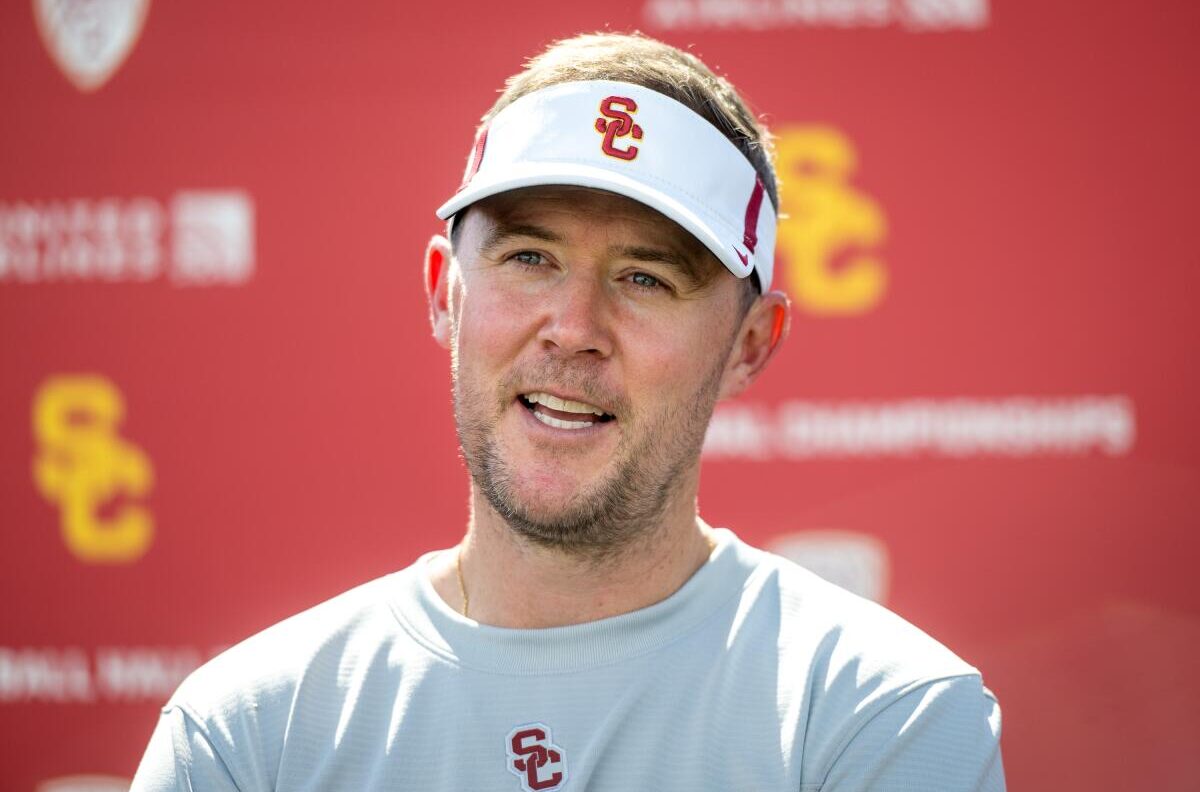
USC football coach Lincoln Riley talks with the media after practice on the first day of fall training camp Aug. 5. Image Credit: Michael Owen Baker/For The Times
One of college football’s most iconic rivalries is officially on pause, and USC head coach Lincoln Riley is not mincing words about who he believes is responsible. Speaking ahead of the Trojans’ appearance in the Valero Alamo Bowl, Riley publicly blamed Notre Dame for the breakdown of negotiations that will halt the storied series in 2026 and 2027.
The rivalry, which dates back to 1926 and has been played 96 times, has been a near-annual tradition since 1946. Its sudden interruption has sent shockwaves through college football, raising broader questions about conference realignment, scheduling power, and College Football Playoff priorities.
“Anytime, Anywhere”: Riley Says Notre Dame Didn’t Follow Through
Riley said USC acted in good faith after Notre Dame publicly pledged to play the Trojans “anytime, anywhere.” According to Riley, USC athletic director Jen Cohen submitted a formal proposal earlier this month to continue the rivalry in 2026 and 2027, only for it to be swiftly rejected.
What frustrated Riley most was the speed of Notre Dame’s response.
“Five minutes after we got the call, it was announced that they had scheduled another opponent,” Riley said, referencing Notre Dame’s newly announced home-and-home series with BYU. “That might be the fastest scheduling act in college football history.”
Notre Dame added BYU to fill its final nonconference openings for 2026 and 2027, effectively shutting the door on USC for those seasons.
READ ALSO
Could Alex Golesh transform Arkansas football? The bold move rocking College sports
Scheduling Tensions Between Big Ten and Independent Programs
At the heart of the dispute lies a philosophical clash over scheduling strategy. Since joining the Big Ten, USC has pushed to play its nonconference games earlier in the season, aligning with most league members and reducing late-season fatigue before potential CFP consideration.
Traditionally, the USC–Notre Dame game was played mid-to-late October in South Bend or at the end of the regular season in Los Angeles. Riley acknowledged Notre Dame’s independence provides more flexibility but emphasized that USC must now prioritize a CFP-friendly path.
USC has never appeared in the College Football Playoff. In a letter to the USC community last month, Cohen noted that USC is the only Big Ten program to play a nonconference opponent after Week 4 in each of the past two seasons.
“Intentionally making our road to the CFP significantly more difficult than our Big Ten peers does not align with our goal to win championships,” Cohen wrote.
Rivalry on Hold Until at Least 2030
In a joint statement, USC and Notre Dame said both schools will “continue working toward bringing back” the rivalry. However, any resumption is unlikely before 2030, marking the longest interruption in the series since World War II.
Riley, who has lost three straight games to Notre Dame after winning his first matchup in 2022, emphasized that USC remains committed to the rivalry’s future.
“We at USC would love for the game to continue,” Riley said. “We have no problem following through on our promises.”
Riley’s Comments Come After Alamo Bowl Loss
Riley’s remarks followed a dramatic 30–27 overtime loss to TCU in the Alamo Bowl, a game that capped USC’s season at 9–4. After the loss, Riley acknowledged execution issues, particularly in the red zone, while continuing to look ahead to long-term program goals.
The rivalry dispute now adds another layer of pressure as Riley works to elevate USC into consistent national title contention under the expanded College Football Playoff format.
FAQ
Why did the USC–Notre Dame rivalry end?
The rivalry was paused after Notre Dame rejected USC’s proposal to continue the series in 2026 and 2027, opting instead to schedule BYU.
What did Lincoln Riley say about Notre Dame?
Riley said Notre Dame failed to honor its commitment to play USC “anytime, anywhere” and placed full responsibility for the pause on the Irish.
Is the USC–Notre Dame rivalry permanently canceled?
No. Both schools say they hope to resume the series, but it likely will not return until 2030 at the earliest.
How does the College Football Playoff factor into this decision?
USC believes playing late-season nonconference games puts the program at a disadvantage compared to other Big Ten teams when CFP selections are made.
Has USC ever made the College Football Playoff?
No. USC has never appeared in the CFP since its inception.
Why could Notre Dame schedule BYU instead of USC?
As an FBS independent, Notre Dame has greater flexibility in scheduling compared to conference-affiliated programs like USC.
Did USC want to continue the rivalry?
Yes. Riley and athletic director Jen Cohen both stated USC made a formal proposal and remains open to continuing the series.