

Kennedy Center to shut down for two years as Trump orders sweeping reconstruction amid cultural backlash

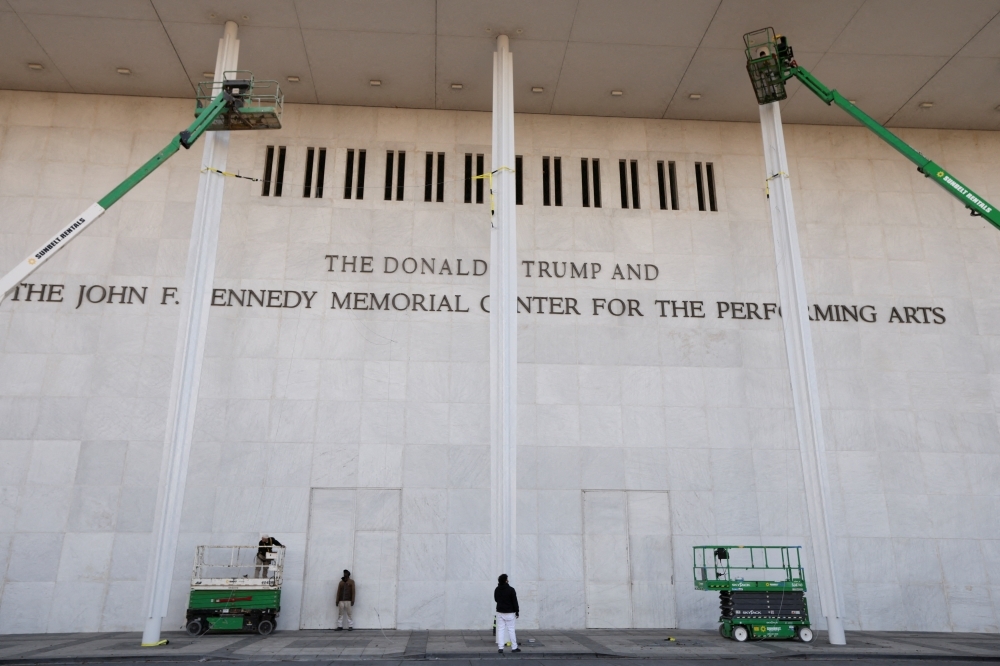
The newly added lettering for US President Donald Trump’s name is displayed at the facade of the John F. Kennedy Centre for the Performing Arts, a day after its board announced it would rename the institution The Donald J. Trump and The John F. Kennedy Memorial Centre for the Performing Arts, in Washington, D.C. December 19, 2025. — Reuters pic
The John F. Kennedy Center for the Performing Arts, one of America’s most iconic cultural landmarks, will shut its doors for two years beginning July 4, 2026, following an announcement by U.S. President Donald Trump. The decision marks one of the most dramatic interventions in the institution’s history and comes amid widespread controversy over governance changes, artist boycotts, and the addition of Trump’s name to the building.
Trump said the closure would allow for a “complete rebuilding and revitalization”, describing the Kennedy Center as “tired, broken, and dilapidated.” The shutdown coincides with the 250th anniversary of the United States, which Trump cited as symbolic justification for the timing.
Why the Kennedy Center Is Closing
According to Trump’s statement on Truth Social, the closure is necessary to ensure higher construction quality and faster completion. He argued that continuing performances during renovations would slow progress and reduce standards.
While previous discussions had referenced upgrades, a full two-year shutdown had not been publicly disclosed until the announcement. The Kennedy Center previously underwent a $250 million expansion in 2019, but Trump has repeatedly criticized that project, claiming it added underused spaces.
Trump secured more than $257 million in congressional funding for capital repairs, though the total cost of the new reconstruction remains undisclosed.
Renaming the Kennedy Center Sparks Artist Backlash
The shutdown follows months of turmoil after the institution was renamed the “Donald J. Trump and the John F. Kennedy Memorial Center for the Performing Arts.” New signage bearing Trump’s name appeared on the building’s facade shortly after a Trump-aligned board took control and voted to make him chairman.
The response from the arts community was swift. Major performers and composers, including Philip Glass, Renée Fleming, and Stephen Schwartz, canceled appearances. The Washington National Opera cut formal ties with the venue, and attendance at the National Symphony Orchestra reportedly fell by 50 percent compared to last year.
READ ALSO
Kennedy Center Honors: History, significance and the 2025 controversy
Political and Legal Challenges Intensify
The renaming and closure have triggered legal and constitutional questions. Democratic Representative Joyce Beatty filed a lawsuit arguing that because the Kennedy Center was named by federal law in 1964, Congress must approve any name change.
Other lawmakers, including Rep. Chellie Pingree, questioned whether Trump has the authority to shut down the venue without congressional oversight, especially given existing contracts affecting staff, artists, and donors.
Members of the Kennedy family have also condemned the move, emphasizing that the center serves as a living memorial to President John F. Kennedy, established after his assassination.
What Happens to Performances and Staff
The Kennedy Center typically hosts more than 2,000 performances annually, making the closure a major disruption to Washington, D.C.’s cultural life. Staff reportedly learned of the decision through Trump’s announcement, prompting uncertainty around layoffs and operational changes.
Richard Grenell, the center’s president, acknowledged the disruption but said the closure would allow leadership to “think bigger” and invest resources more strategically. No definitive relocation plans have been announced for the National Symphony Orchestra, which performs up to 150 concerts annually at the venue.
A Cultural Institution at a Crossroads
Trump has framed the reconstruction as part of a broader effort to reshape Washington’s landmarks during his second term. Yet critics argue the shutdown reflects deeper cultural and political divisions, with some lawmakers accusing the administration of damaging the institution financially and reputationally.
As the Kennedy Center prepares to go dark, its future identity, both artistic and symbolic, remains uncertain.
FAQ
Why is the Kennedy Center closing for two years?
The Kennedy Center is closing to allow for a large-scale reconstruction ordered by President Donald Trump, who said a full shutdown is necessary for higher-quality and faster renovations.
When will the Kennedy Center close and reopen?
The center will close on July 4, 2026, and is scheduled to reopen in 2028, pending completion of construction.
Is the Kennedy Center permanently closed?
No. The closure is temporary and intended to last two years.
Why was Trump’s name added to the Kennedy Center?
After replacing several board members with allies, the new board voted to rename the institution to include Trump’s name. The move has sparked legal and political challenges.
Do performers support the changes?
Many prominent artists have canceled performances in protest, citing concerns over politicization and governance.
Does Congress need to approve the renaming?
Some lawmakers and legal scholars argue yes, since the center was named by federal law in 1964. Lawsuits are currently challenging the change.
What happens to Kennedy Center employees during the closure?
Staffing decisions have not been fully disclosed. Management has said more information will be provided as plans develop.
Where will major performances take place during the shutdown?
Some organizations, such as the Washington National Opera, are securing alternative venues, but many plans remain undecided.