

Did Kansas break Capitol rules for MLK? Gov. Laura Kelly steps in as ‘Lift Every Voice’ rings out

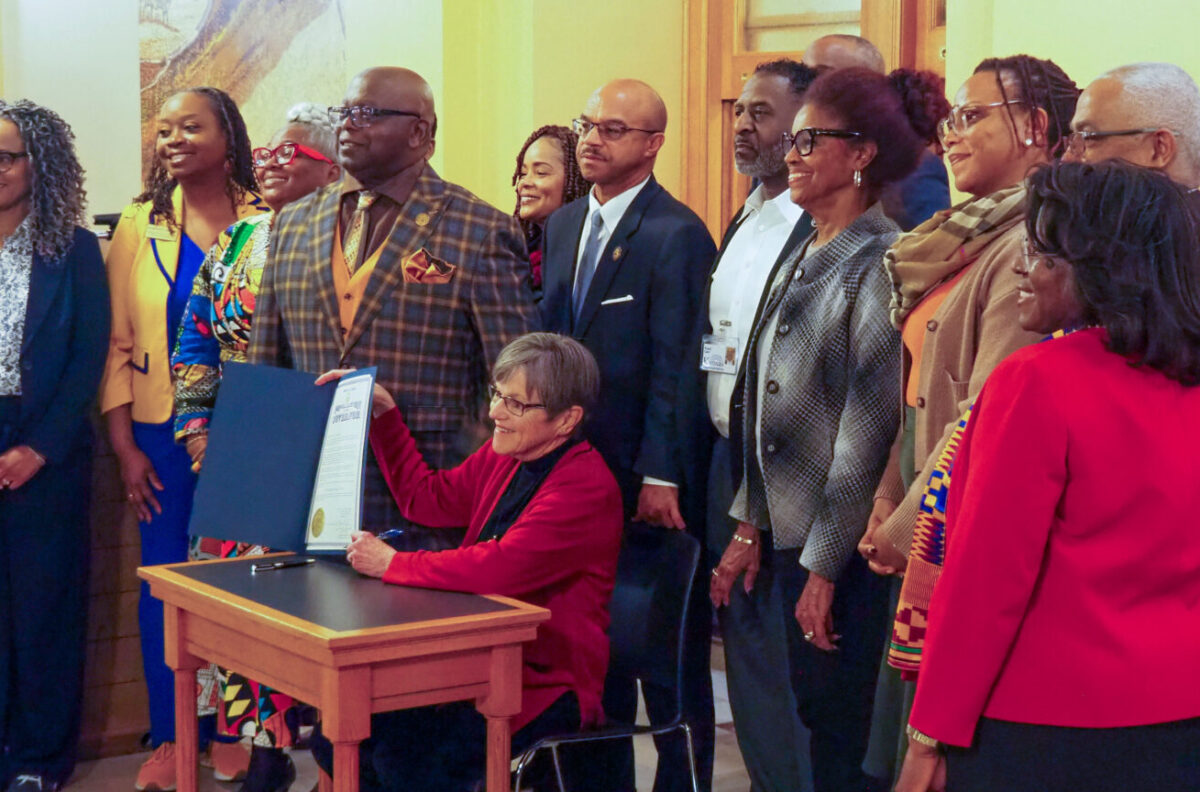
Gov. Laura Kelly signs a proclamation honoring the Rev. Martin Luther King Jr. during a Statehouse celebration for the late civil rights leader. In her remarks, she calls for a reawakening in the United States of the selfless ideals championed by King. (Photo by Tim Carpenter/Kansas Reflector)
A routine rule governing sound in the Kansas Statehouse rotunda unexpectedly became the focal point of a powerful civil rights moment when Gov. Laura Kelly intervened to allow the singing of “Lift Every Voice and Sing” during a Martin Luther King Jr. Day gathering.
The incident unfolded during an MLK celebration inside the Capitol, where organizers informed attendees that a long-standing policy restricted singing in the rotunda to the noon lunch hour. Because the program began after 1 p.m., participants were initially told the historic anthem could only be spoken, not sung.
‘We Are Not Allowed to Sing It’, Until the Governor Spoke
Members of the audience were cautioned against breaking the rule, with organizers warning that Capitol marshals could intervene if singing occurred. The announcement was met with visible disappointment from those gathered to honor King’s legacy.
Moments later, Gov. Kelly approached the lectern, took the microphone, and announced she would use her executive authority to override the restriction. Before she could finish her sentence, applause filled the rotunda, and the crowd began singing.
The spontaneous moment transformed what could have been a procedural footnote into a defining statement about symbolism, free expression, and civil rights in Kansas.
Kelly Warns of ‘Dark Times’ and Eroding Unity
During her remarks, Kelly reflected on King’s enduring vision of equality, reminding attendees of his call for a nation that judges people by character rather than skin color. She emphasized that King’s work remains a guiding force for justice and public service, especially amid rising political division.
The governor warned that current national discourse risks undermining King’s legacy, saying it is increasingly difficult to ignore the toxic and divisive tone dominating American politics.
“This is a moment when unity must be chosen,” Kelly said, urging Kansans to reject prejudice and embrace nonviolent collective action.
READ ALSO
How Martin Luther’s bold act on reformation day sparked a movement that reshaped christianity
Political Undercurrents and National Context
Kelly’s comments also carried clear political weight. Without naming specific policies, she criticized efforts by President Donald Trump that she said weakened national recognition of King’s legacy and civil rights progress.
Her remarks resonated with several Democratic lawmakers and civil rights advocates in attendance, who framed the moment as a reminder that symbolic actions still matter in public spaces, especially those tied to government authority.
Voices From Kansas’ Civil Rights History
Among those present was Carolyn Wims-Campbell, a friend and classmate of Linda Brown, whose name is forever linked to the landmark Brown v. Board of Education case originating in Topeka. She described the MLK gathering as deeply personal, noting that segregation once limited where Black families could gather even in Kansas.
State lawmakers echoed similar sentiments. Rep. Susan Ruiz highlighted shared struggles across racial and immigrant communities, while Sen. Pat Pettey warned that scaling back recognition of King’s legacy harms not only Black Americans but the nation as a whole.
A Moment That Resonated Beyond the Rotunda
Kelly closed the ceremony by signing a formal proclamation honoring King’s life and legacy. The decision to override the Capitol rule ensured the celebration would be remembered not just as a commemorative event, but as a statement of values.
In a political climate where cultural symbols often spark controversy, the Kansas Capitol moment underscored how leadership decisions, even brief ones, can redefine the meaning of public space.
FAQ
What happened at the Kansas MLK event in 2026?
Gov. Laura Kelly overrode a Capitol rule that restricted singing, allowing attendees to sing “Lift Every Voice and Sing” during an MLK celebration.
Why was singing initially not allowed in the Kansas Capitol rotunda?
Capitol policy limits singing in the rotunda to the noon lunch hour. The MLK event began after that time.
Did Kansas ban “Lift Every Voice and Sing”?
No. The restriction was procedural, not a ban. The governor used executive authority to bypass it.
Why is “Lift Every Voice and Sing” significant?
The song is widely recognized as a historic civil rights anthem symbolizing resilience, freedom, and unity.
What did Gov. Laura Kelly say during the event?
Kelly warned about rising political divisiveness, called for unity, and emphasized that Martin Luther King Jr.’s legacy must be actively preserved.
Was President Donald Trump mentioned?
Yes. Kelly criticized actions she said undermined national recognition of King’s legacy.
Why is this moment important for Kansas politics?
The incident highlighted tensions between bureaucratic rules and symbolic civil rights expression within government spaces.