

What caused Japan earthquake? Here’s what to know

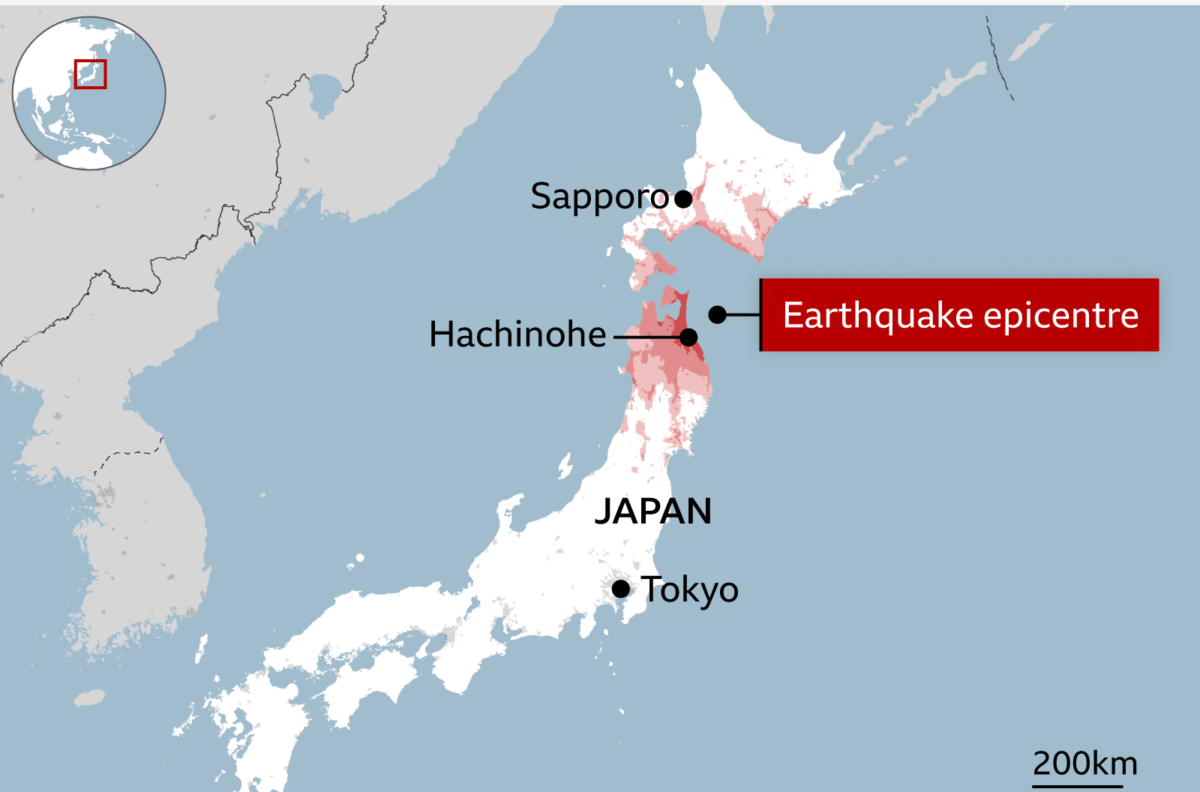
japan earthquake Photo credit: BBC
A powerful undersea earthquake jolted northern Japan on Monday, prompting emergency alerts and triggering a brief tsunami scare along several coastal towns. The tremor, initially measured at magnitude 7.2 before being upgraded to 7.6, struck off the coast of Hokkaido near Aomori Prefecture, according to the Japan Meteorological Agency (JMA). The quake originated roughly 30 miles beneath the ocean surface, strong enough to be felt across large parts of northern Honshu.
Following the quake, Japanese authorities immediately issued a tsunami warning for waves potentially reaching up to 10 feet. Sirens blared in coastal communities as residents were advised to move to higher ground. Within hours, however, JMA downgraded the alert to a tsunami advisory, indicating a lower-level threat. Still, precautionary evacuations and coastal patrols continued throughout the afternoon.
【八戸市 地震の瞬間】
激しく音をたて揺れるABA青森朝日放送・八戸支社の様子▼【最新情報】速報中https://t.co/wee4B6NLRV pic.twitter.com/TulEO3ZmJy
— テレ朝NEWS (@tv_asahi_news) December 8, 2025
Early observations recorded small tsunami waves in several locations. Offshore instruments near Iwate Prefecture detected an initial rise around six miles from the coast. NHK also reported a wave measuring roughly one foot off Erimo Town in Hokkaido. Another reading showed waves of about 1.5 feet near Urakawa, underscoring the continued need for caution even after the advisory downgrade.
Emergency teams were especially attentive to Japan’s nuclear facilities, given the country’s disaster history. Public broadcaster NHK confirmed that nuclear plants in the region activated their safety protocols immediately after the quake. Government officials also established a response center at the office of Prime Minister Sanae Takaichi to coordinate real-time updates and oversight.
The International Atomic Energy Agency (IAEA) later announced that no irregularities were found at the Fukushima Daiichi nuclear plant or other nuclear sites. Even so, the memory of the 2011 disaster loomed large. On March 11, 2011, a magnitude-9.0 earthquake—the strongest ever recorded in Japan—triggered a massive tsunami that overwhelmed Fukushima Daiichi, knocking out its power systems and causing three reactor meltdowns. The catastrophe released radioactive materials into the air and displaced thousands of residents who have yet to return home.
Although Japan has invested heavily in reinforced sea walls, early warning systems, and nuclear safety protocols since the Fukushima disaster, long-term cleanup challenges continue. In August 2023, Japan began releasing treated radioactive wastewater from the Fukushima facility, a move that attracted global criticism despite approval from IAEA experts. Meanwhile, hundreds of tons of highly radioactive debris from the melted reactors remain stored on-site. The government and plant operator, TEPCO, are targeting a 30-to-40-year timeline for completing the cleanup by 2051. However, many experts argue that dismantling the reactors and fully removing the fuel debris could take nearly a century.
For now, U.S. and Canadian coastal regions appear unaffected by Monday’s quake. The U.S. National Tsunami Warning Center confirmed that no alerts were issued for Alaska, British Columbia, Washington, Oregon, or California, stating there is no immediate threat to North America.
As Japan continues monitoring the aftershocks and coastal activity, officials are urging residents to remain vigilant while emergency teams carry out safety inspections across the northern region.
FAQ
1. Was there a tsunami after the earthquake?
Small tsunami waves were recorded, but no major destructive tsunami occurred. The initial warning was later downgraded.
2. Did the earthquake affect nuclear plants?
Nuclear facilities conducted automatic safety checks, and early assessments showed no abnormalities.
3. Is North America at risk?
No. U.S. and Canadian authorities confirmed there is no tsunami threat to their coastlines.
4. How strong was the earthquake?
The earthquake was a magnitude 7.6, upgraded from an earlier 7.2 reading.
5. Why are Japanese authorities extra cautious?
Japan’s devastating 2011 earthquake and Fukushima nuclear crisis have made preparedness a top national priority.