

2027 Election shockwave: Youths storm Goodluck Jonathan Abuja home, urge former President to return

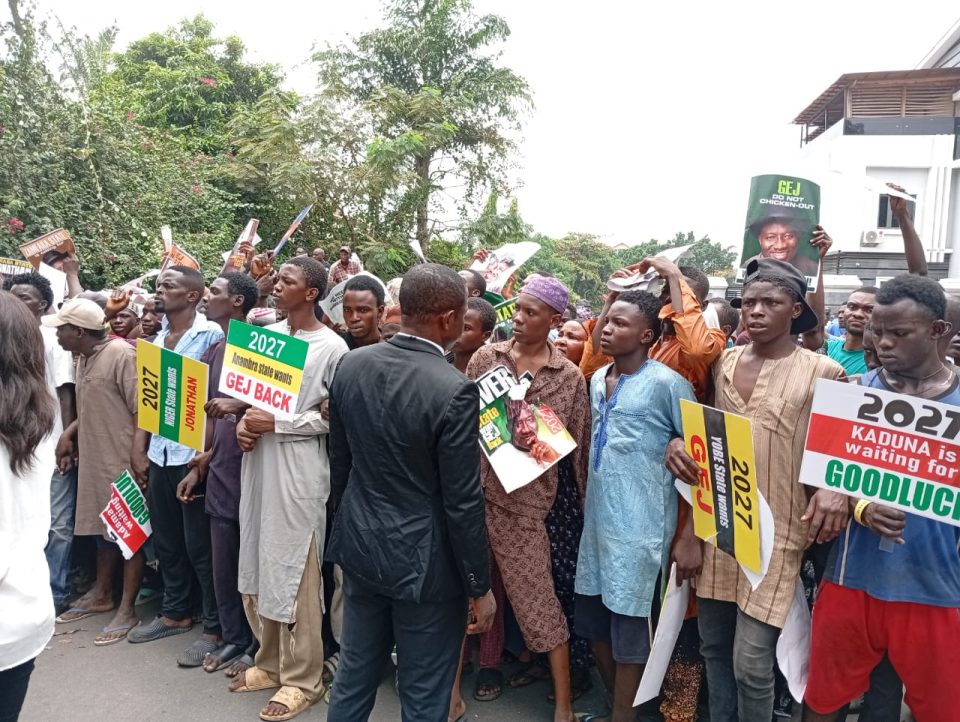
Youths rally ex-President Goodluck Jonathan for 2027 comeback
Former President Goodluck Ebele Jonathan is once again at the centre of Nigeria’s political conversation after hundreds of youths and political supporters staged a rally in Abuja, urging him to contest the 2027 presidential election. The demonstration, which took place at his residence and office in the Federal Capital Territory, signals a fresh wave of agitation for Jonathan’s return to frontline partisan politics as the countdown to 2027 begins to gather momentum.
The renewed calls, led by the Coalition for Goodluck Ebele Jonathan, come amid growing national debate over leadership, economic hardship, insecurity, and political realignments ahead of the next general election. While Jonathan has not publicly declared interest in the race, the increasing public pressure from supporters across the country is reigniting discussions about his political future, constitutional eligibility, and the possible implications of a comeback bid.
With chants, placards, and organised mobilization, the rally has now become one of the most talked-about political developments surrounding the 2027 presidential race, placing Jonathan’s name firmly back in national discourse.
Youths Storm Jonathan’s Abuja Residence Over 2027 Presidential Bid
Hundreds of youths under the umbrella of the Coalition for Goodluck Jonathan converged on the Abuja residence of the former president on Wednesday, openly demanding that he return to the political arena and contest the 2027 presidential election.
The rally, held in the Maitama District of Abuja, drew attention after demonstrators reportedly blocked traffic, danced, sang, and displayed bold placards carrying emotional messages. Some of the placards urged Jonathan to “save Nigeria,” reflecting the frustration among sections of the population over the country’s present political and economic realities.
According to reports, the coalition’s National President, Tom Ohikere, said the movement was not spontaneous but the result of a six-month nationwide consultation. He argued that the calls for Jonathan’s return had been consistent across multiple states and regions, suggesting that the agitation reflects broader public sentiment rather than a one-off political stunt.
The rally also reportedly lasted for several hours, although the former president was said not to be present when the demonstrators arrived. By the time Jonathan returned, the crowd had dispersed, leaving the message behind but receiving no formal response.
Why Supporters Want Goodluck Jonathan Back in 2027
The organisers of the rally framed their appeal around Jonathan’s past record, national image, and perceived leadership style. They described him as a bridge-builder, a unifying figure, and a leader capable of addressing Nigeria’s worsening socio-economic and security challenges.
Tom Ohikere said the coalition believes Jonathan possesses the leadership pedigree needed to stabilise the country. Supporters repeatedly referenced the former president’s years in office from 2010 to 2015, insisting that his tenure still resonates with many Nigerians who compare past economic indicators with current realities.
The coalition’s arguement rests heavily on public memory. Supporters pointed to the exchange rate, the cost of food, and the general cost of living during Jonathan’s administration, contrasting it with present conditions. For many of them, the call is less about nostalgia and more about what they see as a search for a familiar and tested hand in a period of uncertainty.
Another key factor is Jonathan’s post-presidency reputation. Since leaving office, he has largely maintained a statesman profile, participating in diplomacy, election observation, and conflict resolution efforts across Africa. That image has helped preserve his political relevance and may be contributing to the renewed push for his return.
Goodluck Jonathan Yet to Respond as 2027 Speculation Intensifies
Despite the dramatic public appeal, Goodluck Jonathan has not officially responded to the coalition’s call. This silence is notable, especially because similar pressure groups also attempted to draft him into the 2023 presidential race.
In 2022, Jonathan became the subject of intense speculation after political actors and northern groups purchased presidential nomination forms on his behalf. That move generated nationwide debate, particularly because Jonathan was associated with the Peoples Democratic Party (PDP) while the forms were reportedly linked to the ruling All Progressives Congress (APC).
Ultimately, Jonathan declined to enter the race and distanced himself from the campaign after weeks of speculation. His decision at the time reinforced his reputation as a cautious political actor who prefers strategic silence over impulsive declarations.
That history now hangs over the current 2027 agitation. While supporters are optimistic, Jonathan’s reluctance to respond immediately suggests that any decision, if one comes, may take time and could depend on the evolving political climate, party negotiations, and legal calculations.
READ ALSO
Can Goodluck Jonathan Contest the 2027 Presidential Election?
One of the biggest questions dominating online searches is whether Goodluck Jonathan is constitutionally eligible to run for president again in 2027.
The issue stems from the fact that Jonathan first assumed office in 2010 following the death of President Umaru Musa Yar’Adua, completing the remainder of that tenure before winning the 2011 presidential election and serving until 2015.
This has led to long-running legal and constitutional debates over whether his partial first term plus full elected term disqualify him under the constitutional two-term limit. During the 2022 political season, this issue resurfaced sharply, with lawyers and political analysts offering conflicting interpretations.
Although there is no definitive fresh legal pronouncement in the context of 2027 at this stage, the question remains central to any serious comeback conversation. If Jonathan signals interest, constitutional eligibility will almost certainly become one of the most litigated and publicly debated aspects of the race.
For now, the matter remains politically sensitive and legally unsettled in the public domain, making it one of the key uncertainties surrounding the growing calls for his return.
What the Goodluck Jonathan 2027 Movement Means for Nigerian Politics
The renewed mobilisation around Jonathan could have significant implications for Nigeria’s political landscape. Even without a formal declaration, his name alone is powerful enough to influence coalition-building, party strategy, and voter sentiment.
If the pressure campaign continues, Jonathan could emerge as a symbolic rallying point for disaffected voters, youth groups, and political blocs seeking an alternative to the current power structure. His cross-regional appeal, relatively moderate public image, and history of conceding defeat in 2015 still give him a unique standing in Nigerian politics.
At the same time, a Jonathan comeback bid would trigger intense reactions within both the ruling party and the opposition. Questions would immediately arise about which platform he would run on, whether a broad coalition could form around him, and how other 2027 aspirants would reposition in response.
For now, what began as a street rally in Abuja has evolved into a wider political signal: Goodluck Jonathan remains a name capable of stirring national debate, mobilising supporters, and reshaping conversations ahead of the 2027 election.
Goodluck Jonathan Silence Keeps Nigeria Guessing
As Nigeria inches closer to the 2027 election cycle, the renewed calls for Goodluck Ebele Jonathan to return to the presidential ballot underscore the country’s restless political mood. The Abuja rally may be only the latest chapter, but it reflects a deeper hunger among some groups for leadership they believe can stabilise the nation.
Whether Jonathan answers the call or remains in his statesman role, one thing is already clear: his political relevance has not faded. For now, his silence continues to fuel speculation, keeping supporters hopeful and the wider political class on alert.
FAQ: Goodluck Jonathan and the 2027 Presidential Race
1. Why are youths rallying for Goodluck Jonathan in 2027?
Youths and political supporters under the Coalition for Goodluck Jonathan say they believe the former president can help address Nigeria’s current economic hardship, insecurity, and political divisions. They argue that his previous leadership style, calm disposition, and national image make him a strong alternative ahead of the 2027 election.
2. Has Goodluck Jonathan declared for the 2027 presidential election?
No. As of now, Goodluck Jonathan has not officially declared his intention to contest the 2027 presidential election. Support groups have publicly urged him to run, but he has not issued a formal response.
3. Where did the Goodluck Jonathan 2027 rally happen?
The rally took place in Abuja, specifically around the former president’s residence and office in the Maitama area of the Federal Capital Territory, where supporters gathered to call on him to join the race.
4. Who organised the rally for Goodluck Jonathan?
The rally was organised by the Coalition for Goodluck Ebele Jonathan, a group that claims to have representatives from across Nigeria’s 36 states and the FCT. The coalition says it spent six months consulting before launching the public campaign.
5. Can Goodluck Jonathan contest the 2027 presidential election legally?
This is one of the biggest unresolved questions. Jonathan completed part of a term in 2010 after President Yar’Adua’s death and then won a full term in 2011. Because of this, legal and constitutional debates continue over whether he can run again under Nigeria’s two-term constitutional framework. If he declares, the issue will likely face intense legal scrutiny.
6. What party could Goodluck Jonathan use if he runs in 2027?
There is no confirmed party platform yet. In the past, Jonathan was associated with the PDP, but his name also surfaced in APC-related 2022 speculation. If he chooses to run in 2027, the party he adopts will be a major national story.
7. Why do many Nigerians still support Goodluck Jonathan?
Supporters often point to his peaceful concession in 2015, his moderate tone, and memories of relative economic stability during his presidency. Many also see him as a less divisive political figure compared to some contemporary actors.
8. What happened when supporters visited Jonathan’s Abuja home?
Reports say the crowd waited for hours, chanting slogans and displaying placards. However, Jonathan was reportedly not around at the time. He was said to have returned later, after the demonstrators had already dispersed.
9. Did a similar movement happen before now?
Yes. Ahead of the 2023 election, several groups also pushed Jonathan to contest. At one point, nomination forms were reportedly purchased on his behalf, but he eventually declined to join the race.
10. Could Goodluck Jonathan return reshape the 2027 election?
Absolutely. Even without declaring, Jonathan’s name already influences political calculations. If he joins the race, it could disrupt party alignments, shift voter expectations, and create a major realignment in Nigeria’s opposition and ruling party dynamics.
11. What is the main reason supporters want Goodluck Jonathan back?
Supporters say they want a leader they believe can restore stability, reduce hardship, improve national unity, and manage Nigeria’s political tensions more effectively than current alternatives.
12. Is Goodluck Jonathan still active in politics?
Jonathan has largely stayed away from direct partisan politics since leaving office in 2015. However, he remains active in public life through diplomacy, election observation missions, peacebuilding, and statesmanship roles across Africa.