

Inside Davos 2026: Trump takes center stage as trade wars, AI fears and Global power shifts dominate

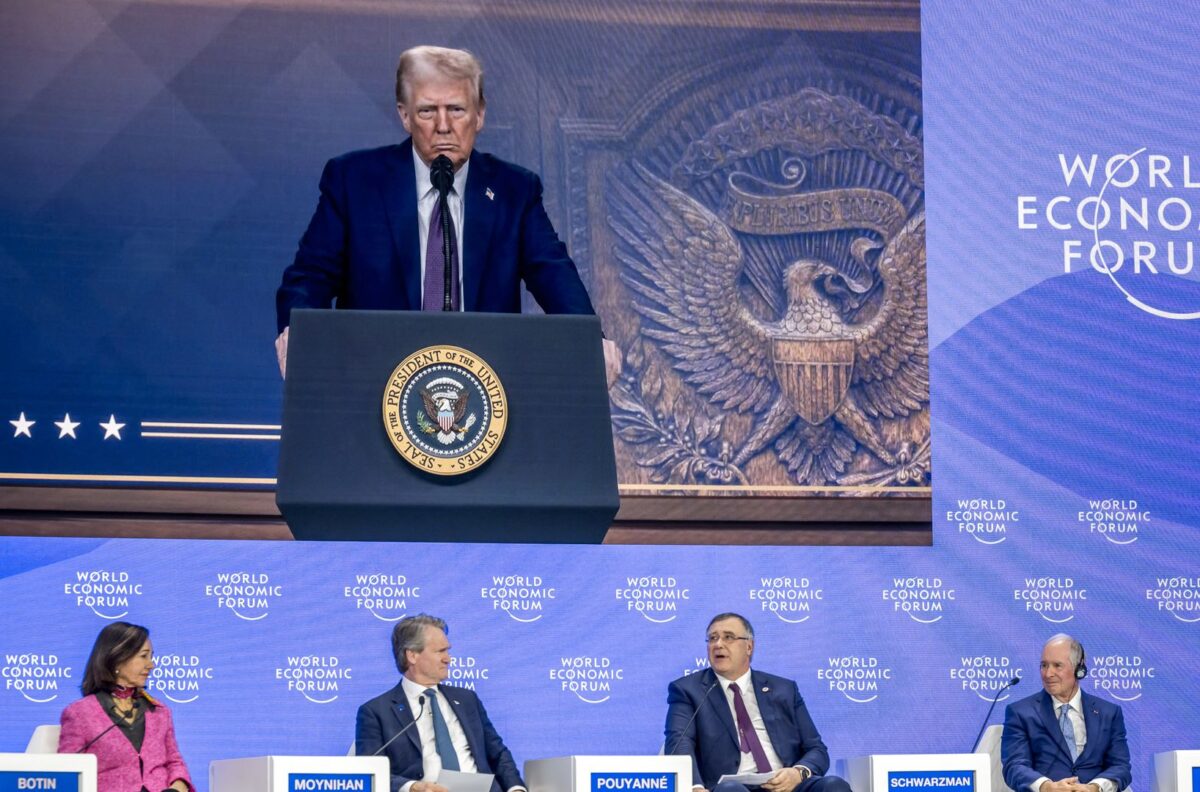
Donald Trump addresses the World Economic Forum annual meeting in Davos on Jan. 23, 2025. Image Credit: Fabrice Coffrini/AFP via Getty Images
Nearly 3,000 political leaders, corporate executives, central bankers and policy influencers have converged on the Swiss Alpine town of Davos for the 2026 World Economic Forum (WEF), as rising geopolitical tensions, aggressive trade threats and the rapid advance of artificial intelligence dominate the global agenda.
Held annually in the ski resort town since 1971, the Davos meeting has evolved from a modest gathering of European executives into the world’s most influential economic and political forum, shaping debates on global growth, inequality, security and technology.
This year’s gathering unfolds against one of the most volatile international backdrops in decades.
Why Davos 2026 Matters More Than Ever
Organisers say the 2026 forum includes a record number of high-level participants, with nearly 400 top political leaders, including more than 60 heads of state and government, alongside 850 CEOs from the world’s largest corporations.
Over 200 sessions are scheduled, covering everything from trade and economic growth to climate change, war, innovation and social stability.
The official theme, “A Spirit of Dialogue,” focuses on five pillars: cooperation, growth, investment in people, innovation and shared prosperity, though critics argue the summit remains heavy on talk and light on action.
Donald Trump Takes Center Stage at Davos
US President Donald Trump is set to deliver one of the most anticipated speeches of the week, as his policies continue to reshape global trade and alliances.
Trump’s threats to impose new tariffs on allies, including Europe and the UK, alongside controversial positions on Greenland, Iran and Venezuela, have injected uncertainty into global markets and diplomatic relations.
Bloomberg reports that Trump’s return to prominence has sparked what some attendees privately describe as a “survival of the richest” mindset, with billionaires and executives scrambling to adapt to an era of unpredictable economic nationalism.
Senior US officials attending include Secretary of State Marco Rubio, Treasury Secretary Scott Bessent, and special envoy Steve Witkoff.
READ ALSO
“Trade war helps no one”: Keir Starmer rejects Trump Tariffs as Greenland tensions escalate
Who’s Attending Davos 2026: A Who’s Who of Global Power
Among confirmed leaders are:
- Emmanuel Macron, President of France
- Ursula von der Leyen, President of the European Commission
- Volodymyr Zelenskyy, President of Ukraine
- Mark Carney, Prime Minister of Canada
- Felix Tshisekedi, President of the Democratic Republic of Congo
- He Lifeng, Vice Premier of China
International institutions are also well represented, including NATO Secretary-General Mark Rutte and World Trade Organization Director-General Ngozi Okonjo-Iweala.
Denmark, notably, has chosen to skip Davos 2026, a move seen as politically symbolic amid Greenland-related tensions.
AI Takes the Spotlight: Promise, Profits and Peril
Artificial intelligence has emerged as one of the dominant themes at Davos 2026.
Tech leaders such as Jensen Huang (Nvidia), Satya Nadella (Microsoft), Demis Hassabis (Google DeepMind) and Arthur Mensch (Mistral AI) are expected to debate how AI can boost productivity while navigating ethical, regulatory and labour concerns.
While businesses tout efficiency and profit gains, labour groups and policymakers warn of job displacement, widening inequality and regulatory gaps, underscoring the growing tension between innovation and social responsibility.
Geopolitics, Trade and War Cast a Long Shadow
Beyond AI, the geopolitical climate has made Davos unusually tense.
Trump’s tariff threats, ongoing conflicts in Ukraine and the Middle East, and renewed fears of global economic fragmentation have reinforced concerns that the post-Cold War world order is fracturing.
Bloomberg describes the mood as a blend of anxiety and adaptation, as executives brace for prolonged instability rather than quick resolution.
Critics Question Davos’ Real-World Impact
Despite its influence, Davos continues to face criticism for symbolising elite excess and inequality, with activists arguing that the summit has failed to deliver meaningful progress on climate change or wealth gaps.
Nevertheless, supporters insist Davos remains one of the few platforms where global rivals, allies and competitors still speak face-to-face.
FAQ
What is Davos and why is it important?
Davos hosts the annual World Economic Forum, where global leaders and CEOs discuss major economic, political and technological challenges.
When is Davos 2026 taking place?
The 2026 World Economic Forum is taking place in January in Davos, Switzerland.
Who attends the World Economic Forum in Davos?
Heads of state, ministers, central bankers, CEOs, tech leaders, activists and international institutions attend.
Is Donald Trump speaking at Davos 2026?
Yes. Trump is scheduled to deliver a major address, drawing global attention due to his trade and foreign policy stance.
What are the main topics at Davos 2026?
Trade wars, artificial intelligence, geopolitical conflict, economic growth, climate change and global cooperation.
Why is AI such a big topic at Davos this year?
AI’s rapid expansion is reshaping industries, raising concerns about jobs, regulation and global competitiveness.
Why do critics oppose Davos?
Critics argue Davos represents elite interests and fails to deliver real solutions to inequality and climate change.
Does Davos influence global policy?
While non-binding, discussions at Davos often shape policy direction, investment decisions and diplomatic priorities.