

Who qualifies for US citizenship at birth? What to know as US Supreme Court takes birthright citizenship case

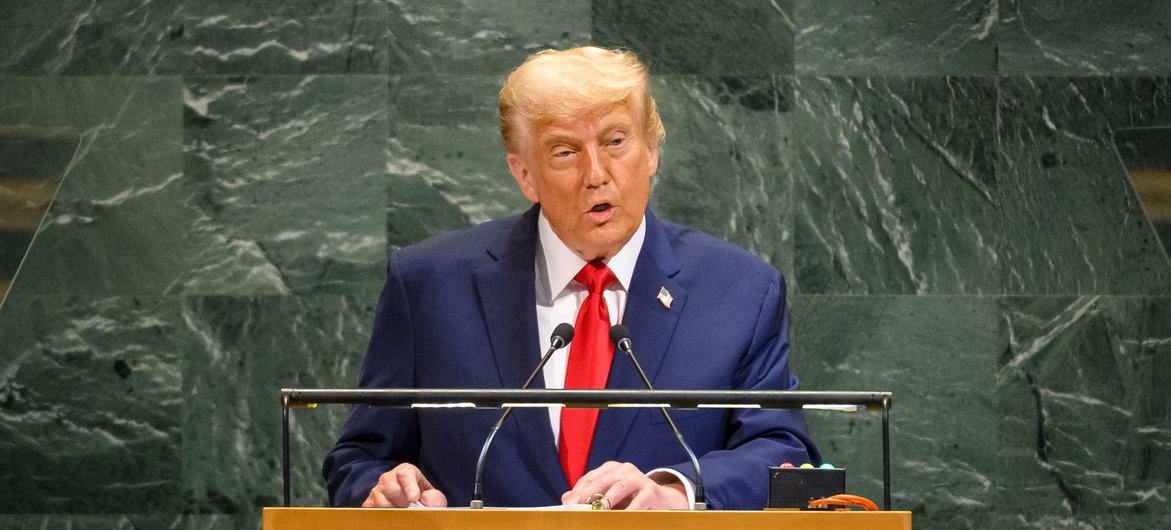
President Donald Trump delivers a controversial address at the 80th UN General Assembly in New York City. Image Credit: UN Photo/Loey
The debate over who qualifies as an American citizen at birth is heading to the highest court in the United States. The Supreme Court has officially agreed to hear a landmark case that will determine whether some children born on US soil have a constitutional right to citizenship — a question that strikes at the heart of American identity, immigration law, and a 160-year legal tradition.
The case springs from a controversial executive order signed by President Donald Trump on his first day back in office. The order attempted to end automatic citizenship for children born in the country to parents who are in the US illegally or who are present on temporary visas. Federal courts immediately blocked the move, ruling that the president had no authority to redefine the Constitution’s longstanding guarantee of birthright citizenship. The administration appealed, pushing the issue all the way to the Supreme Court.
Although the justices have not yet scheduled oral arguments, their eventual ruling could dramatically reshape the nation’s immigration landscape. For decades, the 14th Amendment has served as the foundation for birthright citizenship. Enacted in the aftermath of the Civil War, the amendment was designed to ensure that formerly enslaved people and their descendants were recognized as full citizens. Its text is explicit: “All persons born or naturalized in the United States, and subject to the jurisdiction thereof, are citizens of the United States.”
The Trump administration argues that the phrase “subject to the jurisdiction thereof” should exclude children of people who are not in the country lawfully or permanently. According to government lawyers, the amendment was never intended to apply to the children of undocumented migrants or short-term visitors.
Civil liberties groups strongly disagree. The American Civil Liberties Union (ACLU), which represents the plaintiffs challenging the executive order, maintains that the meaning of the amendment has been settled for more than a century. Cecillia Wang, the ACLU’s national legal director, said the president cannot unilaterally strip away a constitutional guarantee that has defined American citizenship since the 19th century.
“It has always been the law that anyone born on US soil, except for the children of diplomats or occupying forces, is a citizen from birth,” she said, emphasizing that the Supreme Court should close the debate once and for all.
The United States is among roughly 30 countries — mostly in the Western Hemisphere — that still offer unconditional birthright citizenship. According to the Pew Research Center, about 250,000 babies were born to undocumented immigrant parents in 2016, a significant drop from the peak recorded in 2007. By 2022, approximately 1.2 million US-born children of unauthorized immigrants were living in the country.
Studies suggest that eliminating birthright citizenship may not reduce undocumented immigration. Research by the Migration Policy Institute, in collaboration with Pennsylvania State University, predicts that ending the policy could instead increase the number of undocumented people in the US. Their projections estimate an additional 2.7 million undocumented residents by 2045 — a number that could grow to over 5 million by 2075.
For now, all eyes are on the Supreme Court, whose decision is expected to become one of the most consequential immigration rulings in modern history. Whether the justices reaffirm nearly two centuries of legal tradition or redefine who becomes an American at birth will shape the future of millions — and the nation itself.
FAQ Section
1. What is birthright citizenship in the United States?
Birthright citizenship is the principle that anyone born on US soil automatically becomes a US citizen, regardless of their parents’ immigration status. This right stems from the 14th Amendment, established after the Civil War.
2. Why is the Supreme Court hearing this case?
The court agreed to review legal challenges to President Trump’s executive order seeking to deny citizenship to children of undocumented or temporary-visa parents. Lower courts blocked the order, stating it violated the Constitution.
3. Can a president legally end birthright citizenship?
Most constitutional scholars argue that birthright citizenship can only be changed through a constitutional amendment, not by executive order. That is the central issue the Supreme Court will decide.
4. What does “subject to the jurisdiction thereof” mean?
The phrase has historically been interpreted to include nearly everyone on US soil except diplomats and foreign military personnel. The Trump administration argues for a narrower definition excluding undocumented migrants.
5. How many countries grant unconditional birthright citizenship?
Approximately 30 countries, mostly in the Americas, still provide automatic citizenship to anyone born within their borders.
6. How many US-born children have undocumented parents?
Pew Research Center estimates show 1.2 million US citizens were born to unauthorized immigrant parents as of 2022.
7. Could ending birthright citizenship reduce illegal immigration?
Studies show the opposite. Research indicates that ending birthright citizenship would likely increase the undocumented population over time.
8. When will the Supreme Court issue a ruling?
No hearing date has been set, and a decision is expected months after oral arguments begin.
9. What happens if the Supreme Court upholds Trump’s order?
The ruling could strip automatic citizenship from a large group of future US-born children and fundamentally reshape the legal definition of American citizenship.
10. What happens if the court rejects the order?
Birthright citizenship would remain intact, reinforcing the 14th Amendment’s longstanding interpretation and ending the debate for the foreseeable future.