

Asia under water: What triggered the week of deadly floods that swept Indonesia, Thailand, and Sri Lanka

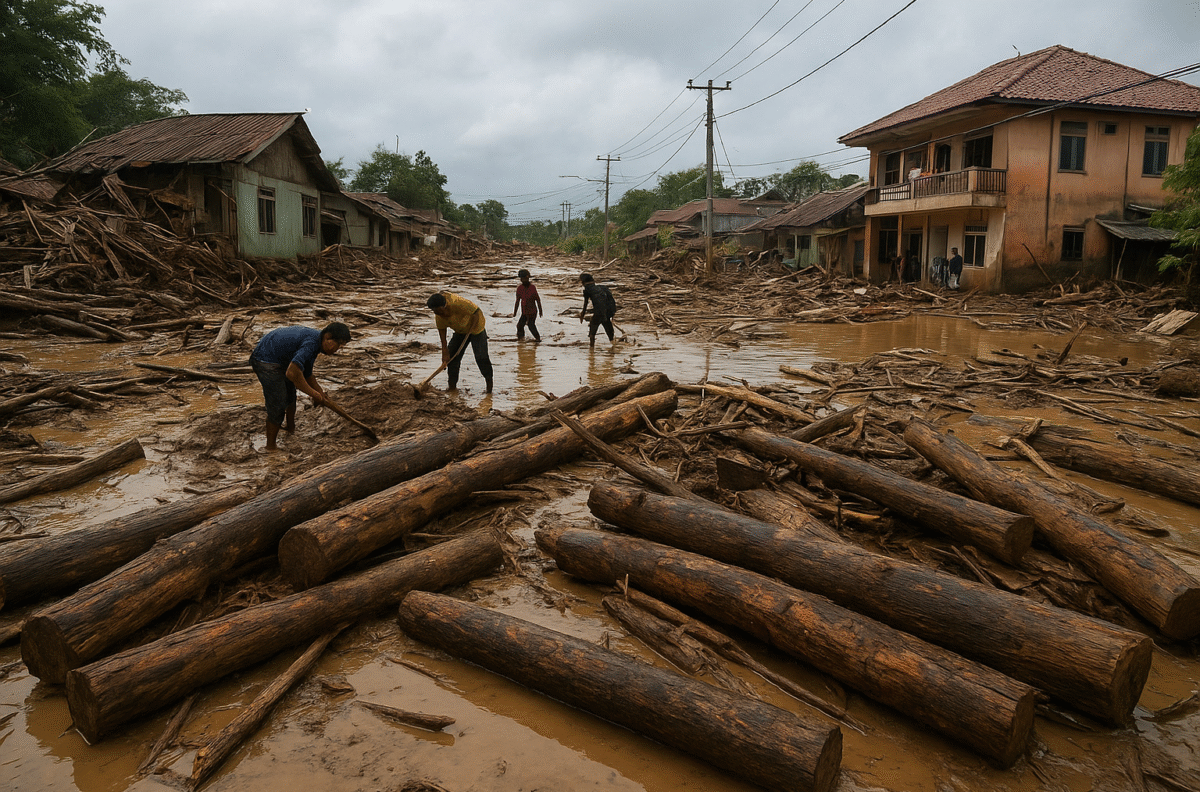
For days, an unrelenting wall of rain hammered the northern tip of Indonesia’s Sumatra Island, turning communities into pools of mud and debris. In Aceh Province alone, nearly 16 inches of rainfall fell in one day — enough to drown entire landscapes and overwhelm even the most flood-resilient towns. By the time the storm shifted southward, four villages had been swallowed by fast-moving waters, leaving homes flattened and families missing.
But the water wasn’t the only threat.
As Cyclone Senyar roared across Sumatra, torrents of logs — large, heavy, and impossible to outrun — surged through North Sumatra Province. Residents described the horrifying sight of timber rolling like battering rams through villages, destroying everything in their path.
“Both sides of the road are just stacked with logs. Those were what crashed into homes,” said Sarma Hutajulu, a volunteer clearing the debris in Tukka District. He and other rescuers spent hours digging through thick, slippery mud in search of survivors.
Cyclone Senyar’s impact didn’t stop at Indonesia’s coastline. The system pushed northwestward, dragging massive monsoon clouds along with it and unleashing widespread flooding in Malaysia and Thailand. The region soon found itself in the middle of one of the deadliest rain-related disasters in recent years.
Across Indonesia, Thailand, Malaysia, and Sri Lanka, nearly 1,400 people have been confirmed dead, with hundreds more still unaccounted for. Over one million residents have been displaced as the storm system tore through low-lying communities, farmland, and dense forest zones.
In the southern Thai city of Hat Yai, the devastation felt almost biblical. Eight-foot-high floodwaters surged through streets, turning neighborhoods into isolated islands. Among them was a small nursing home run by Wassana Suthi and her husband. As water crept into the building, the couple rushed to move their elderly and bedridden residents upstairs.
When the flooding cut off power, they turned to candles for light and battery packs to keep oxygen tanks running. For days, their only lifeline was a Thai Army helicopter that dropped food from the sky.
“When I stepped outside and saw people lining up for food, crying for missing relatives, and abandoned cars floating around, it felt like a movie about the end of the world,” Suthi said, still shaken.
Most of Thailand’s confirmed 182 deaths occurred in Songkhla Province, where Hat Yai is located.
Meanwhile, on the other end of the Indian Ocean, Sri Lanka faced its own catastrophe as Cyclone Ditwah lashed the island with torrential rainfall — the worst in a decade. Hundreds of lives were lost, and more than 360 people remain missing. India and Pakistan deployed military teams, ships, and helicopters to help with rescue operations, marking a rare moment of collaboration between the two rivals.
Back in Thailand, as people begin clearing streets coated in mud and debris, the fear of the next storm looms large. “It has never been this severe,” Suthi said quietly. “Everyone keeps saying the same thing — it felt like a tsunami.”
FAQ
1. What caused the widespread flooding across Asia?
A combination of Cyclone Senyar, Cyclone Ditwah, and intensified monsoon rains triggered extreme flooding and landslides across Indonesia, Thailand, Malaysia, and Sri Lanka.
2. Which countries were most affected?
Indonesia, Thailand, and Sri Lanka reported the highest casualties and displacement figures.
3. Why were logs found sweeping through villages in Indonesia?
Heavy rain triggered landslides in logging and forest areas, sending thousands of logs downhill into residential communities.
4. How high did floodwaters rise in Thailand?
Some parts of Hat Yai saw water levels reach up to eight feet.
5. What international assistance is being provided?
India and Pakistan deployed military teams, helicopters, and naval support to aid rescue and relief efforts in Sri Lanka.