

Al Green escorted out of State of the Union after ‘black people aren’t apes’ protest shakes Capitol

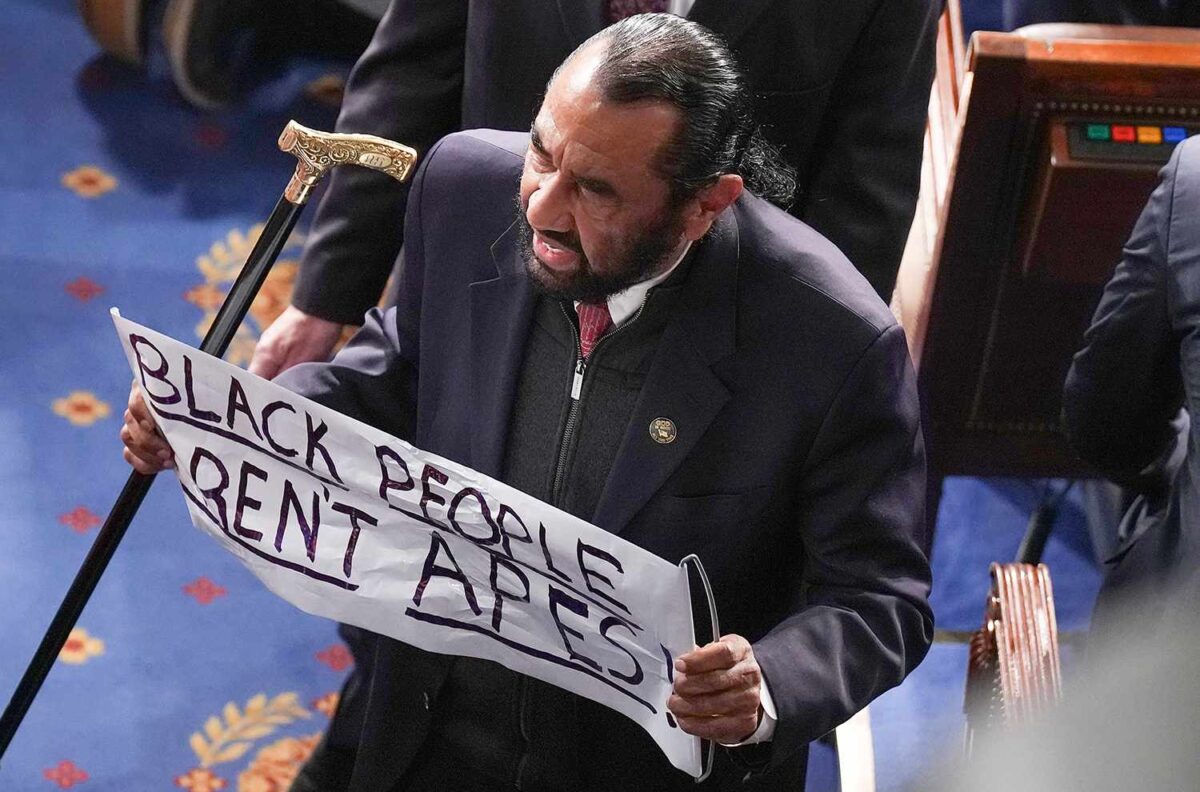
Rep. Al Green at the State of the Union on Feb. 24. Image Credit: Andrew Harnik/Getty
A dramatic moment unfolded inside the US Capitol Tuesday night when Al Green, a veteran Democratic congressman from Texas, was escorted out of the House chamber just minutes into President Donald Trump’s State of the Union address.
Green stood in the center aisle holding a sign that read, “Black people aren’t apes!”, a direct reference to a recent controversy involving the president sharing a racist video depicting former President Barack Obama and former first lady Michelle Obama as apes. The protest immediately drew attention, triggering confrontations and reigniting tensions between Democrats and Republicans.
The incident marks the second consecutive year Green has been removed from the annual address.
Why Was Al Green Escorted Out of the House Chamber?
According to multiple reports, Green remained standing while others sat as Trump began his speech. Holding the protest sign aloft, he sought to ensure the president could see the message.
“I wanted the president to see it, and he saw it,” Green later told reporters. “Black people are not apes… sometimes we have to let him know in public that we know it.”
House officials moved quickly to escort the 78-year-old lawmaker out of the chamber. As he exited, some Republican members reportedly chanted “USA! USA!” while others attempted to block the sign from television cameras.
The protest followed a recent uproar after Trump shared, and later deleted, a video widely criticised as racist. The president said he had not seen the offensive content in its final frames and declined to issue a formal apology.
Tensions Inside the Democratic Party
Green’s action came despite clear guidance from House Democratic leadership urging members to either remain silent during the speech or boycott the event entirely. Leaders were reportedly concerned that disruptions could distract from policy critiques and create internal divisions.
House Democratic Leader Hakeem Jeffries had earlier expressed confidence that members would follow a coordinated strategy. Green, however, defended his decision.
“At some point you cannot let racism continue. If you tolerate it, you perpetuate it,” he said. “I refuse to tolerate racism.”
Green’s protest occurred just one week before a competitive primary contest in his Texas district, adding another layer of political context to his high-profile stand.
READ ALSO
Truth Social backlash explodes after Trump shares racist video targeting Barack and Michelle Obama
Democrats Divided During Trump’s Address
Green was not alone in expressing opposition, though his protest was the most visible. Several Democratic lawmakers chose to sit solemnly through the speech while Republicans frequently stood and applauded.
Some members walked out before the address concluded. Senator Mark Warner left early, posting on social media that he “couldn’t sit through an hour of lies.” Representative Ilhan Omar and Representative Rashida Tlaib were also seen exiting the chamber before the speech ended.
The split strategy highlighted ongoing debates within the Democratic caucus over how aggressively to confront Trump during nationally televised events.
Al Green’s History of Opposition to Trump
Green has long been one of Trump’s most outspoken critics. He was the first member of Congress to call for the president’s impeachment during Trump’s first term and has repeatedly introduced articles of impeachment over the years.
Representing a predominantly African American district in Texas, Green has positioned himself as a staunch advocate for civil rights. His protest sign, though silent, was consistent with his longstanding focus on racial justice and accountability.
When asked whether being removed again carried consequences, Green dismissed the notion.
“It’s of no consequence,” he said. “You have to take a stand.”
Broader Political Implications
The protest underscores deep polarization in Washington as Trump continues to dominate headlines with both policy initiatives and controversies. For Republicans, the removal reinforced procedural order inside the chamber. For many Democrats and civil rights advocates, it symbolized a refusal to remain silent in the face of perceived racism.
The State of the Union, traditionally a moment of unity or at least civility, once again became a stage for visible partisan division.
As the 2026 political landscape intensifies, Green’s protest may resonate beyond the Capitol, particularly among voters closely watching how elected officials respond to issues of race, accountability, and presidential conduct.
FAQ
Why was Al Green removed from the State of the Union?
Al Green was escorted out after holding a sign reading “Black people aren’t apes!” during President Trump’s State of the Union address. The protest referenced a recent controversy involving a racist video shared by the president.
What did Al Green’s protest sign mean?
The sign was a response to a video depicting Barack and Michelle Obama as apes that Trump had shared and later deleted. Green said he wanted to publicly confront what he described as racism.
Has Al Green disrupted a State of the Union before?
Yes. This marks the second consecutive year Green has been removed from a State of the Union address. Previously, he was escorted out for verbally interrupting the president’s speech.
Did Democratic leaders approve of the protest?
No. Democratic leadership had urged members to remain silent during the address or boycott it altogether. Green said he was not defying leadership but making a moral statement.
Did other Democrats protest during the speech?
Several Democrats remained seated throughout the speech, and some walked out early. However, Green’s protest was the most visible and resulted in his removal from the chamber.
What is Al Green known for politically?
Al Green is known for his repeated efforts to impeach Trump and for advocating civil rights issues. He represents a predominantly African American district in Texas.
Did Trump apologise for the controversial video?
Trump said he did not see the offensive portion of the video before it was posted and declined to apologise, attributing the incident to a staff oversight.