

Mahmoud Ahmadinejad: 10 things to know about Iran’s controversial ex-president

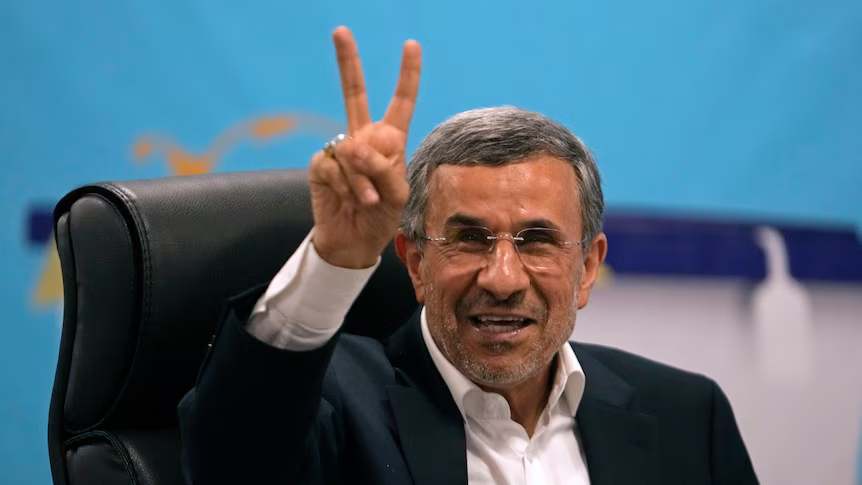
From Holocaust remarks to nuclear defiance, here are 10 key facts about Mahmoud Ahmadinejad, Iran’s hardline former president who led from 2005 to 2013.
The death of former Iranian president Mahmoud Ahmadinejad at 69 marks the end of one of the most polarising political careers in modern Middle Eastern history. A fiery nationalist, staunch hardliner and outspoken critic of the West, Ahmadinejad led Iran from 2005 to 2013 and left behind a legacy still debated across the globe.
Here are 10 essential things to know about the controversial former leader.
1. He Rose From Obscurity to the Presidency
Before becoming president, Ahmadinejad was relatively unknown internationally. He served as mayor of Tehran beginning in 2003, positioning himself as a humble, anti-elite conservative. In 2005, he stunned observers by defeating former president Ali Akbar Hashemi Rafsanjani in a runoff election few expected him to win.
His victory was strongly backed by conservative networks and reportedly enjoyed the support of Iran’s Supreme Leader, Ali Khamenei.
2. He Positioned Himself as a Champion of the Poor
Ahmadinejad campaigned on promises of social justice, wealth redistribution and economic equality. He pledged to use Iran’s oil wealth to reduce the gap between rich and poor, appealing strongly to working-class voters.
However, critics argue that his economic policies — including heavy state spending and subsidies — ultimately contributed to soaring inflation and economic instability.
3. His Presidency Was Marked by Economic Turmoil
During his time in office, inflation surged, unemployment climbed and capital fled the country. Businesses reportedly relocated abroad, particularly to Dubai, amid restrictive financial policies and uncertainty.
By the end of his presidency, a significant portion of the population was living below the poverty line.
4. He Strengthened the Revolutionary Guard’s Influence
Under Ahmadinejad, members of the powerful Islamic Revolutionary Guard Corps gained increasing control over strategic sectors, including oil, infrastructure and telecommunications.
Critics said this deepened the military’s influence over Iran’s political and economic systems.
5. He Took a Hardline Stance on Social Issues
As mayor of Tehran and later as president, Ahmadinejad enforced conservative Islamic codes. Reports during his leadership included crackdowns on women accused of wearing make-up in public and on couples holding hands.
He also criticised Western cultural symbols, once condemning fast-food outlets as examples of moral decay.
6. His Holocaust Remarks Sparked Global Outrage
Shortly after taking office in 2005, Ahmadinejad described the Holocaust as a “myth” and hosted a controversial conference in Tehran attended by Holocaust deniers.
His rhetoric intensified international tensions, particularly with Israel and Western nations.
7. He Famously Called for Israel to Be “Wiped Off the Map”
One of the most widely quoted and disputed remarks attributed to Ahmadinejad was a call for Israel to be removed from the map — a statement that sparked diplomatic firestorms worldwide.
Though some supporters later disputed translation nuances, the comment cemented his reputation as a confrontational global figure.
8. He Defied the West Over Iran’s Nuclear Programme
Ahmadinejad vigorously defended Iran’s nuclear ambitions, insisting the country had a sovereign right to develop civilian nuclear energy.
His administration faced international sanctions after Iran’s nuclear activities were referred to the UN Security Council. Years later, his successor, Hassan Rouhani, signed a nuclear deal aimed at limiting Iran’s programme in exchange for sanctions relief.
9. His 2009 Re-Election Triggered Mass Protests
Ahmadinejad’s re-election in 2009, in which he claimed a wide margin of victory over reformist candidate Mir-Hossein Mousavi, sparked widespread protests known as the Green Movement.
Millions of Iranians took to the streets alleging electoral fraud. The demonstrations were suppressed by security forces, including the Basij militia.
10. His Legacy Remains Deeply Divisive
To supporters, Ahmadinejad was incorruptible, humble and committed to defending Iran’s sovereignty against foreign pressure. To critics, he was an authoritarian populist whose rhetoric isolated Iran and worsened economic conditions.
After leaving office in 2013, he was largely sidelined from mainstream power but continued to voice political opinions and at times criticised the establishment.
Reports indicate he was killed during a strike on his residence in Tehran in February 2026 amid escalating regional conflict, though details surrounding his death remain part of broader geopolitical tensions.
FAQ
When did Mahmoud Ahmadinejad serve as Iran’s president?
He served two terms from 2005 to 2013.
Why was Ahmadinejad controversial?
His Holocaust comments, anti-Israel rhetoric, nuclear defiance and crackdown on protests drew widespread international criticism.
What was his stance on Iran’s nuclear programme?
He strongly defended Iran’s right to develop nuclear energy and resisted Western pressure and sanctions.
What happened during the 2009 election?
His re-election triggered mass protests over alleged vote rigging, leading to a harsh security crackdown.
How is he remembered today?
His legacy is deeply polarising — praised by supporters as nationalist and anti-corruption, criticised by opponents as divisive and economically damaging.